Thank you for visiting nature.com. You are using a browser version with limited support for CSS. To obtain
the best experience, we recommend you use a more up to date browser (or turn off compatibility mode in
Internet Explorer). In the meantime, to ensure continued support, we are displaying the site without styles
and JavaScript.
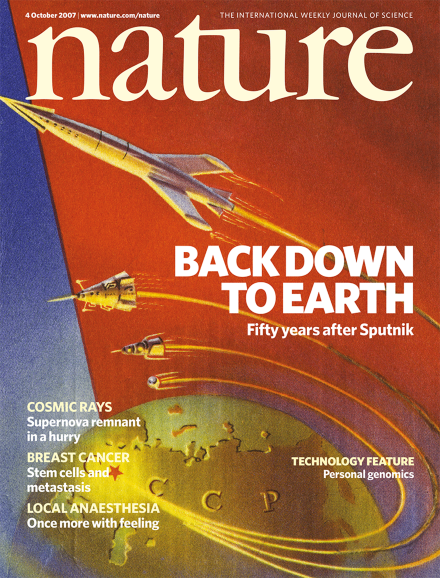
Fifty years after the momentous launch of Sputnik, Russia has yet to find a scientific system that is anything close to meeting its twenty-first century needs.
The Russian Academy of Sciences has resisted pressure from czarists and communists. Can it thwart the reforms planned by Putin's government? Quirin Schiermeier reports.
Russian researchers, and those who have worked in Russia, share their thoughts with Nature on the problems faced by the country's scientific system ? and how they could be addressed.
International collaboration and a can-do spirit have allowed some Russian scientists to flourish. Alison Abbott watches an extraordinary field test for mutant mice in the Russian wilderness.
When the Sputnik satellite went into orbit in 1957, it revolutionized the practice of international science and changed the demography of Western research.
In 1957, science advisers were brought into the White House as the President's Science Advisory Committee. Its demise has deprived the US government of invaluable counsel.
Local anaesthetics stop pain, but block all other sensations too. In rats, one molecular delivery vehicle makes an unusual local anaesthetic specific for pain — provided a little spice is added to the mix first.
The Josephson effect is a macroscopic manifestation of quantum mechanics usually seen in superconductors. Observation of this effect in a gas of ultracold atoms demonstrates the underlying unity of solid and gaseous systems.
Blowing up a balloon seems straightforward: pump in gas and let the changing air pressure do the rest. But when it comes to blowing up nature's own balloons — lung airways — things are a little more complicated.
A deft colloidal templating process allows simple-cubic crystals to be formed from more readily available complex precursors. It's a promising way to produce the regular crystals much in demand for photonics.
The antimicrobial peptide LL37 is essential for normal immune responses to infection or tissue injury. But in the autoimmune skin disorder psoriasis, LL37 propagates disease by forming complexes with host DNA.
Making films of atomic-scale processes as they happen makes huge demands on any imaging system. One approach combines the advantages of pulsed laser harmonics and computerized image reconstruction.
Protein aggregation causes problems for biotechnology and leads to many fatal human diseases. But a grasp of the physical principles involved enables 'superproteins' to be designed that have exceptional solubilities.
Engrafted mesenchymal stem cells (MSCs) promote breast cancer metastasis formation. Breast cancer cells induce MSCs to produce the cytokine CCL5, which then acts on breast tumour cells, enhancing their ability to migrate and extravasate blood vessel at the site of future metastases.
Plasmacytoid dendritic cells (pDCs) produce type 1 interferon in response to viral infection and activation of endosomal Toll-like receptors. This paper shows that in psoriatic skin pDC TLR-9 is activated by an antimicrobial peptide in complex with endogenous human DNA that is released from dying cells.
A lasing effect with a single artificial atom (a Josephson-junction charge qubit) that is embedded in a superconducting resonator is demonstrated, making use of the property that such artificial atoms are strongly and controllably coupled to resonator modes. The device is essentially different from existing lasers and masers; one and the same artificial atom excited by current injection produces many photons.
A discovery of the brightening and decay of X-ray hot spots in the shell of the SNR RX J1713.˜73946 on a one-year timescale is reported. This rapid variability shows that the X-rays are produced by ultrarelativistic electrons through a synchrotron process.
The paper reports the observation of the AC and DC Josephson effects in a single Bose-Einstein condensate Josephson junction. The system may be suitable for use as an analogue of the superconducting quantum interference device (SQUID), which would sense rotation.
Behaviour similar to that of the 'pseudogap' regime in unconventional superconductors is reported in a family of superconducting organic molecular metals. The 'pseudogap' signature that was measured (fluctuating superconductivity above the critical temperature) is most pronounced in those samples that are close to being in a Mott insulating state, suggesting a close relationship between the two phenomena.
A lasing effect with a single artificial atom (a Josephson-junction charge qubit) that is embedded in a superconducting resonator is demonstrated, making use of the property that such artificial atoms are strongly and controllably coupled to resonator modes. The device is essentially different from existing lasers and masers; one and the same artificial atom excited by current injection produces many photons.
Glacial moraines (rocky deposits left behind by glaciers) on Mauna Kea volcano, Hawaii are dated to reveal the timing of glacier retreat during the last deglaciation, and a model of glacier extent is used to estimate the temperature changes associated with this retreat. It is found that temperatures at high elevations in the central Pacific were about seven degrees Celsius colder than today during the Last Glacial Maximum, which indicates that the lapse rate was higher than at present.
Fossils of 'eucrustacea' (crustaceans of modern aspect) are common in the fossil record from around 500 million years ago. A remarkable new 'Orsten' type Konservat-Lagerstäette from the Lower Cambrian of China reveals the earliest known eucrustacean in exquisite three-dimensional detail, significantly extending the fossil record of this important group.
This paper explores how non-random patterns in the strengths of the interactions between predators and prey are related to stability in naturally assembling communities.
Humans can see in conditions from darkened cinemas to bright sun because cone photoreceptors adapt their mean output to the current light conditions; here, a second site of adaptation is identified, in the retina between the cone bipolar cells and ganglion cells. The two adaptation mechanisms are complementary with cone adaptation occurring at higher light levels and together they extend the operating range of human vision.
A drawback of most local anaesthetics is their non-specific action. Their lipophilic nature permits them access to any neuron, where they indiscriminately block sodium channels in the membrane. A membrane-impermeant sodium channel blocker, QX-314, can be targeted to pain-sensing neurons. The authors exploited the specific expression of TRPV1 channels in pain-sensing neurons, the opening of which by capsaicin allows QX-314 access to the inside of the cell.
The structure of the nuclear pore complexes in intact nuclei is studied by cryoelectron tomography. The trajectory of cargo molecules was traced used gold-labelled proteins fused to a nuclear localization signal. Superimposition of multiple tomograms has yielded a map outlining the pathway of cargo molecules during import into the nucleus.
During DNA recombination, two DNA molecules become covalently linked in a four-way structure known as a Holliday junction, which stay connected until the structure is dissolved by the protein resolvase. Although structures of a naked Holliday junction have been obtained, it has been difficult to solve the structure of resolvase sitting in a Holliday junction. This is one of two papers that use two different phage resolvases to solve the structure of resolvase sitting in a Holliday junction.
During DNA recombination, two DNA molecules become covalently linked in a four-way structure known as a Holliday junction, which stays connected until the structure is dissolved by the protein resolvase. Although structures of a naked Holliday junction have been obtained, it has been difficult to solve the structure of resolvase sitting in a Holliday junction. This is one of two papers that use two different phage resolvases to solve the structure of resolvase sitting in a Holliday junction.
Innovations in DNA sequencing and genotyping are opening doors for personal genomics. Nathan Blow explores these technological advances and their implications.