Table of contents
Volume 444 Number 7115 pp1-122
(this content only available online) indicates content that is available online only
Editorials
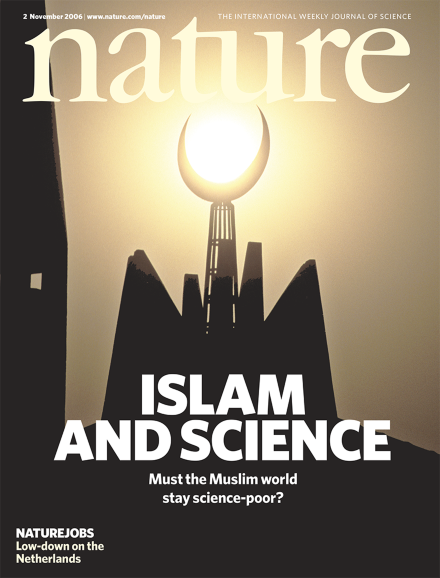
Science and the Islamists p1
Muslim countries stand to gain much from science but will fail to do so if fundamentalists repress openness. Chronic neglect by Arab leaders doesn't help either.
doi:10.1038/444001a
See also: Editor's summary
A global call to arms p2
A seminal report on climate change deserves the world's attention.
doi:10.1038/444002a
Enough biodefence p2
Who wants a bioweapons lab next door?
doi:10.1038/444002b
Research Highlights
Research highlights p04
doi:10.1038/44404a
Correction p05
doi:10.1038/44405a
News
How much will it cost to save the world? p6
The Stern Review won't be the last word on the cost of global warming. But it has upped the stakes in the debate. Jim Giles reports.
doi:10.1038/444006a
Sidelines p8
doi:10.1038/444008a
Ethiopian plan for Lucy tour splits museums p8
Palaeontologists say fossil bones should stay in Africa.
Rex Dalton
doi:10.1038/444008b
Search for alien signals stalls for want of cash p9
Microsoft co-founder withholds millions from radio telescope.
doi:10.1038/061023-15
A votre santé: now in pill form? p11
'Life-enhancing' effects of resveratrol cause a stir.
Erika Check
doi:10.1038/444011a
Hwang takes the stand at fraud trial p12
Korea's fallen star begins his defence.
David Cyranoski
doi:10.1038/444012a
Safer embryo tests could boost IVF pregnancy rates p12
Health of cells may be revealed by tell-tale molecules.
Helen Pearson
doi:10.1038/444012b
News in brief p14
doi:10.1038/444014a
Correction p15
doi:10.1038/444015a
Business
Drilling for nanotech gold p16
One US nanotechnology start-up has hit the jackpot — but for others the prospect of such overnight success seems remote. Colin Macilwain reports.
doi:10.1038/444016a
In brief p17
doi:10.1038/444017a
Market watch p17
Colin Macilwain
doi:10.1038/444017b
News Features
Islam and Science: Ambition & neglect p19
doi:10.1038/444019a
See also: Editor's summary
Islam and Science: The Islamic world p20
The 57 countries in the Organization of the Islamic Conference are home to 1.3 billion people. The attendant diversity in culture, geography, economics and politics can be seen in these snapshots of five different approaches to science.
doi:10.1038/443020a
Islam and Science: An Islamist revolution p22
Islamist political parties are taking over from secular ones across the Muslim world. What does this mean for science at home and scientific cooperation with the West? Ehsan Masood investigates.
doi:10.1038/444022a
Islam and Science: The data gap p26
Statistics on scientific investment and performance are lacking across the Muslim world. Declan Butler analyses the best of what is available.
doi:10.1038/444026a
Islam and Science: Oil rich, science poor p28
The wealthy Arab states offer scant support for science and technology. Jim Giles finds out whether this indifference to research is likely to change.
doi:10.1038/444028a
Islam and Science: Q&A The reformer p29
Mostafa Moin is a paediatrician and medical researcher who has served as Iran's minister for higher education and for science. He was a reformist candidate in Iran's presidential election last year, which was won by religious conservative Mahmoud Ahmadinejad. Declan Butler asks Moin about the prospects for science in Iran.
doi:10.1038/444029a
Correspondence
Dishing a modern myth about microbes p31
Tom Fenchel, Genoveva F. Esteban and Bland J. Finlay
doi:10.1038/444031a
The daunting process of MIAME p31
David W. Galbraith
doi:10.1038/444031b
No room for complacency on drug resistance in Africa p31
Ian M. Hastings, David G. Lalloo and Saye H. Khoo
doi:10.1038/444031c
Brief: goodbye to a quirky perspective on science p31
Alex Small
doi:10.1038/444031d
Brief Communications (RIP) and the soul of wit p31
Jeremy Wolfe
doi:10.1038/444031e
Commentaries
Islam and Science: Steps towards reform p33
Building a knowledge-based society in today's Arab world depends on overcoming primarily political obstacles to progress. Nader Fergany analyses the reforms required for an Arab renaissance.
doi:10.1038/444033a
See also: Editor's summary
Islam and science: Where are the new patrons of science? p35
Muslim nations must take a big leap forward in developing science and technology to catch up with the rest of the world, argues Herwig Schopper, or they risk falling behind in the global economy.
doi:10.1038/444035a
Books and Arts
Beautiful models p37
The dynamics of evolutionary processes creates a remarkable picture of life.
Sean Nee reviews Evolutionary Dynamics: Exploring the Equations of Life by Martin Nowak
doi:10.1038/444037a
The pork-barrel diet p38
Tim Lang reviews What to Eat: An Aisle-by-Aisle Guide to Savvy Food Choices and Good Eating by Marion Nestle
doi:10.1038/444038a
A precise past p39
doi:10.1038/444039a
Having faith p39
Ann Cale Kruger and Melvin Konner review Minds and Gods: The Cognitive Foundations of Religion by Todd Tremlin
doi:10.1038/444039b
Science in culture: Creativity on the wings of a dove p40
Violet Fire, an opera about the life of physicist Nikola Tesla, fails to spark.
Horace Freeland Judson
doi:10.1038/444040a
See also: Editor's summary
News and Views
Photonics: A cooling light breeze p41
Mirrors confine light, and light exerts pressure on mirrors. The combination of these effects can be exploited to cool tiny, flexible mirrors to low temperatures purely through the influence of incident light.
Khaled Karrai
doi:10.1038/444041a
See also: Editor's summary
Evolutionary biology: To work or not to work p42
Coercion, not kinship, often determines who acts altruistically in an insect colony. But underlying affinities for kin emerge when coercion is removed: kin selection is what turns suppressed individuals into altruists.
David C. Queller
doi:10.1038/444042a
See also: Editor's summary
Geophysics: Same old magnetism p43
Latitudes at which ancient salt deposits occur show that Earth's magnetic field has always aligned along its rotation axis. One possible implication is that ancient global glaciations were not caused by a realignment of this axis.
Edward Irving
doi:10.1038/444043a
See also: Editor's summary
50 & 100 Years Ago p44
doi:10.1038/444044a
Cancer biology: Second step to retinal tumours p45
The mutations that cause retinoblastoma are well known, but how they enable the cancer to evade controls on cell division was unclear. Secondary mutations affecting a growth-regulatory pathway have now been identified.
Valerie A. Wallace
doi:10.1038/444045a
See also: Editor's summary
Physical chemistry: Porous solids get organized p46
A powerful combination of analytical techniques is used to shed light on the complex crystallizations of porous solids. Molecular recognition creates the seeds of order from which complex lattices grow.
Rutger A. van Santen
doi:10.1038/444046a
Neurobiology: Crossed circuits p47
Can the brain be induced to reroute neural information? Such an achievement is crucial if the function of damaged brain areas is to be taken on elsewhere. A study in monkeys explores this prospect.
Andrew B. Schwartz
doi:10.1038/444047a
See also: Editor's summary
Materials science: Qubits in the pink p49
Crystal imperfections known as nitrogen–vacancy defects give some diamonds a characteristic pink colour. Appropriately manipulated, these defects might have rosy prospects as the 'qubits' of a quantum computer.
Pieter Kok and Brendon W. Lovett
doi:10.1038/444049a
Brief Communications
Enforced altruism in insect societies p50
Tom Wenseleers and Francis L. W. Ratnieks
doi:10.1038/444050a
First paragraph | Full Text | PDF (185K) | Supplementary information
See also: Editor's summary | News and Views by Queller
Top of page
Brief Communications Arising
Geochemistry: Does U–Pb date Earth's core formation? pE1
Qing-zhu Yin and Stein B. Jacobsen
doi:10.1038/nature05358
First paragraph | Full Text | PDF (76K)
Geochemistry: How well can Pb isotopes date core formation? pE1
Balz S. Kamber and Jan D. Kramers
doi:10.1038/nature05359
First paragraph | Full Text | PDF (93K)
Geochemistry: Does U–Pb date Earth's core formation?; How well can Pb isotopes date core formation? (Reply) pE2
B. J. Wood and A. N. Halliday
doi:10.1038/nature05360
First paragraph | Full Text | PDF (88K)
Articles
Proterozoic low orbital obliquity and axial-dipolar geomagnetic field from evaporite palaeolatitudes p51
David A. D. Evans
doi:10.1038/nature05203
Abstract | Full Text | PDF (1,046K) | Supplementary information
See also: Editor's summary | News and Views by Irving
Long-term motor cortex plasticity induced by an electronic neural implant p56
Andrew Jackson, Jaideep Mavoori and Eberhard E. Fetz
doi:10.1038/nature05226
Abstract | Full Text | PDF (358K) | Supplementary information
See also: Editor's summary | News and Views by Schwartz
Inactivation of the p53 pathway in retinoblastoma p61
Nikia A. Laurie, Stacy L. Donovan, Chie-Schin Shih, Jiakun Zhang, Nicholas Mills, Christine Fuller, Amina Teunisse, Suzanne Lam, Yolande Ramos, Adithi Mohan, Dianna Johnson, Matthew Wilson, Carlos Rodriguez-Galindo, Micaela Quarto, Sarah Francoz, Susan M. Mendrysa, R. Kiplin Guy, Jean-Christophe Marine, Aart G. Jochemsen and Michael A. Dyer
doi:10.1038/nature05194
Abstract | Full Text | PDF (1,317K) | Supplementary information
See also: Editor's summary | News and Views by Wallace
Letters
Self-cooling of a micromirror by radiation pressure p67
S. Gigan, H. R. Böhm, M. Paternostro, F. Blaser, G. Langer, J. B. Hertzberg, K. C. Schwab, D. Bäuerle, M. Aspelmeyer and A. Zeilinger
doi:10.1038/nature05273
First paragraph | Full Text | PDF (448K) | Supplementary information
See also: Editor's summary | News and Views by Karrai
Radiation-pressure cooling and optomechanical instability of a micromirror p71
O. Arcizet, P.-F. Cohadon, T. Briant, M. Pinard and A. Heidmann
doi:10.1038/nature05244
First paragraph | Full Text | PDF (457K) | Supplementary information
See also: Editor's summary | News and Views by Karrai
Sub-kelvin optical cooling of a micromechanical resonator p75
Dustin Kleckner and Dirk Bouwmeester
doi:10.1038/nature05231
First paragraph | Full Text | PDF (395K)
See also: Editor's summary | News and Views by Karrai
Complex zeolite structure solved by combining powder diffraction and electron microscopy p79
Fabian Gramm, Christian Baerlocher, Lynne B. McCusker, Stewart J. Warrender, Paul A. Wright, Bada Han, Suk Bong Hong, Zheng Liu, Tetsu Ohsuna and Osamu Terasaki
doi:10.1038/nature05200
First paragraph | Full Text | PDF (882K) | Supplementary information
See also: Editor's summary
10Be evidence for the Matuyama–Brunhes geomagnetic reversal in the EPICA Dome C ice core p82
G. M. Raisbeck, F. Yiou, O. Cattani and J. Jouzel
doi:10.1038/nature05266
First paragraph | Full Text | PDF (210K)
See also: Editor's summary
Deuterostome phylogeny reveals monophyletic chordates and the new phylum Xenoturbellida p85
Sarah J. Bourlat, Thorhildur Juliusdottir, Christopher J. Lowe, Robert Freeman, Jochanan Aronowicz, Mark Kirschner, Eric S. Lander, Michael Thorndyke, Hiroaki Nakano, Andrea B. Kohn, Andreas Heyland, Leonid L. Moroz, Richard R. Copley and Maximilian J. Telford
doi:10.1038/nature05241
First paragraph | Full Text | PDF (181K) | Supplementary information
See also: Editor's summary
Post-mating sexual selection increases lifetime fitness of polyandrous females in the wild p89
Diana O. Fisher, Michael C. Double, Simon P. Blomberg, Michael D. Jennions and Andrew Cockburn
doi:10.1038/nature05206
First paragraph | Full Text | PDF (236K) | Supplementary information
See also: Editor's summary
Global distribution and conservation of rare and threatened vertebrates p93
Richard Grenyer, C. David L. Orme, Sarah F. Jackson, Gavin H. Thomas, Richard G. Davies, T. Jonathan Davies, Kate E. Jones, Valerie A. Olson, Robert S. Ridgely, Pamela C. Rasmussen, Tzung-Su Ding, Peter M. Bennett, Tim M. Blackburn, Kevin J. Gaston, John L. Gittleman and Ian P. F. Owens
doi:10.1038/nature05237
First paragraph | Full Text | PDF (471K) | Supplementary information
See also: Editor's summary
Insights from the genome of the biotrophic fungal plant pathogen Ustilago maydis p97
Jörg Kämper,
Regine Kahmann,
Michael Bölker,
Li-Jun Ma,
Thomas Brefort,
Barry J. Saville,
Flora Banuett,
James W. Kronstad,
Scott E. Gold,
Olaf Müller,
Michael H. Perlin,
Han A. B. Wösten,
Ronald de Vries,
José Ruiz-Herrera,
Cristina G. Reynaga-Peña,
Karen Snetselaar,
Michael McCann,
José Pérez-Martín,
Michael Feldbrügge,
Christoph W. Basse,
Gero Steinberg,
Jose I. Ibeas,
William Holloman,
Plinio Guzman,
Mark Farman,
Jason E. Stajich,
Rafael Sentandreu,
Juan M. González-Prieto,
John C. Kennell,
Lazaro Molina,
Jan Schirawski,
Artemio Mendoza-Mendoza,
Doris Greilinger,
Karin Münch,
Nicole Rössel,
Mario Scherer,
Miroslav Vrane
,
Oliver Ladendorf,
Volker Vincon,
Uta Fuchs,
Björn Sandrock,
Shaowu Meng,
Eric C. H. Ho,
Matt J. Cahill,
Kylie J. Boyce,
Jana Klose,
Steven J. Klosterman,
Heine J. Deelstra,
Lucila Ortiz-Castellanos,
Weixi Li,
Patricia Sanchez-Alonso,
Peter H. Schreier,
Isolde Häuser-Hahn,
Martin Vaupel,
Edda Koopmann,
Gabi Friedrich,
Hartmut Voss,
Thomas Schlüter,
Jonathan Margolis,
Darren Platt,
Candace Swimmer,
Andreas Gnirke,
Feng Chen,
Valentina Vysotskaia,
Gertrud Mannhaupt,
Ulrich Güldener,
Martin Münsterkötter,
Dirk Haase,
Matthias Oesterheld,
Hans-Werner Mewes,
Evan W. Mauceli,
David DeCaprio,
Claire M. Wade,
Jonathan Butler,
Sarah Young,
David B. Jaffe,
Sarah Calvo,
Chad Nusbaum,
James Galagan
and
Bruce W. Birren
doi:10.1038/nature05248
First paragraph | Full Text | PDF (396K) | Supplementary information
See also: Editor's summary
Two modes of fusion pore opening revealed by cell-attached recordings at a synapse p102
Liming He, Xin-Sheng Wu, Raja Mohan and Ling-Gang Wu
doi:10.1038/nature05250
First paragraph | Full Text | PDF (452K) | Supplementary information
Movement of 'gating charge' is coupled to ligand binding in a G-protein-coupled receptor p106
Yair Ben-Chaim, Baron Chanda, Nathan Dascal, Francisco Bezanilla, Itzchak Parnas and Hanna Parnas
doi:10.1038/nature05259
First paragraph | Full Text | PDF (542K) | Supplementary information
See also: Editor's summary
XIAP deficiency in humans causes an X-linked lymphoproliferative syndrome p110
Stéphanie Rigaud, Marie-Claude Fondanèche, Nathalie Lambert, Benoit Pasquier, Véronique Mateo, Pauline Soulas, Lionel Galicier, Françoise Le Deist, Frédéric Rieux-Laucat, Patrick Revy, Alain Fischer, Geneviève de Saint Basile and Sylvain Latour
doi:10.1038/nature05257
First paragraph | Full Text | PDF (463K) | Supplementary information
Surface expression of MHC class II in dendritic cells is controlled by regulated ubiquitination p115
Jeoung-Sook Shin, Melanie Ebersold, Marc Pypaert, Lelia Delamarre, Adam Hartley and Ira Mellman
doi:10.1038/nature05261
First paragraph | Full Text | PDF (641K) | Supplementary information
Naturejobs
ProspectProspects p119
Young Japanese scientists must deal with career trends similar to those of their US counterparts.
Paul Smaglik
doi:10.1038/nj7115-119a
Career Views
Hans-Olov Adami, Chair, Department of Epidemiology, Harvard School of Public Health p120
Hans-Olov Adami lays plans to emphasize international collaborations in epidemiology at the Harvard School of Public Health.
Virginia Gewin
doi:10.1038/nj7115-120a
A bench to call your own p120
The University of California, San Francisco, opens a special brand of incubator.
Monya Baker
doi:10.1038/nj7115-120b
The joys of communication p120
Communicating science has its perks.
Katja Bargum
doi:10.1038/nj7115-120c
Highlights
Highlight: The Netherlands
doi:10.1038/nj0130
Special Feature: NIH
doi:10.1038/nj0131
Futures
A concrete example p122
When the cracks begin to show.
The Artistic Forms and Complexity Group:, J. -P. Boon, J. Casti, C. Djerassi, J. Johnson, A. Lovett, T. Norretranders, V. Patera, C. Sommerer, R. Taylor and S. Thurner
doi:10.1038/444122a