Table of contents
Volume 442 Number 7099 pp109-222

In this issue (13 July 2006)
Also this week
(this content only available online) indicates content that is available online only
Editorials
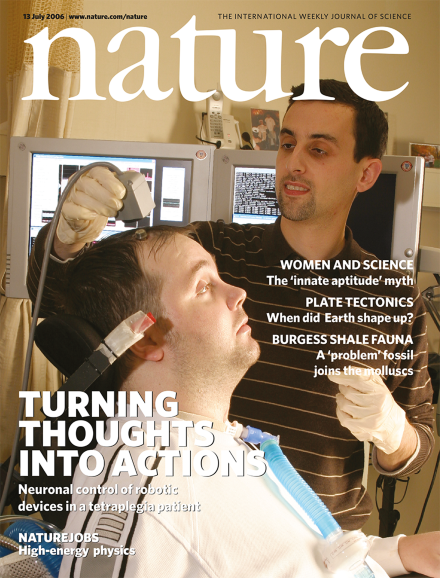
Is this the bionic man? p109
Systems that allow a brain to control a computer are inching ever closer to reality — but their most important applications may be different from those envisaged by science fiction.
doi:10.1038/442109a
Building bridges p110
An American geneticist advocates a rapprochement with religion.
doi:10.1038/442110a
The beautiful game p110
Punditry took a hiding in Germany.
doi:10.1038/442110b
News
Family tragedy spotlights flu mutations p114
Human-to-human transmission raises demand for DNA data.
Declan Butler
doi:10.1038/442114a
Genomics luminary weighs in on US faith debate p114
Top geneticist asks the God question.
Erika Check
doi:10.1038/442114b
Snapshot: Deep-sea wonders p116
From the whimsical to the downright scary, images featuring creatures from the deep are showcased in the BP Kongsberg Underwater Image Competition being held this week at the 11th International Deep-Sea Biology Symposium, UK. Narelle Towie takes a look at some of the most striking entries.
doi:10.1038/442116a
PS I want all the rights p118
Stakes raised in open-access debate.
Emma Marris
doi:10.1038/442118a
City state hopes research cash will buy global status p118
Singapore to double research budget.
Ichiko Fuyuno and David Cyranoski
doi:10.1038/442118b
Sidelines p119
doi:10.1038/442119a
Is India's 'patent factory' squandering funds? p120
Research agency slammed for patenting everything.
K. S. Jayaraman
doi:10.1038/442120a
Business
Giving it away p122
Charities are starting to operate like venture capitalists, putting their cash into fledgling drug companies. Virginia Gewin reports.
doi:10.1038/442122a
In brief p123
doi:10.1038/442123a
Market watch p123
Colin Macilwain
doi:10.1038/442123b
News Features
Neuroprosthetics: In search of the sixth sense p125
Implants in the brain could one day help paralysed people move robotic arms and legs. But first, scientists need to work out how our brains know where our limbs are, says Alison Abbott.
doi:10.1038/442125a
See also: Editor's summary
Geology: The start of the world as we know it p128
Plate tectonics has created oceans and pushed up mountain ranges. But when did the process that shapes the planet get going? Alexandra Witze joins the geologists debating the issue.
doi:10.1038/442128a
See also: Editor's summary
Correspondence
Misconduct: forum should not be used to settle scores p132
Guosheng Wu
doi:10.1038/442132a
Misconduct: China needs university ethics courses p132
Qizhi Wang
doi:10.1038/442132b
Rushed decision on collider would limit useful options p132
Robert Aymar
doi:10.1038/442132c
Speaking for Taiwan about colours, maps and politics p132
Michael Chen
doi:10.1038/442132d
Commentary
Does gender matter? p133
The suggestion that women are not advancing in science because of innate inability is being taken seriously by some high-profile academics. Ben A. Barres explains what is wrong with the hypothesis.
doi:10.1038/442133a
See also: Editor's summary
Books and Arts
God is bred p137
Religious belief can be viewed as an adaptation that was favoured as the human brain evolved.
Crispin Tickell reviews Six Impossible Things Before Breakfast: The Evolutionary Origins of Belief by Lewis Wolpert
doi:10.1038/442137a
Keep it in the family p138
Svenn Torgersen reviews Genes and Behavior: Nature–Nurture Interplay Explained by Michael Rutter
doi:10.1038/442138a
Throwaway culture p139
John Emsley reviews Made to Break: Technology and Obsolescence in America by Giles Slade
doi:10.1038/442139a
The politics of space p139
Steven Beckwith reviews The Last of the Great Observatories: Spitzer and the Era of Faster, Better, Cheaper by George Rieke
doi:10.1038/442139b
Science in Culture p140
PowerPoint presentations and the culture of pitch.
Martin Kemp
doi:10.1038/442140a
See also: Editor's summary
News and Views
Neuroscience: Converting thoughts into action p141
There is a clear need to help people who have brain or spinal-cord damage to communicate and interact with the outside world. Progress to that end is being made with brain-implantation technology.
Stephen H. Scott
doi:10.1038/442141a
See also: Editor's summary
Quantum physics: New spin on the Hall effect p143
The spin Hall effect occurs when electrons with opposite spins go their separate ways in an electric field. The phenomenon is crucial to spin-based electronics, and its electrical signal has just been spotted.
Andrew D. Kent
doi:10.1038/442143a
Atmospheric chemistry: Radicals follow the Sun p145
Hydroxyl free radicals are part of a complex network of atmospheric chemical reactions. But a long-term study shows that their concentration can be predicted by the intensity of ultraviolet sunlight alone.
Paul O. Wennberg
doi:10.1038/442145a
See also: Editor's summary
Palaeontology: A ghost with a bite p146
Witness a snail scraping microbial films from the inside of an aquarium. Go back 505 million years, and this looks to have been the way an enigmatic early animal made its living (but without the aquarium).
Stefan Bengtson
doi:10.1038/442146a
See also: Editor's summary
Solid-state physics: Supersolid simulations p147
Supersolids — substances that are crystalline but also behave as free-flowing superfluids — can exist, according to quantum theory. Models now suggest a route to the clinching experimental evidence.
Dieter Jaksch
doi:10.1038/442147a
Music: Calculated tones p149
Richard Webb
doi:10.1038/442149a
Obituary: Raymond Davis Jr (1914–2006) p150
Father of solar neutrino detection.
James R. Distel
doi:10.1038/442150a
Brief Communications
Quantum engineering: An atom-sorting machine p151
Laser-trapped atoms in strings can be deftly rearranged and the spacing between them precisely adjusted.
Yevhen Miroshnychenko, Wolfgang Alt, Igor Dotsenko, Leonid Förster, Mkrtych Khudaverdyan, Dieter Meschede, Dominik Schrader and Arno Rauschenbeutel
doi:10.1038/442151a
First paragraph | Full Text | PDF (198K) | Supplementary information
Top of page
Brief Communications Arising
Embryology: Does prepatterning occur in the mouse egg? pE3
Takashi Hiiragi, Sophie Louvet-Vallée, Davor Solter and Bernard Maro
doi:10.1038/nature04907
First paragraph | Full Text | PDF (365K)
Embryology: Does prepatterning occur in the mouse egg? (Reply) pE4
Berenika Plusa, Anna-Katerina Hadjantonakis, Dionne Gray, Karolina Piotrowska-Nitsche, Agnieszka Jedrusik, Virginia E. Papaioannou, David M. Glover and Magdalena Zernicka-Goetz
doi:10.1038/nature04908
First paragraph | Full Text | PDF (365K)
Review
Clarifying the mechanics of DNA strand exchange in meiotic recombination p153
Matthew J. Neale and Scott Keeney
doi:10.1038/nature04885
Abstract | Full Text | PDF (346K)
See also: Editor's summary
Articles
A soft-bodied mollusc with radula from the Middle Cambrian Burgess Shale p159
Jean-Bernard Caron, Amélie Scheltema, Christoffer Schander and David Rudkin
doi:10.1038/nature04894
Abstract | Full Text | PDF (595K) | Supplementary information
See also: Editor's summary | News and Views by Bengtson
Neuronal ensemble control of prosthetic devices by a human with tetraplegia p164
Leigh R. Hochberg, Mijail D. Serruya, Gerhard M. Friehs, Jon A. Mukand, Maryam Saleh, Abraham H. Caplan, Almut Branner, David Chen, Richard D. Penn and John P. Donoghue
doi:10.1038/nature04970
Abstract | Full Text | PDF (648K) | Supplementary information
See also: Editor's summary | News and Views by Scott
Letters
Energy input and response from prompt and early optical afterglow emission in
-ray bursts p172
W. T. Vestrand, J. A. Wren, P. R. Wozniak, R. Aptekar, S. Golentskii, V. Pal'shin, T. Sakamoto, R. R. White, S. Evans, D. Casperson and E. Fenimore
doi:10.1038/nature04913
First paragraph | Full Text | PDF (293K)
See also: Editor's summary
Direct electronic measurement of the spin Hall effect p176
S. O. Valenzuela and M. Tinkham
doi:10.1038/nature04937
First paragraph | Full Text | PDF (501K) | Supplementary information
See also: News and Views by Kent
Ultrasensitive solution-cast quantum dot photodetectors p180
Gerasimos Konstantatos, Ian Howard, Armin Fischer, Sjoerd Hoogland, Jason Clifford, Ethan Klem, Larissa Levina and Edward H. Sargent
doi:10.1038/nature04855
First paragraph | Full Text | PDF (253K) | Supplementary information
See also: Editor's summary
Strong correlation between levels of tropospheric hydroxyl radicals and solar ultraviolet radiation p184
Franz Rohrer and Harald Berresheim
doi:10.1038/nature04924
First paragraph | Full Text | PDF (1,246K) | Supplementary information
See also: Editor's summary | News and Views by Wennberg
Low-frequency earthquakes in Shikoku, Japan, and their relationship to episodic tremor and slip p188
David R. Shelly, Gregory C. Beroza, Satoshi Ide and Sho Nakamula
doi:10.1038/nature04931
First paragraph | Full Text | PDF (2,950K) | Supplementary information
See also: Editor's summary
Isolation of a novel acidiphilic methanogen from an acidic peat bog p192
Suzanna L. Bräuer, Hinsby Cadillo-Quiroz, Erika Yashiro, Joseph B. Yavitt and Stephen H. Zinder
doi:10.1038/nature04810
First paragraph | Full Text | PDF (153K) | Supplementary information
See also: Editor's summary
A high-performance brain–computer interface p195
Gopal Santhanam, Stephen I. Ryu, Byron M. Yu, Afsheen Afshar and Krishna V. Shenoy
doi:10.1038/nature04968
First paragraph | Full Text | PDF (329K) | Supplementary information
See also: Editor's summary | News and Views by Scott
A germline-specific class of small RNAs binds mammalian Piwi proteins p199
Angélique Girard, Ravi Sachidanandam, Gregory J. Hannon and Michelle A. Carmell
doi:10.1038/nature04917
First paragraph | Full Text | PDF (524K) | Supplementary information
See also: Editor's summary
A novel class of small RNAs bind to MILI protein in mouse testes p203
Alexei Aravin, Dimos Gaidatzis, Sébastien Pfeffer, Mariana Lagos-Quintana, Pablo Landgraf, Nicola Iovino, Patricia Morris, Michael J. Brownstein, Satomi Kuramochi-Miyagawa, Toru Nakano, Minchen Chien, James J. Russo, Jingyue Ju, Robert Sheridan, Chris Sander, Mihaela Zavolan and Thomas Tuschl
doi:10.1038/nature04916
First paragraph | Full Text | PDF (364K) | Supplementary information
See also: Editor's summary
Three-dimensional structure of the myosin V inhibited state by cryoelectron tomography p208
Jun Liu, Dianne W. Taylor, Elena B. Krementsova, Kathleen M. Trybus and Kenneth A. Taylor
doi:10.1038/nature04719
First paragraph | Full Text | PDF (421K) | Supplementary information
See also: Editor's summary
The cargo-binding domain regulates structure and activity of myosin 5 p212
Kavitha Thirumurugan, Takeshi Sakamoto, John A. Hammer, III, James R. Sellers and Peter J. Knight
doi:10.1038/nature04865
First paragraph | Full Text | PDF (288K) | Supplementary information
See also: Editor's summary
Naturejobs
ProspectProspect p217
Being a good scientist means finding a balance between efficiency and enjoyment.
Paul Smaglik
doi:10.1038/nj7099-217a
Special Report
Physical exercise p218
The opening of the Large Hadron Collider in Europe will offer high-powered opportunities for particle physicists to decode the mysteries of the Universe. Virginia Gewin finds out more.

Virginia Gewin
doi:10.1038/nj7099-218a
Career Views
Jim Peacock, chief scientist, Canberra, Australia p220
Jim Peacock takes helm as Australia's chief scientist.
Virginia Gewin
doi:10.1038/nj7099-220a
Science without the red tape p220
Small Chilean centre is big on collaboration and innovation.
Gene Russo
doi:10.1038/nj7099-220b
Bowled over (but not out) p220
Cricket games teach science lesson.
Mhairi Dupre
doi:10.1038/nj7099-220c
Futures
The Republic of George's Island p222
One man against the elements.
Donna McMahon
doi:10.1038/442222a