Table of contents


Top

Editorial

Good and bad in Pakistan p379

The Pakistan government is investigating whether scientists leaked nuclear technology to Iran. The affair could undermine public confidence in President Musharraf and divert attention from long-overdue reforms to science and education.

doi:10.1038/427379a


Top

News

Prolific ecologist vows to fight Danish misconduct verdict p381

Alison Abbott

doi:10.1038/427381a


Prospects brighten around the red planet p382

Tony Reichhardt

doi:10.1038/427382a


Photo express p382

Quirin Schiermeier

doi:10.1038/427382b


Japan's ethnic crime database sparks fears over human rights p383

David Cyranoski

doi:10.1038/427383a


North Korea offers US tour party glimpse of weapons programme p383

Geoff Brumfiel

doi:10.1038/427383b


Quashed convictions reignite row over British cot deaths p384

Laura Nelson

doi:10.1038/427384a


African labs win major role in tsetse-fly genome project p384

Declan Butler

doi:10.1038/427384b


Wildlife attacks hinder conservation efforts p385

Rex Dalton

doi:10.1038/427385a


NIH acts to quench 'conflict of interest' allegations p385

Erika Check

doi:10.1038/427385b


news in brief p386

doi:10.1038/427386a


Top

news feature

Mathematics:  The reluctant celebrity p388

A reclusive Russian claims to have solved a century-old mathematical problem — but his enigmatic personality is adding a fresh dimension to the proof-checking process. Emily Singer reports.

Emily Singer

doi:10.1038/427388a


Brain development:  The most important sexual organ p390

New evidence suggests that the brain begins to develop differently in males and females much earlier than was thought — before sex hormones come into play. Carina Dennis considers the implications.

Carina Dennis

doi:10.1038/427390a


Top

Correspondence

Fraud offers big rewards for relatively little risk p393

We need to change the over-competitive culture that promotes publishing at all costs.

T.M. Fenning

doi:10.1038/427393a


Biodefence funds have tight strings attached p393

Edward McSweegan

doi:10.1038/427393b


Bridging a know–do gap p393

Sarah Davies and Abiola Sulaimon

doi:10.1038/427393c


Hibben was not proved guilty of misconduct p393

Terry L. Yates

doi:10.1038/427393d


Correction p393

doi:10.1038/427393e


Top

Books and Arts

Crops behaving badly p395

Are transgenic crops the reckless delinquents their critics claim?

Rick Roush reviews Dangerous Liaisons: When Cultivated Plants Mate with their Wild Relatives by Norman C. Ellstrand


Japan's secret weapons p396

Alastair Hay reviews A Plague Upon Humanity: The Secret Genocide of Axis Japan's Germ Warfare Operation by Daniel Barenblatt

doi:10.1038/427396a


Love, actually p396

Alison Jolly reviews Why We Love: The Nature and Chemistry of Romantic Love by Helen Fisher

doi:10.1038/427396b


Fossils off the record p397

Martin Rudwick reviews To See the Fellows Fight: Eye Witness Accounts of Meetings of the Geological Society of London and its Club, 1822–1868

doi:10.1038/427397a


Science in culture p398

Jean-Baptiste Oudry's paintings brought beasts to life.

Martin Kemp reviews

doi:10.1038/427398a


Top

Essay

Concept

Engineering complex systems p399

J. M. Ottino

doi:10.1038/427399a


Top

News and Views

Fungi and the food of the gods p401

Plants protect themselves against attacks by microorganisms in various ways. In some circumstances at least, it turns out that they enlist the help of mutualistic fungi in defence of the home front.

Keith Clay

doi:10.1038/427401a


Nanotechnology:  How does a nanofibre grow? p402

Decades of research have failed to decipher the atomic-scale mechanism by which carbon nanofibres grow out of vapour. High-resolution microscopy shows that the carbon atoms have a bumpy ride.

Pulickel M. Ajayan

doi:10.1038/427402a


Developmental biology:  Tail of decay p403

Humans and other vertebrates develop in a head-to-tail sequence. A mechanism that is based on a gradual decay of RNA appears to contribute to this process.

Alexander F. Schier

doi:10.1038/427403a


Earthquake science:  Faults greased at high speed p405

The dynamics of the tectonic faults that produce earthquakes remain puzzling. An inference from laboratory experiments could help: at high rates of slip, friction at the interface may fall dramatically.

Chris Marone

doi:10.1038/427405a


100 and 50 years ago p405

doi:10.1038/427405b


Materials science:  A natural solution to corrosion? p406

Corrosion damage can be reduced if inhibitor molecules are introduced into a metal's environment. As inhibitors may themselves be noxious, the inhibitory properties of natural amino acids are now under scrutiny.

Stuart Lyon

doi:10.1038/427406a


Cell biology:  Pathogen propulsion p407

Deepa Nath

doi:10.1038/427407a


Molecular Motors:  Turning the ATP motor p407

A long-standing question regarding ATP synthase — a cellular energy-generator — has been which direction it spins in when generating ATP. Some elegant experiments have revealed the answer.

Richard L. Cross

doi:10.1038/427407b


news and views in brief p409

doi:10.1038/427409a


Top

Brief Communications

Olfaction:  Scent-triggered navigation in honeybees p411

Bees react to a perfume reminiscent of a distant food source by revisiting the site.

Judith Reinhard, Mandyam V. Srinivasan and Shaowu Zhang

doi:10.1038/427411a


Lifespan:  Catch-up growth and obesity in male mice p411

Susan E. Ozanne and C. Nicholas Hales

doi:10.1038/427411b


Palaeogeography:  Devonian tetrapod from western Europe p412

Gaël Clément, Per E. Ahlberg, Alain Blieck, Henning Blom, Jennifer A. Clack, Edouard Poty, Jacques Thorez and Philippe Janvier

doi:10.1038/427412a


TNF ligands (communication arising):  Is TALL-1 a trimer or a virus-like cluster? p413

Eugene A. Zhukovsky, Jie-Oh Lee, Michael Villegas, Cheryl Chan, Seung Chu and Cameron Mroske

doi:10.1038/427413a


TNF ligands (communication arising: response):  Is Tall-1 a trimer or a virus-like cluster? p414

Xia Hong, John Kappler, Yingfang Liu, Liangguo Xu, Hong-Bing Shu and Gongyi Zhang

doi:10.1038/427414a


Top

Analysis

Summing up the noise in gene networks p415

Johan Paulsson

doi:10.1038/nature02257


Top

Article

fgf8 mRNA decay establishes a gradient that couples axial elongation to patterning in the vertebrate embryo p419

Julien Dubrulle and Olivier Pourquié

doi:10.1038/nature02216

See also: News and Views by Schier


Top

Letters to Nature

A high-mobility electron gas at the LaAlO3/SrTiO3 heterointerface p423

A. Ohtomo and H. Y. Hwang

doi:10.1038/nature02308


Atomic-scale imaging of carbon nanofibre growth p426

Stig Helveg, Carlos López-Cartes, Jens Sehested, Poul L. Hansen, Bjerne S. Clausen, Jens R. Rostrup-Nielsen, Frank Abild-Pedersen and Jens K. Nørskov

doi:10.1038/nature02278

See also: News and Views by Ajayan


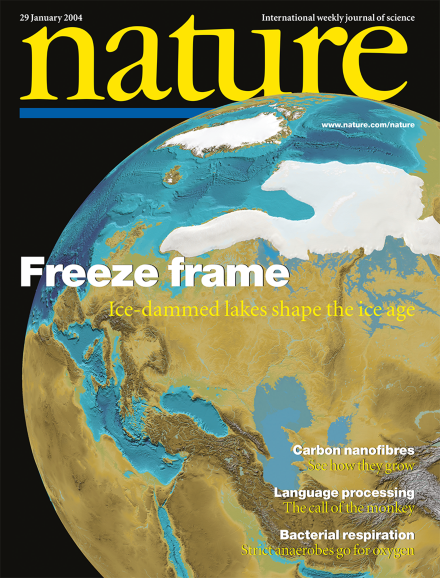
Enhanced ice sheet growth in Eurasia owing to adjacent ice-dammed lakes p429

G. Krinner, J. Mangerud, M. Jakobsson, M. Crucifix, C. Ritz and J. I. Svendsen

doi:10.1038/nature02233


Natural examples of olivine lattice preferred orientation patterns with a flow-normal a-axis maximum p432

Tomoyuki Mizukami, Simon R. Wallis and Junji Yamamoto

doi:10.1038/nature02179


Friction falls towards zero in quartz rock as slip velocity approaches seismic rates p436

Giulio Di Toro, David L. Goldsby and Terry E. Tullis

doi:10.1038/nature02249

See also: News and Views by Marone


A new orang-utan relative from the Late Miocene of Thailand p439

Yaowalak Chaimanee, Varavudh Suteethorn, Pratueng Jintasakul, Chavalit Vidthayanon, Bernard Marandat and Jean-Jacques Jaeger

doi:10.1038/nature02245


The strict anaerobe Bacteroides fragilis grows in and benefits from nanomolar concentrations of oxygen p441

Anthony D. Baughn and Michael H. Malamy

doi:10.1038/nature02285


A newly discovered Roseobacter cluster in temperate and polar oceans p445

Natascha Selje, Meinhard Simon and Thorsten Brinkhoff

doi:10.1038/nature02272


Species-specific calls evoke asymmetric activity in the monkey's temporal poles p448

Amy Poremba, Megan Malloy, Richard C. Saunders, Richard E. Carson, Peter Herscovitch and Mortimer Mishkin

doi:10.1038/nature02268


SOL-1 is a CUB-domain protein required for GLR-1 glutamate receptor function in C. elegans p451

Yi Zheng, Jerry E. Mellem, Penelope J. Brockie, David M. Madsen and Andres V. Maricq

doi:10.1038/nature02244


The RickA protein of Rickettsia conorii activates the Arp2/3 complex p457

Edith Gouin, Coumaran Egile, Pierre Dehoux, Véronique Villiers, Josephine Adams, Frank Gertler, Rong Li and Pascale Cossart

doi:10.1038/nature02318


The ADP/ATP translocator is not essential for the mitochondrial permeability transition pore p461

Jason E. Kokoszka, Katrina G. Waymire, Shawn E. Levy, James E. Sligh, Jiyang Cai, Dean P. Jones, Grant R. MacGregor and Douglas C. Wallace

doi:10.1038/nature02229


Mechanically driven ATP synthesis by F1-ATPase p465

Hiroyasu Itoh, Akira Takahashi, Kengo Adachi, Hiroyuki Noji, Ryohei Yasuda, Masasuke Yoshida and Kazuhiko Kinosita, Jr

doi:10.1038/nature02212

See also: News and Views by Cross


Top

Naturejobs

Prospects

Mapping life-science skills p469

Paul Smaglik

doi:10.1038/nj6973-469a


Career View

MOVERS p470

doi:10.1038/nj6972-470c


Graduate Journal:  The long and the short of it p470

Tshaka Cunningham

doi:10.1038/nj6973-470a


Scientists & Societies p470

Johanna Nilsson

doi:10.1038/nj6973-470b


Extra navigation

.
  • Japanese table of contents

Open Innovation Challenges

ADVERTISEMENT