Table of contents
Volume 419 Number 6902 pp1-96
Opinion
Obstacles to biodefence p1
The United States is expected soon to establish its Department of Homeland Security. The precise threats facing the nation are uncertain, but challenges in its preparedness to deal with attacks on health and agriculture are all too obvious.
doi:10.1038/419001a
News
Geneticists lay foundations for human transcriptome database p3
David Cyranoski
doi:10.1038/419003a
Bush urged to boost funding for physical sciences p3
Geoff Brumfiel
doi:10.1038/419003b
News
Name-calling gets stem-cell researcher into hot water p4
Carina Dennis
doi:10.1038/419004a
Dispute over first authorship lands researchers in dock p4
Alison Abbott
doi:10.1038/419004b
Court judgement opens door for study of ancient skeleton p5
Rex Dalton
doi:10.1038/419005a
Diabetes trial stirs debate on safety of xenotransplants p5
Erika Check
doi:10.1038/419005b
News
Hunt for cosmic rays offers scope for Africa p6
David Adam
doi:10.1038/419006a
Norway sinks ocean carbon study p6
Jim Giles
doi:10.1038/419006b
Call for cash to end the decay of Berlin's great collections p7
Quirin Schiermeier
doi:10.1038/419007a
Gene-bank expansion plan launched at Earth summit p7
Michael Cherry
doi:10.1038/419007b
news feature
Correction p9
doi:10.1038/419009a
Homeland-security research: Mission impossible? p10
A new Department of Homeland Security is to be given the task of defending the United States against further terrorist attacks. Geoff Brumfiel outlines the challenges facing its research wing.
Geoff Brumfiel
doi:10.1038/419010a
High-energy astrophysics: Let's catch some rays p12
Particles with hundreds of millions times more energy than those in physicists' accelerators regularly strike the Earth, but no one is sure where they come from. Philip Ball reports on attempts to solve the mystery.
Philip Ball
doi:10.1038/419012a
Correspondence
French users need European neutrons p15
Big projects may not be popular at present, but policy-makers must think of the future.
and Société Française de la Neutronique
doi:10.1038/419015a
Shared knowledge can combat malaria p15
Yimin Wu and M. John Rogers
doi:10.1038/419015b
Prokaryote taxonomy online: challenges ahead p15
Aharon Oren and Erko Stackebrandt
doi:10.1038/419015c
Book Reviews
A feast for the mind p17
An introduction to the concept of mind provides plenty of food for thought.
Rosaleen McCarthy reviews Exploring Consciousness/Consciousness by Rita Carter
doi:10.1038/419017a
Predicting extinction risk p18
Richard Frankham reviews Population Viability Analysis edited by Steven R. Beissinger and Dale R. McCullough
doi:10.1038/419018a
Still a round after all this time p18
doi:10.1038/419018b
Shock results p19
Peter Bryant reviews Surprise, Uncertainty and Mental Structures by Jerome Kagan
doi:10.1038/419019a
concepts
Cell polarity: A chemical compass p21
Only now are we beginning to unravel the mechanisms behind a cell's ability to point in any direction and navigate effectively.
Henry R. Bourne and Orion Weiner
doi:10.1038/419021a
News and Views
Medicine: RNA as drug and antidote p23
Edward Tuddenham
doi:10.1038/419023a
High-energy physics: The matter with antimatter p24
The Universe is made of matter, not antimatter, and 'CP violation' in particle decays could be the reason. Results from experiments measuring this effect at last confirm the predictions of a 30-year-old theory.
Michael Peskin
doi:10.1038/419024a
100 and 50 years ago p25
doi:10.1038/419025a
Cell biology: Spinning actin to divide p27
When our cells divide, they are cut down the middle by a tightening belt of proteins. New work reveals that the protein filaments in this belt are made from scratch every time.
Shuh Narumiya and Issei Mabuchi
doi:10.1038/419027a
Materials science: Edge effects p28
How do crystal structures terminate at 'flat' surfaces? New developments in electron crystallography mean that the detailed atomic structure of surfaces in complex crystals can be determined — with surprising results.
Michael O'Keeffe
doi:10.1038/419028a
Immunology: The roots of antibody diversity p29
When faced with foreign molecules our antibodies mutate, allowing them to bind to the intruders more strongly. In a story full of surprises, it looks as though the mechanism of mutation has finally been revealed.
Patricia J. Gearhart
doi:10.1038/419029a
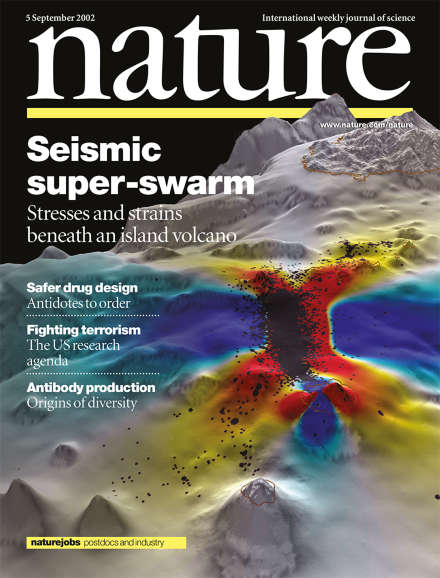
Seismology: Stressed to quaking point p32
The Earth's crust can deform catastrophically in earthquakes, but it's difficult to predict exactly what causes such failure. Analysing thousands of small shocks might help us better understand how earthquakes occur.

Chris Marone
doi:10.1038/419032a
Brief Communications
Anthropology: A lost Neanderthal neonate found p33
A remarkable discovery in a French museum answers some long-standing questions.
Bruno Maureille
doi:10.1038/419033a
First paragraph | Full Text | PDF (97K)
Ecology: Effect of British hunting ban on fox numbers p34
Philip J. Baker, Stephen Harris and Charlotte C. Webbon
doi:10.1038/419034a
First paragraph | Full Text | PDF (65K)
Review
The voltage-gated potassium channels and their relatives p35
Gary Yellen
doi:10.1038/nature00978
Abstract | Full Text | PDF (295K)
Article
Altering the pathway of immunoglobulin hypermutation by inhibiting uracil-DNA glycosylase p43
Javier Di Noia and Michael S. Neuberger
doi:10.1038/nature00981
Abstract | Full Text | PDF (538K) | Supplementary information
See also: News and Views by Gearhart
Letters to Nature
Spin vector alignment of Koronis family asteroids p49
Stephen M. Slivan
doi:10.1038/nature00993
First paragraph | Full Text | PDF (180K)
Collapse and revival of the matter wave field of a Bose–Einstein condensate p51
Markus Greiner, Olaf Mandel, Theodor W. Hänsch and Immanuel Bloch
doi:10.1038/nature00968
First paragraph | Full Text | PDF (319K)
The structure and chemistry of the TiO2-rich surface of SrTiO3 (001) p55
Natasha Erdman, Kenneth R. Poeppelmeier, Mark Asta, Oliver Warschkow, Donald E. Ellis and Laurence D. Marks
doi:10.1038/nature01010
First paragraph | Full Text | PDF (1,562K) | Supplementary information
See also: News and Views by O'Keeffe
Evidence from the ad 2000 Izu islands earthquake swarm that stressing rate governs seismicity p58
Shinji Toda, Ross S. Stein and Takeshi Sagiya
doi:10.1038/nature00997
First paragraph | Full Text | PDF (1,823K)
See also: News and Views by Marone
Pretender punishment induced by chemical signalling in a queenless ant p61
Thibaud Monnin, Francis L. W. Ratnieks, Graeme R. Jones and Richard Beard
doi:10.1038/nature00932
First paragraph | Full Text | PDF (342K)
An ultra-sparse code underliesthe generation of neural sequences in a songbird p65
Richard H. R. Hahnloser, Alexay A. Kozhevnikov and Michale S. Fee
doi:10.1038/nature00974
First paragraph | Full Text | PDF (819K) | Supplementary information
Deficient pheromone responses in mice lacking a cluster of vomeronasal receptor genes p70
Karina Del Punta, Trese Leinders-Zufall, Ivan Rodriguez, David Jukam, Charles J. Wysocki, Sonoko Ogawa, Frank Zufall and Peter Mombaerts
doi:10.1038/nature00955
First paragraph | Full Text | PDF (370K)
The ELF4 gene controls circadian rhythms and flowering time in Arabidopsis thaliana p74
Mark R. Doyle, Seth J. Davis, Ruth M. Bastow, Harriet G. McWatters, László Kozma-Bognár, Ferenc Nagy, Andrew J. Millar and Richard M. Amasino
doi:10.1038/nature00954
First paragraph | Full Text | PDF (308K) | Supplementary information
Protective role of phospholipid oxidation products in endotoxin-induced tissue damage p77
Valery N. Bochkov, Alexandra Kadl, Joakim Huber, Florian Gruber, Bernd R. Binder and Norbert Leitinger
doi:10.1038/nature01023
First paragraph | Full Text | PDF (437K)
Actin dynamics in the contractile ring during cytokinesis in fission yeast p82
Robert J. Pelham, Jr and Fred Chang
doi:10.1038/nature00999
First paragraph | Full Text | PDF (454K) | Supplementary information
See also: News and Views by Narumiya & Mabuchi
The U1 snRNP protein U1C recognizes the 5' splice site in the absence of base pairing p86
Hansen Du and Michael Rosbash
doi:10.1038/nature00947
First paragraph | Full Text | PDF (278K)
RNA aptamers as reversible antagonists of coagulation factor IXa p90
Christopher P. Rusconi, Elizabeth Scardino, Juliana Layzer, George A. Pitoc, Thomas L. Ortel, Dougald Monroe and Bruce A. Sullenger
doi:10.1038/nature00963
First paragraph | Full Text | PDF (779K)
See also: News and Views by Tuddenham
corrigendum: Sub-ångstrom resolution using aberration corrected electron optics p94
P. E. Batson, N. Dellby and O. L. Krivanek
doi:10.1038/nature01058
New on the Market
Putting the C into PCR p95
A round-up of thermocyclers and other PCR-related kit.
doi:10.1038/419095a