Table of contents


From the editors

p797 | doi:10.1038/nrn2527

Top

Research Highlights

Chemosensation: A behavioural U-turn | PDF (125 KB)

p799 | doi:10.1038/nrn2523

Synaptogenesis: Altering your inhibitions | PDF (146 KB)

p800 | doi:10.1038/nrn2520

Neurodegenerative disease: New ways of tackling Abeta toxicity | PDF (149 KB)

p800 | doi:10.1038/nrn2522

In the news

Out of control | PDF (98 KB)

p800 | doi:10.1038/nrn2531

Stem cells: At home with neural stem cells | PDF (155 KB)

p801 | doi:10.1038/nrn2517

Repair: Confounding influence | PDF (135 KB)

p802 | doi:10.1038/nrn2518

Development: The many faces of NKX2-1 | PDF (140 KB)

p802 | doi:10.1038/nrn2519

Attention: The guard and the gate | PDF (143 KB)

p802 | doi:10.1038/nrn2525

In brief

Aging | Circadian rhythms | Behaviour | PDF (129 KB)

p803 | doi:10.1038/nrn2528

Memory: Scaffolding fearful thoughts | PDF (130 KB)

p804 | doi:10.1038/nrn2524

Development: Moving in waves | PDF (153 KB)

p804 | doi:10.1038/nrn2526

Learning: That'll teach you! | PDF (116 KB)

p804 | doi:10.1038/nrn2530

Top

Progress

C1q: the perfect complement for a synaptic feast?

V. Hugh Perry & Vincent O'Connor

p807 | doi:10.1038/nrn2394

Selective remodelling of synapses contributes to the successful wiring of the nervous system during development. Perry and O'Connor discuss recent studies that have implicated a key component of the immune system, the complement cascade, in this process.

Top

Reviews

Silent synapses and the emergence of a postsynaptic mechanism for LTP

Geoffrey A. Kerchner & Roger A. Nicoll

p813 | doi:10.1038/nrn2501

Silent synapses cannot mediate neurotransmission. Kerchner and Nicoll discuss different mechanisms that have been proposed to underlie synaptic silence, and conclude that LTP and synaptic unsilencing occur by a postsynaptic mechanism that involves AMPA receptor recruitment.

There is a Corrigendum (1 March 2009) associated with this article.

Ubiquitin, the proteasome and protein degradation in neuronal function and dysfunction

Hwan-Ching Tai & Erin M. Schuman

p826 | doi:10.1038/nrn2499

The complex morphology of neurons requires distinctive adaptations for the molecular mechanisms of protein degradation. These are discussed by Tai and Schuman with respect to normal function and dysfunction in neurodegenerative diseases.

Article series: Neuron-glia interactions

Remyelination in the CNS: from biology to therapy

Robin J. M. Franklin & Charles ffrench-Constant

p839 | doi:10.1038/nrn2480

In the CNS, remyelination of denuded axons occurs to reinstate neuronal function. Franklin and ffrench-Constant consider the cells and molecular signals that are required for remyelination and how this knowledge can be channelled towards more effective therapies for demyelinating diseases.

Functional role of the supplementary and pre-supplementary motor areas

Parashkev Nachev, Christopher Kennard & Masud Husain

p856 | doi:10.1038/nrn2478

The supplementary motor complex has a role in regulating action, but whether each of its subregions has a distinct function is unclear. Husain and colleagues review the literature and discuss outstanding issues regarding the function of this complex.

See also: Correspondence by Leek & Johnston | Correspondence by Nachev et al. .

Top

Perspectives

Science and society

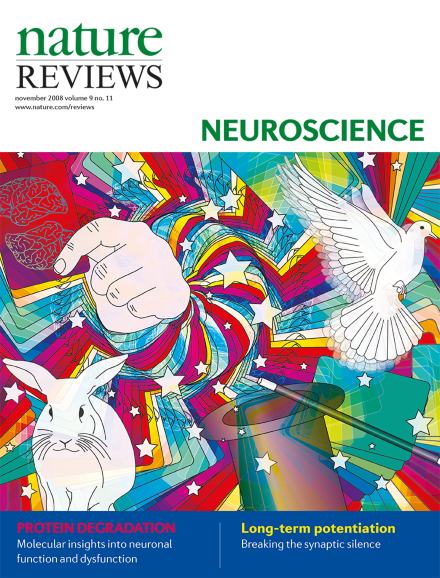
Attention and awareness in stage magic: turning tricks into research

Stephen L. Macknik, Mac King, James Randi, Apollo Robbins, Teller, John Thompson & Susana Martinez-Conde

p871 | doi:10.1038/nrn2473

Magic tricks require the manipulation of the audience's attention and awareness. Macknik, Martinez-Conde and their magician co-authors describe the visual and cognitive illusions that underlie many magic tricks, and the techniques that magicians use to achieve these illusions. An interview with Martinez-Conde for Neuropod is available for download.

See also: Correspondence by Lamont & Henderson | Correspondence by Macknik & Martinez-Conde | Correspondence by Lamont & Henderson | Correspondence by Macknik & Martinez-Conde | Correspondence by Lamont & Henderson | Correspondence by Macknik & Martinez-Conde | Correspondence by Lamont & Henderson | Correspondence by Macknik & Martinez-Conde

Viewpoint

Asian promise: the state and future of collaborations in neuroscience

Mu-Ming Poo, Ley Sander, Marc Fivaz & Yasunori Hayashi

p881 | doi:10.1038/nrn2512

As neuroscience research in Asia undergoes unprecedented growth, collaborations are being established between laboratories in Asia and the West. Four neuroscientists describe their experiences of such collaborations and give their input on the challenges and opportunities that they provide.

Extra navigation

Subscribe

Subscribe to Nature Reviews Neuroscience

Open Innovation Challenges

naturejobs

Advertisement