Thank you for visiting nature.com. You are using a browser version with limited support for CSS. To obtain
the best experience, we recommend you use a more up to date browser (or turn off compatibility mode in
Internet Explorer). In the meantime, to ensure continued support, we are displaying the site without styles
and JavaScript.
The formation of complex neuronal circuitry requires precise spatial, temporal and cell-type-specific regulation of the responses of neurons to extracellular guidance and synaptogenic cues. Ghosh and colleagues discuss the key roles of transcription factors in regulating connectivity in the nervous system.
Keene and Waddell explore evidence from cutting-edge genetic, imaging and physiological studies and review how the genetic model system of the fly has enabled us to identify the neurons involved and the circuitry of olfactory memory formation and consolidation.
Epigenetic regulation of gene expression occurs in the developing and the mature brain. Nestler and colleagues review recent evidence that epigenetic mechanisms, by causing stable changes in gene expression, are involved in learning and memory and in several psychiatric disorders.
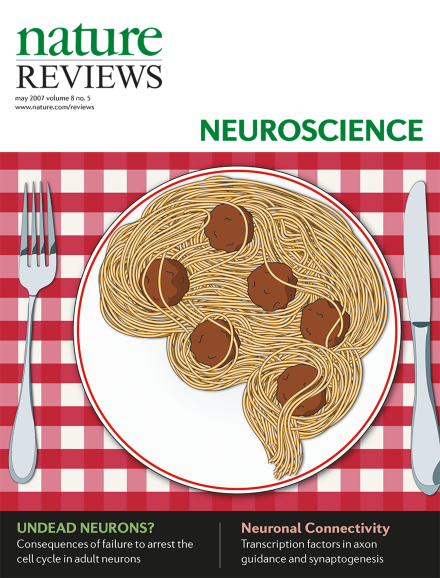
Once neurogenesis is complete, mature neurons do not divide. Herrup and Yang outline the evidence that, in order to achieve this, adult neurons must constantly hold their cell cycle in check, and discuss the pathological consequences of failure of cell cycle regulation.
Subtle differences between the images formed by each eye enable us to perceive stereoscopic depth. Parker describes examples of the features of stereoscopic vision that have led to revised hypotheses about the roles of different cortical areas in binocular depth perception.
Decades of research have not yet succeeded in definitively characterizing the neuroanatomy of speech processing. Hickok and Poeppel describe a dual-stream model of speech processing and discuss how this model can account for some of the field's paradoxical findings.