Table of contents
December 2007 Vol 8 No 12
From the Editors
p903 | doi:10.1038/nrg2276
Research Highlights
Genomics: Genomics on the fly | PDF (185 KB)
p904 | doi:10.1038/nrg2283
Technology: New front-end for high-throughput resequencing | PDF (303 KB)
p905 | doi:10.1038/nrg2271
In the news
Interfering with conception | PDF (303 KB)
p905 | doi:10.1038/nrg2272
Gene expression: Proteins in profile | PDF (357 KB)
p906 | doi:10.1038/nrg2274
Horizontal gene transfer: Unclonable, that's what you are! | PDF (357 KB)
p906 | doi:10.1038/nrg2275
In brief
Genomics | Cancer | Genome evolution | Gene networks | PDF (180 KB)
p906 | doi:10.1038/nrg2285
Association studies: The best of the rest | PDF (284 KB)
p907 | doi:10.1038/nrg2280
Gene therapy: Gene editors deliver | PDF (346 KB)
p908 | doi:10.1038/nrg2277
Genomics: Decoding the regulatory genome | PDF (346 KB)
p908 | doi:10.1038/nrg2281
Evolution: Neanderthals help to tell our story | PDF (184 KB)
p908 | doi:10.1038/nrg2284
In brief
Gene regulation | RNA world | Epigenetics | Evolution | PDF (270 KB)
p909 | doi:10.1038/nrg2286
Cancer genomics: Combing the genome for cancer genes | PDF (209 KB)
p910 | doi:10.1038/nrg2282
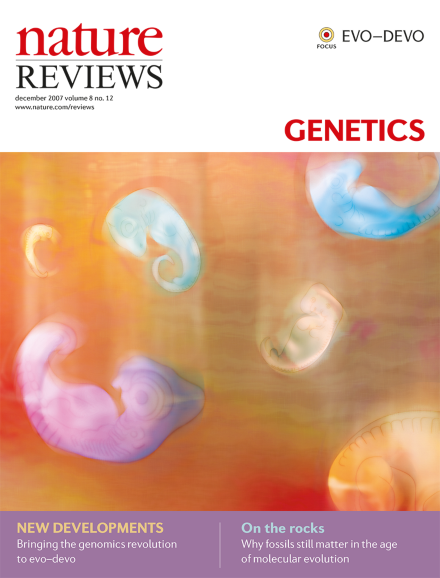
Focus on: Evo–devo
Reviews
Written in stone: fossils, genes and evo–devo
Rudolf A. Raff
p911 | doi:10.1038/nrg2225
Evo–devo has its origins in both palaentology and developmental genetics, but there is a tendency to overlook the former as being old-fashioned. However, integrating information from both sources is essential to generating realistic hypotheses about how developmental processes evolved.
The road to modularity
Günter P. Wagner, Mihaela Pavlicev & James M. Cheverud
p921 | doi:10.1038/nrg2267
A module is a linked group of phenotypic traits that depend on each other but are relatively independent of other modules. The insight that developmental mechanisms are modular is important for their evolution, making modularity a key concept in evo–devo and beyond.
Evolutionary developmental biology and genomics
Cristian Cañestro, Hayato Yokoi & John H. Postlethwait
p932 | doi:10.1038/nrg2226
The genomics era offers many exciting opportunities to answer questions in evo–devo. Newly sequenced genomes of phylogenetically diverse organisms allow us to chronicle the gain and loss of morphological features and correlate them with their genetic underpinnings.
Perspective
Opinion
Evo–devo: extending the evolutionary synthesis
Gerd B. Müller
p943 | doi:10.1038/nrg2219
Evo–devo is now a mature field encompassing a wide range of research areas. The author offers his assessment of its main theoretical implications and challenges for the immediate future.
Reviews
Mammalian karyotype evolution
Malcolm A. Ferguson-Smith & Vladimir Trifonov
p950 | doi:10.1038/nrg2199
Remarkably, conservation of genomes of all species in terms of sequence and synteny is accompanied by a great diversity of karyotypes, which can be explained by rearrangements of chromosomal segments. The authors look at how these rearrangements come about, and how their analysis can construct evolutionary relationships among mammals.
Cooperation of signalling pathways in embryonic mammary gland development
Gertraud W. Robinson
p963 | doi:10.1038/nrg2227
Genetic studies in mice are providing an increasingly complete picture of the signalling interactions that underlie the development of the mammary gland; in the process they inform us about the human disorders that are caused by mutations in these pathways, including breast cancer.
Perspective
Guidelines
A unified classification system for eukaryotic transposable elements
Thomas Wicker, François Sabot, Aurélie Hua-Van, Jeffrey L. Bennetzen, Pierre Capy, Boulos Chalhoub, Andrew Flavell, Philippe Leroy, Michele Morgante, Olivier Panaud, Etienne Paux, Phillip SanMiguel & Alan H. Schulman
p973 | doi:10.1038/nrg2165
Transposable elements are diverse and abundantly present in eukaryotic genomes. To help with the challenge of their identification and annotation, these authors propose the first unified hierarchical classification system for transposable elements. The system and nomenclature are kept up to date in a related database — WikiPoson.
See also: Correspondence by Kapitonov & Jurka et al. | Correspondence by Seberg & Petersen et al.
Correspondence
Correspondence: On the value of haplotype-based genotype–phenotype analysis and on data transformation in pharmacogenetics and -genomics
Stefan Viktor Vormfelde & Jürgen Brockmöller
| doi:10.1038/nrg1916-c1
Correspondence: Reply: On the value of haplotype-based genotype–phenotype analysis and on data transformation in pharmacogenetics and -genomics
David J. Balding
| doi:10.1038/nrg1916-c2