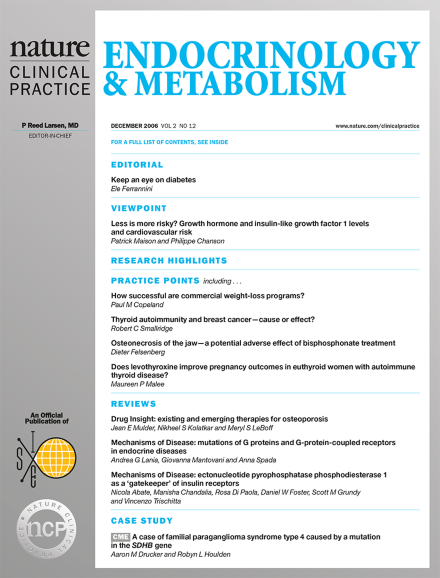
Table of contents
December 2006 Volume 2 No 12
Viewpoint
Less is more risky? Growth hormone and insulin-like growth factor 1 levels and cardiovascular risk
650Elevated levels of growth hormone (GH) and insulin-like growth factor 1 (IGF1) in conditions such as acromegaly have been implicated in increased cardiovascular risk. The authors of this Viewpoint argue, however, that hormone deficiency might pose a greater risk than hormone excess, and ask the question—what levels of GH and IGF1 can be considered 'safe'?
Research Highlights
DHEA therapy could reduce GH dose requirement in hypopituitary women
652Successful oral sulfonylurea treatment for diabetes caused by Kir6.2 mutations
652Screening for congenital hypothyroidism with the Dutch T4–TSH–TBG system
653Ultrasonography and scintigraphy in the diagnosis of primary hyperparathyroidism
653Patients with several large thyroid nodules should undergo multiple biopsies
654Thiazolidinediones could exacerbate BMD loss in elderly women
654Overweight and normal-weight people estimate calorie intake in the same way
655Metformin use during pregnancy does not increase the risk of major malformation
655High BMI does not increase overall mortality in patients with coronary artery disease
655Treatment of early signs of diabetes might not delay progression
656Pubertal boys treated with aromatase inhibitors require serum lipid monitoring
656Chromogranin A identifies patients with pheochromocytoma with high sensitivity
657Practice Points
How successful are commercial weight-loss programs?
658Thyroid autoimmunity and breast cancer—cause or effect?
660Osteonecrosis of the jaw—a potential adverse effect of bisphosphonate treatment
662Does levothyroxine improve pregnancy outcomes in euthyroid women with autoimmune thyroid disease?
664Cognitive dysfunction following treatment of Cushing's syndrome
666Reviews
Drug Insight: existing and emerging therapies for osteoporosis
670Osteoporosis is an increasingly prevalent condition that, currently, is underdiagnosed and thus undertreated, so that improved screening and preventative dietary and lifestyle changes are needed. For more-severe cases, there are also several drug classes available or in development that work in different ways; these are detailed in this Review.
doi:10.1038/ncpendmet0325 | Full Text | PDF (206K)
Mechanisms of Disease: mutations of G proteins and G-protein-coupled receptors in endocrine diseases
681Many hormones use G-protein-coupled receptors and G proteins in the target cell to transduce their signals. A range of disease-causing mutations have been characterized that mimic states of hormone deficiency or excess. This Review describes these mutations, and their resultant clinical and biochemical features.
doi:10.1038/ncpendmet0324 | Full Text | PDF (233K)
Mechanisms of Disease: ectonucleotide pyrophosphatase phosphodiesterase 1 as a 'gatekeeper' of insulin receptors
694Ectonucleotide pyrophosphatase phosphodiesterase 1 (E-NPP1) inhibits the insulin receptor. E-NPP1 mutations are associated with type 2 diabetes, and E-NPP1 expression is increased in nonobese, nondiabetic insulin-resistant subjects; E-NPP1 might therefore act as a marker for at-risk individuals and reveal new targets for prevention and treatment of diabetes and cardiovascular disease.
doi:10.1038/ncpendmet0367 | Full Text | PDF (255K)
Case Study

A case of familial paraganglioma syndrome type 4 caused by a mutation in the SDHB gene
702doi:10.1038/ncpendmet0342 | Full Text | PDF (274K)