Table of contents
March 2007 Vol 6 No 3
In this issue
p169 | doi:10.1038/nrd2267
Editorial: Psychiatric drug discovery on the couch
p171 | doi:10.1038/nrd2268
News and Analysis
Big pharma slims down to bolster productivity | PDF (222 KB)
p173 | doi:10.1038/nrd2284
Cancer nanotechnology: small, but heading for the big time | PDF (187 KB)
p174 | doi:10.1038/nrd2285
News in Brief
Genetic test for breast cancer | Good cholesterol still matters | Key genes in diabetes identified | FDA announces new safety initiatives | PDF (230 KB)
p176 | doi:10.1038/nrd2286
Patent watch
Bill to block gene patents | Pfizer wins another round against Synthon | Generic manufacturers prevail over Sanofi–Aventis | Antifungal drugs | PDF (115 KB)
p178 | doi:10.1038/nrd2287
An Audience With
Paul Herrling | PDF (101 KB)
p180 | doi:10.1038/nrd2288
From the analyst's couch
Multiple myeloma therapies | PDF (191 KB)
p181 | doi:10.1038/nrd2269
Fresh from the Pipeline
Posaconazole | PDF (167 KB)
p183 | doi:10.1038/nrd2270
Research Highlights
G-Protein-coupled receptors: New switch to activate class B GPCRs | PDF (125 KB)
p185 | doi:10.1038/nrd2274
Cancer: Double death for cancer cells | PDF (112 KB)
p186 | doi:10.1038/nrd2273
Sleep disorders: Counting orexins | PDF (152 KB)
p186 | doi:10.1038/nrd2277
Target validation: Determining druggability | PDF (118 KB)
p187 | doi:10.1038/nrd2275
Anticancer drugs: Collusion | PDF (120 KB)
p188 | doi:10.1038/nrd2276
In brief
Antibacterial drugs | Anticancer drugs | Stem cells | Anticancer drugs | PDF (121 KB)
p188 | doi:10.1038/nrd2278
Perspectives
Viewpoint
How can drug discovery for psychiatric disorders be improved?
Yves Agid, György Buzsáki, David M. Diamond, Richard Frackowiak, Jay Giedd, Jean-Antoine Girault, Anthony Grace, Jeremy J. Lambert, Husseini Manji, Helen Mayberg, Maurizio Popoli, Alain Prochiantz, Gal Richter-Levin, Peter Somogyi, Michael Spedding, Per Svenningsson & Daniel Weinberger
p189 | doi:10.1038/nrd2217
Despite the clear need for better therapies for psychiatric disorders such as depression and schizophrenia, novel drugs — particularly those that could revolutionize treatment — have been rare in recent years. Following a symposium in which the underlying reasons for this problem were discussed, a group of experts from across the field of neuroscience highlight key advances in our understanding of psychiatric disorders, and propose steps that can be taken to improve the effectiveness of drug discovery in this field.
Innovation
A robustness-based approach to systems-oriented drug design
Hiroaki Kitano
p202 | doi:10.1038/nrd2195
The intrinsic robustness of biological systems is a key factor preventing the success of potential drugs that target specific molecules. Using examples based on existing drugs, Kitano discusses how a greater consideration of the importance of robustness could influence the design of new drugs intended to control complex systems.
Reviews
A decade of fragment-based drug design: strategic advances and lessons learned
Philip J. Hajduk & Jonathan Greer
p211 | doi:10.1038/nrd2220
Fragment-based drug design involves screening a small number of low-molecular-mass compounds with the aim of identifying low-affinity 'fragments' that are well-suited for optimization into more potent compounds. Hajduk and Greer describe the evolution of this approach into a valuable alternative to high-throughput screening for the discovery of lead compounds, and highlight lessons learned from its application over the past decade.
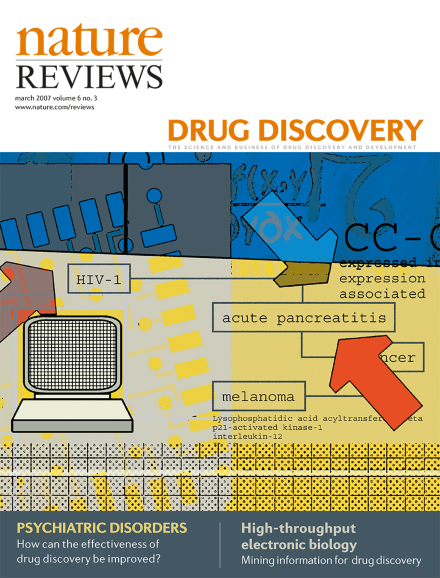
High-throughput electronic biology: mining information for drug discovery
William Loging, Lee Harland & Bryn Williams-Jones
p220 | doi:10.1038/nrd2265
In this Review, Loging and colleagues discuss how high-throughput techniques in electronic biology can utilize the vast range of life science in silico resources, and examine how best to apply these techniques to aid the drug discovery process.
Lipids and lipid-based formulations: optimizing the oral delivery of lipophilic drugs
Christopher J. H. Porter, Natalie L. Trevaskis & William N. Charman
p231 | doi:10.1038/nrd2197
Lipophilic, poorly water-soluble drug candidates are common outcomes of drug discovery programmes. Porter and colleagues discuss mechanisms by which lipids and lipidic excipients can improve oral absorption of lipophilic drugs, and provide a perspective on the future applications of lipid-based delivery systems.
Careers and Recruitment
Correspondence
Correspondence: Biosimilars: the impact of their heterogeneity on regulatory approval
Asterios S Tsiftsoglou
| doi:10.1038/nrd2093-c1
Corrigendum: Mining the Wnt pathway for cancer therapeutics
Nick Barker & Hans Clevers
| doi:10.1038/nrd2279
Corrigendum: Drug–target residence time and its implications for lead optimization
Robert A. Copeland, David L. Pompliano & Thomas D. Meek
| doi:10.1038/nrd2281
Erratum: 2006 drug approvals: finding the niche
Joanna Owens
| doi:10.1038/nrd2282