Table of contents

ARTICLE NAVIGATION - ISSUE
January 2009, Volume 3 No 1 pp1-64
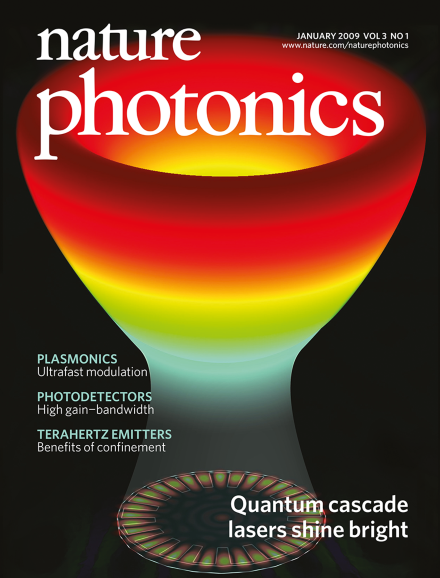
About the coverEditorial
A new look - p1
doi:10.1038/nphoton.2008.253
Although Nature Photonics may have had a face-lift, its mission to bring you a selection of the most exciting research findings in all areas of optics and optoelectronics remains the same.
Interviews
Future investments - pp2 - 3
Interview with Gustav Kalbe
doi:10.1038/nphoton.2008.255
The European Commission has identified photonics as a key technology for the future health of European industry. Nature Photonics spoke to Gustav Kalbe, Head of Sector at the Photonics Unit, about how he and his colleagues are influencing photonics research.
Full Text - Future investments | PDF (157 KB) - Future investments
Research Highlights
Our choice from the recent literature - pp4 - 5
doi:10.1038/nphoton.2008.254
Full Text - Our choice from the recent literature | PDF (137 KB) - Our choice from the recent literature
News and Views
Silicon photonics: Look out III–V - pp7 - 8
Yasunori Tokuda & Eiji Yagyu
doi:10.1038/nphoton.2008.257
Optical communication makes good use of sensitive avalanche photodiodes, typically made from group III–V semiconductor compounds. New research shows that silicon may be a viable alternative material for realizing such detectors with better performance.
Full Text - Silicon photonicsLook out III–V | PDF (102 KB) - Silicon photonicsLook out III–V
Silicon photonics: Silicon's time lens - pp8 - 10
B. Jalali, D. R. Solli & S. Gupta
doi:10.1038/nphoton.2008.261
How can we capture ultrafast optical signals in real time? A time lens is one possibility — able to image the temporal profile of a short optical signal, analogous to a conventional lens. Such a device has now been created on a silicon chip.
Full Text - Silicon photonicsSilicon's time lens | PDF (281 KB) - Silicon photonicsSilicon's time lens
Imaging: Direct observation of an exoplanet - p10
David Pile
doi:10.1038/nphoton.2008.256
Full Text - ImagingDirect observation of an exoplanet | PDF (230 KB) - ImagingDirect observation of an exoplanet
Semiconductor Lasers: Lasing high in k-space - pp11 - 12
Jérôme Faist
doi:10.1038/nphoton.2008.260
The demonstration that lasing at high-k wavevectors is possible in a quantum cascade laser may open new avenues for the design of intersub-band devices.
Full Text - Semiconductor LasersLasing high in k-space | PDF (92 KB) - Semiconductor LasersLasing high in k-space
Active Plasmonics: Ultrafast developments - pp12 - 13
L. Cao & Mark L. Brongersma
doi:10.1038/nphoton.2008.259
Recent research suggests that plasmonics may offer a route to the development of modulators with terahertz bandwidths, many orders of magnitude faster than today's devices.
Full Text - Active PlasmonicsUltrafast developments | PDF (97 KB) - Active PlasmonicsUltrafast developments
Quantum Cascade Lasers: Breaking energy bands - pp13 - 15
Carlo Sirtori
doi:10.1038/nphoton.2008.262
By applying an extremely large magnetic field to break a semiconductor's energy bands into discrete levels, researchers have shown that it is possible for terahertz quantum cascade lasers to operate at unprecedented temperatures and wavelengths.
Full Text - Quantum Cascade LasersBreaking energy bands | PDF (173 KB) - Quantum Cascade LasersBreaking energy bands
Microphotonics: An out-of-plane experience - pp15 - 16
Kartik Srinivasan
doi:10.1038/nphoton.2008.258
Using clever device engineering, European researchers have created vertically emitting microcavity lasers, potentially paving the way towards powerful terahertz sources and detectors useful for imaging and biological sensing.
Full Text - MicrophotonicsAn out-of-plane experience | PDF (163 KB) - MicrophotonicsAn out-of-plane experience
Letters
Magnetic-field-assisted terahertz quantum cascade laser operating up to 225 K - pp41 - 45
A. Wade, G. Fedorov, D. Smirnov, S. Kumar, B. S. Williams, Q. Hu & J. L. Reno
doi:10.1038/nphoton.2008.251
The application of a very strong magnetic field is experimentally demonstrated to enable operation of terahertz quantum cascade lasers at much higher temperatures than usual. Lasing at a frequency of 3 THz is reported at up to 225 K when a field of 19.3 T is applied. The results validate theoretical predictions that quantum confinement is a route towards room temperature operation.
Abstract - | Full Text - Magnetic-field-assisted terahertz quantum cascade laser operating up to 225 K | PDF (525 KB) - Magnetic-field-assisted terahertz quantum cascade laser operating up to 225 K | Supplementary information
Subject Categories: Lasers, LEDs and light sources | Terahertz optics
See also: News and Views by Sirtori
Vertically emitting microdisk lasers - pp46 - 49
Lukas Mahler, Alessandro Tredicucci, Fabio Beltram, Christoph Walther, Jérôme Faist, Bernd Witzigmann, Harvey E. Beere & David A. Ritchie
doi:10.1038/nphoton.2008.248
Applications of microdisk lasers are intrinsically limited by their planar and isotropic emission. Now, by implementing appropriate diffraction gratings along the disk circumference, scientists present a vertically emitting terahertz quantum-cascade microdisk laser, shedding light on the fabrication of arrays of single-mode, highly collimated and powerful terahertz sources.
Abstract - | Full Text - Vertically emitting microdisk lasers | PDF (425 KB) - Vertically emitting microdisk lasers | Supplementary information
Subject Categories: Lasers, LEDs and light sources | Novel materials and engineered structures | Terahertz optics
See also: News and Views by Srinivasan
High k-space lasing in a dual-wavelength quantum cascade laser - pp50 - 54
Kale J. Franz, Stefan Menzel, Anthony J. Hoffman, Dan Wasserman, John W. Cockburn & Claire Gmachl
doi:10.1038/nphoton.2008.250
Scientists report a dual-wavelength quantum cascade laser that lases at wave factors k
0 and k
3.6
108 m-1. The finding may change the conventional idea that population inversion of lasing occurs only at k
0 and give ways on designing intersub-band devices with high k-space.
Abstract - | Full Text - High k-space lasing in a dual-wavelength quantum cascade laser | PDF (709 KB) - High k-space lasing in a dual-wavelength quantum cascade laser
Subject Categories: Lasers, LEDs and light sources | Fundamental optical physics | Quantum optics
See also: News and Views by Faist
Ultrafast active plasmonics - pp55 - 58
Kevin F. MacDonald, Zsolt L. Sámson, Mark I. Stockman & Nikolay I. Zheludev
doi:10.1038/nphoton.2008.249
The ability to modulate optical plasmons, propagating along a metal–dielectric waveguide, on the femtosecond time scale suggests that plasmons may be a suitable data carrier for future ultrasfast communication applications.
Abstract - | Full Text - Ultrafast active plasmonics | PDF (355 KB) - Ultrafast active plasmonics
Subject Category: Plasmonics
See also: News and Views by Cao & Brongersma
Monolithic germanium/silicon avalanche photodiodes with 340 GHz gain–bandwidth product - pp59 - 63
Yimin Kang, Han-Din Liu, Mike Morse, Mario J. Paniccia, Moshe Zadka, Stas Litski, Gadi Sarid, Alexandre Pauchard, Ying-Hao Kuo, Hui-Wen Chen, Wissem Sfar Zaoui, John E. Bowers, Andreas Beling, Dion C. McIntosh, Xiaoguang Zheng & Joe C. Campbell
doi:10.1038/nphoton.2008.247
A monolithically grown Ge/Si avalanche photodetectors (APD) with a gain–bandwidth product of 340 GHz, the highest value for any APDs operating at 1,300 nm, and a sensitivity equivalent to commercially available III-V compound APDs is reported. The excellent performance paves the way to achieving low-cost, CMOS-based, Ge/Si APDs operating at data rates of 40 Gb s-1 or higher, where the performance of III-V APDs is severely limited.
Abstract - | Full Text - Monolithic germanium/silicon avalanche photodiodes with 340 GHz gain–bandwidth product | PDF (343 KB) - Monolithic germanium/silicon avalanche photodiodes with 340 GHz gain–bandwidth product
Subject Category: Optoelectronic devices and components
See also: News and Views by Tokuda & Yagyu
Interview
Quantum warming - p64
Interview with Qing Hu
doi:10.1038/nphoton.2008.272
The demonstration in this issue that strong magnetic confinement of electrons can dramatically increase the operating temperature of terahertz quantum cascade lasers is good news for the dream of reaching room temperature. Nature Photonics spoke with Qing Hu about the result and the future prospects.