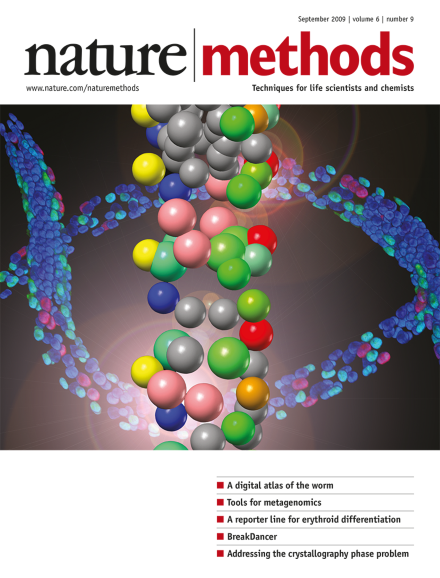
Table of contents
September 2009, Volume 6 No 9 pp623-686
- In This Issue
- Editorial
- Correspondence
- Research Highlights
- News and Views
- Brief Communications
- Articles
- Technology Feature
- Application Notes
Editorial
Metagenomics versus Moore's law - p623
doi:10.1038/nmeth0909-623
Metagenomics sprang from advances in sequencing technology, and continued improvements are providing data in quantities unimaginable a few years ago. But without concerted efforts, the amount of data will quickly outpace the ability of scientists to analyze it.
Abstract - Metagenomics versus Moore's law | Full Text - Metagenomics versus Moore's law | PDF (41 KB) - Metagenomics versus Moore's law
Correspondence
CASD-NMR: critical assessment of automated structure determination by NMR - pp625 - 626
Antonio Rosato, Anurag Bagaria, David Baker, Benjamin Bardiaux, Andrea Cavalli, Jurgen F Doreleijers, Andrea Giachetti, Paul Guerry, Peter Güntert, Torsten Herrmann, Yuanpeng J Huang, Hendrik R A Jonker, Binchen Mao, Thérèse E Malliavin, Gaetano T Montelione, Michael Nilges, Srivatsan Raman, Gijs van der Schot, Wim F Vranken, Geerten W Vuister & Alexandre M J J Bonvin
doi:10.1038/nmeth0909-625
Full Text - CASD-NMR: critical assessment of automated structure determination by NMR | PDF (175 KB) - CASD-NMR: critical assessment of automated structure determination by NMR
Research Highlights
Targeting ancient DNA - p629
Nicole Rusk
doi:10.1038/nmeth0909-629
A method that allows precise capture of Neanderthal genome sequences will permit detailed comparison of modern and ancient humans.
Abstract - Targeting ancient DNA | Full Text - Targeting ancient DNA | PDF (88 KB) - Targeting ancient DNA
ADVERTISEMENT
Tethered together - pp630 - 631
Allison Doerr
doi:10.1038/nmeth0909-630a
Researchers describe a genetic approach to identify the native components responsible for forming molecular transport junctions between the mitochondria and the endoplasmic reticulum.
Abstract - Tethered together | Full Text - Tethered together | PDF (190 KB) - Tethered together
Location, location, location - pp630 - 631
Michael Eisenstein
doi:10.1038/nmeth0909-630b
A strategy for selectively disabling activated neurons helps researchers to characterize brain circuitry controlling addiction-related behaviors.
Abstract - Location, location, location | Full Text - Location, location, location | PDF (190 KB) - Location, location, location
News in brief - p631
doi:10.1038/nmeth0909-631
Reading between the lines - p632
Michael Eisenstein
doi:10.1038/nmeth0909-632
A phenotype prediction tool helps 'fill in the blanks' for expression microarrays, extending their predictive power and uncovering once-hidden biases.
Abstract - Reading between the lines | Full Text - Reading between the lines | PDF (149 KB) - Reading between the lines
Stopping intracellular leakage with chemistry - p634
Allison Doerr
doi:10.1038/nmeth0909-634
Researchers develop a strategy to improve the intracellular retention of fluorescent probes and thus their imaging sensitivity.
Abstract - Stopping intracellular leakage with chemistry | Full Text - Stopping intracellular leakage with chemistry | PDF (65 KB) - Stopping intracellular leakage with chemistry
News and Views
Google 'EarthWorm' - pp635 - 636
William A Mohler
doi:10.1038/nmeth0909-635
A three-dimensional digital atlas allows cell-by-cell navigation of Caenorhabditis elegans.
Abstract - Google 'EarthWorm' | Full Text - Google 'EarthWorm' | PDF (157 KB) - Google 'EarthWorm'
See also: Article by Long et al.
The 'rare biosphere': a reality check - pp636 - 637
Jens Reeder & Rob Knight
doi:10.1038/nmeth0909-636
Methods for error correction and classification of metagenomic datasets suggest that the rare biosphere is not as large as previously assumed.
Abstract - The 'rare biosphere': a reality check | Full Text - The 'rare biosphere': a reality check | PDF (107 KB) - The 'rare biosphere': a reality check
See also: Brief Communication by Quince et al. | Article by Brady & Salzberg
Brief Communications
Accurate determination of microbial diversity from 454 pyrosequencing data - pp639 - 641
Christopher Quince, Anders Lanzén, Thomas P Curtis, Russell J Davenport, Neil Hall, Ian M Head, L Fiona Read & William T Sloan
doi:10.1038/nmeth.1361
PyroNoise, an algorithm that preclusters the flowgrams generated on a 454 GS FLX with DNA extracted from microbial samples can distinguish between noise and genuine sequence diversity in a metagenomic dataset.
Abstract - Accurate determination of microbial diversity from 454 pyrosequencing data | Full Text - Accurate determination of microbial diversity from 454 pyrosequencing data | PDF (255 KB) - Accurate determination of microbial diversity from 454 pyrosequencing data | Supplementary information
See also: News and Views by Reeder & Knight
Modular scanning FCS quantifies receptor-ligand interactions in living multicellular organisms - pp643 - 645
Jonas Ries, Shuizi Rachel Yu, Markus Burkhardt, Michael Brand & Petra Schwille
doi:10.1038/nmeth.1355
A combination of static-volume, two-focus and dual-color scanning fluorescence correlation spectroscopy is used for the in vivo analysis of receptor-ligand interactions in living zebrafish embryos. The measured binding affinities suggest that Fgf8 binds to both Fgfr1 and Fgfr4 during gastrulation.
Abstract - Modular scanning FCS quantifies receptor-ligand interactions in living multicellular organisms | Full Text - Modular scanning FCS quantifies receptor-ligand interactions in living multicellular organisms | PDF (332 KB) - Modular scanning FCS quantifies receptor-ligand interactions in living multicellular organisms | Supplementary information
Digital transcriptome profiling using selective hexamer priming for cDNA synthesis - pp647 - 649
Christopher D Armour, John C Castle, Ronghua Chen, Tomas Babak, Patrick Loerch, Stuart Jackson, Jyoti K Shah, John Dey, Carol A Rohl, Jason M Johnson & Christopher K Raymond
doi:10.1038/nmeth.1360
To deplete abundant rRNA from total RNA during cDNA library generation, hexamer primers that perfectly match rRNA are removed. These 'not so randomly primed' cDNA libraries can be generated from small amount of total RNA, preserve strand orientation and are equally enriched in polyadenylated and non-polyadenylated transcripts.
Abstract - Digital transcriptome profiling using selective hexamer priming for cDNA synthesis | Full Text - Digital transcriptome profiling using selective hexamer priming for cDNA synthesis | PDF (312 KB) - Digital transcriptome profiling using selective hexamer priming for cDNA synthesis | Supplementary information
Crystallographic ab initio protein structure solution below atomic resolution - pp651 - 653
Dayté D Rodríguez, Christian Grosse, Sebastian Himmel, César González, Iñaki M de Ilarduya, Stefan Becker, George M Sheldrick & Isabel Usón
doi:10.1038/nmeth.1365
A general approach to address the 'phase problem' in protein crystallography is described, allowing protein structures to be directly solved from 2 Å resolution diffraction data without using heavy atom doping or relying on a preexisting structure model for molecular replacement.
Abstract - Crystallographic : ab initio: protein structure solution below atomic resolution | Full Text - Crystallographic ab initio protein structure solution below atomic resolution | PDF (565 KB) - Crystallographic ab initio protein structure solution below atomic resolution | Supplementary information
Isolation of deletion alleles by G4 DNA-induced mutagenesis - pp655 - 657
Daphne B Pontier, Evelien Kruisselbrink, Victor Guryev & Marcel Tijsterman
doi:10.1038/nmeth.1362
Deletions of polyguanine tracts in Caenorhabditis elegans deficient in the DOG-1 DNA helicase can be exploited to generate deletion alleles of several genes for which no such alleles exist in this organism.
Abstract - Isolation of deletion alleles by G4 DNA-induced mutagenesis | Full Text - Isolation of deletion alleles by G4 DNA-induced mutagenesis | PDF (662 KB) - Isolation of deletion alleles by G4 DNA-induced mutagenesis | Supplementary information
ErythRED, a hESC line enabling identification of erythroid cells - pp659 - 662
Tanya Hatzistavrou, Suzanne J Micallef, Elizabeth S Ng, Jim Vadolas, Edouard G Stanley & Andrew G Elefanty
doi:10.1038/nmeth.1364
A human embryonic stem cell line, ErythrRED, harbors a red fluorescent protein under the control of regulatory sequences from the beta-globin locus, as a reporter for erythroid differentiation.
Abstract - ErythRED, a hESC line enabling identification of erythroid cells | Full Text - ErythRED, a hESC line enabling identification of erythroid cells | PDF (681 KB) - ErythRED, a hESC line enabling identification of erythroid cells | Supplementary information
A customized and versatile high-density genotyping array for the mouse - pp663 - 666
Hyuna Yang, Yueming Ding, Lucie N Hutchins, Jin Szatkiewicz, Timothy A Bell, Beverly J Paigen, Joel H Graber, Fernando Pardo-Manuel de Villena & Gary A Churchill
doi:10.1038/nmeth.1359
This array with 623,124 SNP probes and 916,269 probes to query structural variants opens the door to a detailed characterization of genetic diversity in laboratory mouse strains. This will allow genome-wide association studies in mice.
Abstract - A customized and versatile high-density genotyping array for the mouse | Full Text - A customized and versatile high-density genotyping array for the mouse | PDF (458 KB) - A customized and versatile high-density genotyping array for the mouse | Supplementary information
Articles
A 3D digital atlas of C. elegans and its application to single-cell analyses - pp667 - 672
Fuhui Long, Hanchuan Peng, Xiao Liu, Stuart K Kim & Eugene Myers
doi:10.1038/nmeth.1366
A digital atlas of C. elegans at the post-embryonic L1 stage is presented, along with automated methods for nucleus segmentation and annotation. These resources will enable quantitative analyses of nuclear spatial arrangements as well as high-throughput single-cell analyses in this organism.
Abstract - A 3D digital atlas of : C. elegans: and its application to single-cell analyses | Full Text - A 3D digital atlas of C. elegans and its application to single-cell analyses | PDF (550 KB) - A 3D digital atlas of C. elegans and its application to single-cell analyses | Supplementary information
See also: News and Views by Mohler
Phymm and PhymmBL: metagenomic phylogenetic classification with interpolated Markov models - pp673 - 676
Arthur Brady & Steven L Salzberg
doi:10.1038/nmeth.1358
This algorithm for the assignment of phylogenetic groups to fragments generated by metagenomic sequencing projects improves on the currently required 1 kb fragment length for classification. Trained on 539 complete genomes, Phymm can classify reads as short as 100 bp. Combining Phymm with the sequence alignment algorithm BLAST further improves accuracy.
Abstract - Phymm and PhymmBL: metagenomic phylogenetic classification with interpolated Markov models | Full Text - Phymm and PhymmBL: metagenomic phylogenetic classification with interpolated Markov models | PDF (290 KB) - Phymm and PhymmBL: metagenomic phylogenetic classification with interpolated Markov models | Supplementary information
See also: News and Views by Reeder & Knight
BreakDancer: an algorithm for high-resolution mapping of genomic structural variation - pp677 - 681
Ken Chen, John W Wallis, Michael D McLellan, David E Larson, Joelle M Kalicki, Craig S Pohl, Sean D McGrath, Michael C Wendl, Qunyuan Zhang, Devin P Locke, Xiaoqi Shi, Robert S Fulton, Timothy J Ley, Richard K Wilson, Li Ding & Elaine R Mardis
doi:10.1038/nmeth.1363
This software package provides genome-wide detection of structural variants (insertions, deletions, inversions and inter- and intrachromosomal translocations) from 50-base-pair paired-end reads. The sizes of the detected variants vary from 10 base pairs to 1 megabase pair.
Abstract - BreakDancer: an algorithm for high-resolution mapping of genomic structural variation | Full Text - BreakDancer: an algorithm for high-resolution mapping of genomic structural variation | PDF (418 KB) - BreakDancer: an algorithm for high-resolution mapping of genomic structural variation | Supplementary information
ADVERTISEMENT
Technology Feature
Microfluidics: the great divide - pp683 - 686
Nathan Blow
doi:10.1038/nmeth0909-683
Although many intricate microfluidic devices have been created in academic laboratories around the world, far fewer have been commercialized for wider use. But several efforts are underway to bridge this divide.
Abstract - Microfluidics: the great divide | Full Text - Microfluidics: the great divide | PDF (498 KB) - Microfluidics: the great divide
Application Notes
Analysis of 5' transcript heterogeneity by high-throughput sequencing of cDNA
Pietro D Spanu & Ken Doyle
Abstract - Analysis of 5[prime] transcript heterogeneity by high-throughput sequencing of cDNA | Full Text - Analysis of 5' transcript heterogeneity by high-throughput sequencing of cDNA | PDF (356 KB) - Analysis of 5' transcript heterogeneity by high-throughput sequencing of cDNA
Functional isolation of staurosporine binding protein kinases using CCMS technology
Erik Dülsner, Jenny J Fischer, Christian Jurinke & Hubert Köster
Abstract - Functional isolation of staurosporine binding protein kinases using CCMS technology | Full Text - Functional isolation of staurosporine binding protein kinases using CCMS technology | PDF (267 KB) - Functional isolation of staurosporine binding protein kinases using CCMS technology
HybSelect: high-throughput access to genomic regions of interest for targeted next-generation sequencing
Daniel Summerer
Abstract - HybSelect: high-throughput access to genomic regions of interest for targeted next-generation sequencing | Full Text - HybSelect: high-throughput access to genomic regions of interest for targeted next-generation sequencing | PDF (252 KB) - HybSelect: high-throughput access to genomic regions of interest for targeted next-generation sequencing
Highly specific detection of phosphorylated proteins by Duolink
Mats Gullberg & Ann-Catrin Andersson
Abstract - Highly specific detection of phosphorylated proteins by Duolink | Full Text - Highly specific detection of phosphorylated proteins by Duolink | PDF (317 KB) - Highly specific detection of phosphorylated proteins by Duolink