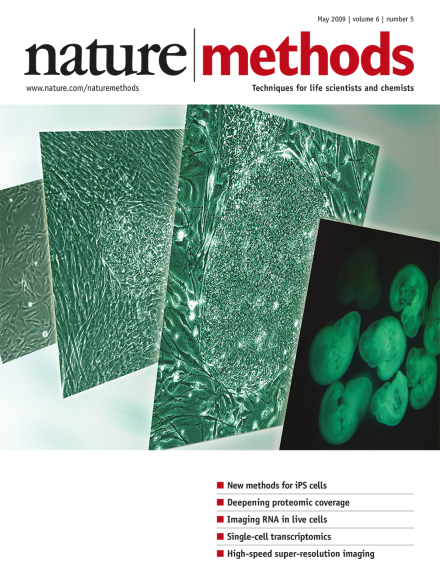
Table of contents
Editorial
Methods section remake - p313
doi:10.1038/nmeth0509-313
Nature Methods follows in the footsteps of Nature by ushering in an Online Methods section, fully integrated with the paper, for all original research articles.
Abstract - | Full Text - Methods section remake | PDF (88 KB) - Methods section remake
Correspondence
Massively parallel exon capture and library-free resequencing across 16 genomes - pp315 - 316
Emily H Turner, Choli Lee, Sarah B Ng, Deborah A Nickerson & Jay Shendure
doi:10.1038/nmeth.f.248
Full Text - Massively parallel exon capture and library-free resequencing across 16 genomes | PDF (657 KB) - Massively parallel exon capture and library-free resequencing across 16 genomes | Supplementary information
Lifeact cannot visualize some forms of stress-induced twisted f-actin - p317
Lise N Munsie, Nicholas Caron, Carly R Desmond & Ray Truant
doi:10.1038/nmeth0509-317
Full Text - Lifeact cannot visualize some forms of stress-induced twisted f-actin | PDF (757 KB) - Lifeact cannot visualize some forms of stress-induced twisted f-actin | Supplementary information
ADVERTISEMENT
Research Highlights
Dawn on the mice - p319
Wayne Peng
doi:10.1038/nmeth0509-319
By directly delivering light deep into the brain, scientists can now study the basis of neurological therapy and animal behavior.
Abstract - | Full Text - Dawn on the mice | PDF (577 KB) - Dawn on the mice
Capturing the human methylome - pp320 - 321
Nicole Rusk
doi:10.1038/nmeth0509-320a
Pairing bisulfite conversion of the human genome with targeted enrichment and high-throughput sequencing allows a quantitative assessment of DNA methylation at base-pair resolution.
Abstract - | Full Text - Capturing the human methylome | PDF (208 KB) - Capturing the human methylome
Sequence is not everything - pp320 - 321
Natalie de Souza
doi:10.1038/nmeth0509-320b
A new algorithm for identifying evolutionary constraint incorporates information on local DNA topology, and leads to the finding that this topology is conserved across species.
Abstract - | Full Text - Sequence is not everything | PDF (208 KB) - Sequence is not everything
News in brief - p321
doi:10.1038/nmeth0509-321
Supercharging through the cell membrane - p322
Allison Doerr
doi:10.1038/nmeth0509-322
Researchers show that superpositively charged GFP enters mammalian cells with ease and can be used as a nucleic acid delivery vehicle.
Abstract - | Full Text - Supercharging through the cell membrane | PDF (127 KB) - Supercharging through the cell membrane
A touching discovery - p324
Michael Eisenstein
doi:10.1038/nmeth0509-324
Fake fingertips provide insights into how fingerprints help humans to feel fine details of surface texture.
Abstract - | Full Text - A touching discovery | PDF (236 KB) - A touching discovery
Protein production: no cells required - p326
Allison Doerr
doi:10.1038/nmeth0509-326
DNA hydrogels improve the efficiency of cell-free protein production.
Abstract - | Full Text - Protein production: no cells required | PDF (121 KB) - Protein production: no cells required
News and Views
Without a trace? PiggyBac-ing toward pluripotency - pp329 - 330
Matthias Stadtfeld & Konrad Hochedlinger
doi:10.1038/nmeth0509-329
A transposon-based approach has been added to the growing arsenal of technologies to produce transgene-free and potentially safer induced pluripotent stem cells.
Abstract - | Full Text - Without a trace? PiggyBac-ing toward pluripotency | PDF (824 KB) - Without a trace? PiggyBac-ing toward pluripotency
See also: Article by Yusa et al.
Review
Imaging intracellular RNA distribution and dynamics in living cells - pp331 - 338
Sanjay Tyagi
doi:10.1038/nmeth.1321
Abstract - | Full Text - Imaging intracellular RNA distribution and dynamics in living cells | PDF (4,233 KB) - Imaging intracellular RNA distribution and dynamics in living cells
Brief Communications
Super-resolution video microscopy of live cells by structured illumination - pp339 - 342
Peter Kner, Bryant B Chhun, Eric R Griffis, Lukman Winoto & Mats G L Gustafsson
doi:10.1038/nmeth.1324
The use of a spatial light modulator for illuminating the sample in structured-illumination microscopy (SIM) increases imaging speed by three orders of magnitude. The resulting 100-nm resolution and 11-Hz frame rate allowed video imaging of tubulin polymerization and depolymerization as well as kinesin movement on microtubules.
Abstract - | Full Text - Super-resolution video microscopy of live cells by structured illumination | PDF (395 KB) - Super-resolution video microscopy of live cells by structured illumination | Supplementary information
Enzymatic assembly of DNA molecules up to several hundred kilobases - pp343 - 345
Daniel G Gibson, Lei Young, Ray-Yuan Chuang, J Craig Venter, Clyde A Hutchison III & Hamilton O Smith
doi:10.1038/nmeth.1318
The combination of 5' exonuclease, DNA polymerase and ligase with overlapping DNA fragments facilitates the in vitro assembly of large DNA constructs, including an entire bacterial genome.
Abstract - | Full Text - Enzymatic assembly of DNA molecules up to several hundred kilobases | PDF (220 KB) - Enzymatic assembly of DNA molecules up to several hundred kilobases | Supplementary information
Single molecule–sensitive probes for imaging RNA in live cells - pp347 - 349
Philip J Santangelo, Aaron W Lifland, Paul Curt, Yukio Sasaki, Gary J Bassell, Michael E Lindquist & James E Crowe Jr
doi:10.1038/nmeth.1316
Upon binding multiple fluorophores and being complexed into tetramers, these RNA imaging probes show high sensitivity and can detect single endogenous RNA molecules at low probe concentration.
Abstract - | Full Text - Single molecule–sensitive probes for imaging RNA in live cells | PDF (550 KB) - Single molecule–sensitive probes for imaging RNA in live cells | Supplementary information
An ultramarine fluorescent protein with increased photostability and pH insensitivity - pp351 - 353
Wataru Tomosugi, Tomoki Matsuda, Tomomi Tani, Tomomi Nemoto, Ippei Kotera, Kenta Saito, Kazuki Horikawa & Takeharu Nagai
doi:10.1038/nmeth.1317
A fluorescent protein, Sirius, with the most blue-shifted emission spectrum to date, is reported. Sirius allows extended multicolor imaging as well as imaging in acidic environments owing to its pH insensitivity.
Abstract - | Full Text - An ultramarine fluorescent protein with increased photostability and pH insensitivity | PDF (379 KB) - An ultramarine fluorescent protein with increased photostability and pH insensitivity | Supplementary information
Photoconversion in orange and red fluorescent proteins - pp355 - 358
Gert-Jan Kremers, Kristin L Hazelwood, Christopher S Murphy, Michael W Davidson & David W Piston
doi:10.1038/nmeth.1319
Several red and orange fluorescent proteins are reported to be photoconvertible. Specifically, three red fluorescent proteins that can be switched to green, and two orange fluorescent proteins that can be switched to far red are reported.
Abstract - | Full Text - Photoconversion in orange and red fluorescent proteins | PDF (373 KB) - Photoconversion in orange and red fluorescent proteins | Supplementary information
Universal sample preparation method for proteome analysis - pp359 - 362
Jacek R Wi
niewski,
Alexandre Zougman,
Nagarjuna Nagaraj
&
Matthias Mann
doi:10.1038/nmeth.1322
A method, filter-aided sample preparation (FASP) combines the advantages of in-gel and in-solution digestion for mass spectrometry–based proteomics, allowing deeper proteomic coverage in a shorter analysis time, using small sample amounts.
Abstract - | Full Text - Universal sample preparation method for proteome analysis | PDF (183 KB) - Universal sample preparation method for proteome analysis | Supplementary information
Articles
Generation of transgene-free induced pluripotent mouse stem cells by the piggyBac transposon - pp363 - 369
Kosuke Yusa, Roland Rad, Junji Takeda & Allan Bradley
doi:10.1038/nmeth.1323
piggyBac transposons carrying reprogramming factors are used to reprogram mouse embryonic fibroblasts, with efficiencies equivalent to retroviral transduction, and then removed from the induced pluripotent state cell genome without a trace.
Abstract - | Full Text - Generation of transgene-free induced pluripotent mouse stem cells by the piggyBac transposon | PDF (5,736 KB) - Generation of transgene-free induced pluripotent mouse stem cells by the piggyBac transposon | Supplementary information
Isolation of human iPS cells using EOS lentiviral vectors to select for pluripotency - pp370 - 376
Akitsu Hotta, Aaron Y L Cheung, Natalie Farra, Kausalia Vijayaragavan, Cheryle A Séguin, Jonathan S Draper, Peter Pasceri, Irina A Maksakova, Dixie L Mager, Janet Rossant, Mickie Bhatia & James Ellis
doi:10.1038/nmeth.1325
Lentiviral vectors that express a fluorescent reporter and a selectable marker in pluripotent cells improve and simplify isolation of induced pluripotent stem cell lines in mouse and human.
Abstract - | Full Text - Isolation of human iPS cells using EOS lentiviral vectors to select for pluripotency | PDF (1,293 KB) - Isolation of human iPS cells using EOS lentiviral vectors to select for pluripotency | Supplementary information
mRNA-Seq whole-transcriptome analysis of a single cell - pp377 - 382
Fuchou Tang, Catalin Barbacioru, Yangzhou Wang, Ellen Nordman, Clarence Lee, Nanlan Xu, Xiaohui Wang, John Bodeau, Brian B Tuch, Asim Siddiqui, Kaiqin Lao & M Azim Surani
doi:10.1038/nmeth.1315
Previous whole-transcriptome analysis by RNA-Seq required hundreds of thousands of cells or microgram amounts of RNA. A modification of the cDNA library preparation method now allows unbiased capture of the majority of genes expressed in a single blastomere and oocyte. cDNA sequencing on the SOLiD platform facilitates the quantitative analysis of the transcriptome complexity in a single cell.
Abstract - | Full Text - mRNA-Seq whole-transcriptome analysis of a single cell | PDF (465 KB) - mRNA-Seq whole-transcriptome analysis of a single cell | Supplementary information
Combined atomic force microscopy and side-view optical imaging for mechanical studies of cells - pp383 - 387
Ovijit Chaudhuri, Sapun H Parekh, Wilbur A Lam & Daniel A Fletcher
doi:10.1038/nmeth.1320
An atomic force microscope with a side-view fluorescent imaging path facilitates the direct correlation of mechanical force measurements with observations of changes in cell shape and cytoskeleton rearrangements resulting from the applied forces or during active generation of forces by the cell. The combined instrument could help lead to insights in understanding cell mechanics, contractility and cell-cell adhesion.
Abstract - | Full Text - Combined atomic force microscopy and side-view optical imaging for mechanical studies of cells | PDF (328 KB) - Combined atomic force microscopy and side-view optical imaging for mechanical studies of cells | Supplementary information
ADVERTISEMENT
Technology Feature
Proteins and proteomics: life on the surface - pp389 - 393
Nathan Blow
doi:10.1038/nmeth0509-389
Surface plasmon resonance sensing has entered the next phase of development as researchers advance array-based applications using the technique. Could these new approaches change the way scientists explore protein interactions?
Abstract - | Full Text - Proteins and proteomics: life on the surface | PDF (2,022 KB) - Proteins and proteomics: life on the surface
Application Notes
Enhanced red and far-red fluorescent proteins for in vivo imaging
Ilya Kelmanson
Abstract - | Full Text - Enhanced red and far-red fluorescent proteins for in vivo imaging | PDF (1,232 KB) - Enhanced red and far-red fluorescent proteins for in vivo imaging
Accelerating searches of research grants and scientific literature with novo|seekSM
Ramón Alonso Allende
Abstract - | Full Text - Accelerating searches of research grants and scientific literature with novo|seekSM | PDF (688 KB) - Accelerating searches of research grants and scientific literature with novo|seekSM