Table of contents


Top

Editorial

Vaccines versus viruses p119

doi:10.1038/nm0209-119

Influenza virus vaccination for young children living in the US state of New Jersey and who are attending preschool is now compulsory—a mandate that has highlighted a flourishing public mistrust of vaccines.


Top

News

Canadian research infrastructure receives support, but will it last? p121

Hannah Hoag

doi:10.1038/nm0209-121


Mouse study prompts experts to revisit the promise of leptin p122

Nayanah Siva

doi:10.1038/nm0209-122a


Branded baubles to become history p122

Stu Hutson

doi:10.1038/nm0209-122b


Obama's science team choices bode well for research funding p123

Stu Hutson

doi:10.1038/nm0209-123a


HHMI's Med Into Grad Initiative expands p123

Stu Hutson

doi:10.1038/nm0209-123b


News in brief pp124 - 125

doi:10.1038/nm0209-124


A preemptive strike against HIV pp126 - 129

Cassandra Willyard

doi:10.1038/nm0209-126

Researchers are enrolling thousands of participants around the world in clinical trials in a massive effort to test whether a once-daily pill can prevent HIV. Cassandra Willyard explores why they are optimistic the strategy will work and why it might be difficult to implement.


Straight talk with...Michel Sidibé pp130 - 131

Prashant Nair

doi:10.1038/nm0209-130

Last month, Michel Sidibé assumed his new role as executive director of UNAIDS, the United Nations agency created more than a decade ago to foster global leadership in the response to the AIDS pandemic. Sidibé discussed his new goals as executive director of UNAIDS with Prashant Nair.


Clues emerge about benefits of briefly blocking blood flow p132

Genevive Bjorn

doi:10.1038/nm0209-132


Top

Correspondence

Is the LPS-mediated proteinuria mouse model relevant to human kidney disease? p133

Wayne D Comper

doi:10.1038/nm0209-133a


Is the LPS-mediated proteinuria mouse model relevant to human kidney disease? pp133 - 134

Jochen Reiser & Peter Mundel

doi:10.1038/nm0209-133b


Disease mongering is a myth p134

John L LaMattina

doi:10.1038/nm0209-134


Top

Book Review

Praying to the power of P p135

Jessica S Ancker reviews The Cult of Statistical Significance: How the Standard Error Costs Us Jobs, Justice, and Lives by Stephen T. Ziliak & Deirdre N. McCloskey

doi:10.1038/nm0209-135


Top

News and Views

Torturing a blood vessel pp137 - 138

Cam Patterson

doi:10.1038/nm0209-137

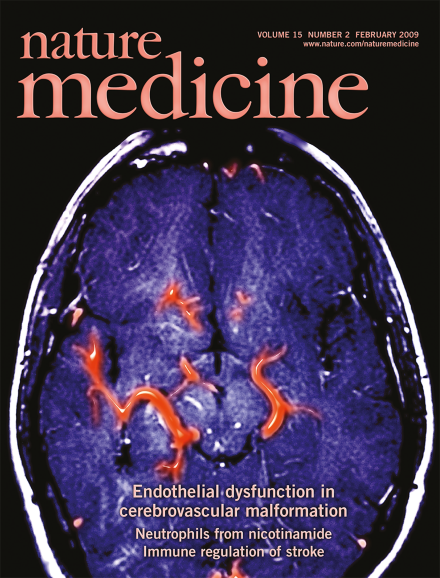
Experiments in mice and zebrafish uncover a pathway behind malformed blood vessels in the brain (pages 169–176 & 177–184). The findings provide a basis for understanding the development of cerebral vascular malformations, a common and deadly condition.

See also: Article by Kleaveland et al. | Article by Whitehead et al.


Regulatory T cells protect the brain after stroke pp138 - 139

Anna M Planas & Angel Chamorro

doi:10.1038/nm0209-138

The inflammatory response goes haywire after stroke, and the brain floods with immune mediators that can injure tissue and worsen outcome. Experiments in mice suggest that regulatory T cells help contain the damage (pages 192–199).

See also: Article by Liesz et al.


Vitamin B3 boosts neutrophil counts pp139 - 141

Arati Khanna-Gupta & Nancy Berliner

doi:10.1038/nm0209-139

A molecular pathway requiring vitamin B3 increases the production of neutrophils (pages 151–158). These findings could lead to new ways to treat neutropenias, diseases involving low neutrophil counts.

See also: Article by Skokowa et al.


Top

Community Corner

Cytokine's role in autoimmune melee probed p143

doi:10.1038/nm0209-143


Top

Between Bedside and Bench

Breaking into bone biology: target practice pp144 - 145

Yongwon Choi, Matthew C Walsh & Joseph R Arron

doi:10.1038/nm0209-144

Osteoporosis researchers do not suffer from a lack of potential drug targets—so one challenge is to decide which ones to focus on. Yongwon Choi, Matthew C. Walsh and Joseph R. Arron now examine several molecules involved in bone biology and assess their prospects. In a second commentary, Cliff Rosen analyzes findings that serotonin, derived from the gut, regulates bone formation. The findings not only could lead to new drug targets, they also could help explain clinical data that serotonin reuptake inhibitors—widely prescribed as antidepressants—weaken bones.


Breaking into bone biology: serotonin's secrets pp145 - 146

Clifford J Rosen

doi:10.1038/nm0209-145


Top

Research Highlights

Research Highlights pp148 - 149

doi:10.1038/nm0209-148


Top

Articles

NAMPT is essential for the G-CSF–induced myeloid differentiation via a NAD+–sirtuin-1–dependent pathway pp151 - 158

Julia Skokowa, Dan Lan, Basant Kumar Thakur, Fei Wang, Kshama Gupta, Gunnar Cario, Annette Müller Brechlin, Axel Schambach, Lars Hinrichsen, Gustav Meyer, Matthias Gaestel, Martin Stanulla, Qiang Tong & Karl Welte

doi:10.1038/nm.1913

In this report, Skokowa et al. delineate a new molecular pathway by which synthesis of the metabolite NAD+ through the action of the enzyme NAMPT promotes myeloid cell differentiation. The potential clinical relevance of this pathway was demonstrated by showing that administration of vitamin B3, a precursor to NAD+, increases neutrophil counts in healthy individuals, and that defective myeloid cell differentiation in individuals with congenital neutropenia can be rescued in vitro by administration of NAMPT.


AdPLA ablation increases lipolysis and prevents obesity induced by high-fat feeding or leptin deficiency pp159 - 168

Kathy Jaworski, Maryam Ahmadian, Robin E Duncan, Eszter Sarkadi-Nagy, Krista A Varady, Marc K Hellerstein, Hui-Young Lee, Varman T Samuel, Gerald I Shulman, Kee-Hong Kim, Sarah de Val, Chulho Kang & Hei Sook Sul

doi:10.1038/nm.1904

A main function of fat cells is to store fuel for future use, which is released when the fat is broken down in a process called lipolysis. Here Hei Sook Sul and colleagues describe a new enzyme in fat, AdPLA, that inhibits lipolysis and shows that genetic deletion results in protection from obesity in two mouse models.


Regulation of cardiovascular development and integrity by the heart of glass–cerebral cavernous malformation protein pathway pp169 - 176

Benjamin Kleaveland, Xiangjian Zheng, Jian J Liu, Yannick Blum, Jennifer J Tung, Zhiying Zou, Shawn M Sweeney, Mei Chen, Lili Guo, Min-min Lu, Diane Zhou, Jan Kitajewski, Markus Affolter, Mark H Ginsberg & Mark L Kahn

doi:10.1038/nm.1918

Cerebral cavernous malformation (CCM) is a life-threatening disorder in which blood vessels in the brain dilate and frequently hemorrhage. Benjamin Kleaveland et al. now provide evidence that CCM arises from defects in a signaling pathway involving the KRIT1 and CCM2 intracellular proteins (which have been previously implicated in CCM) and the HEG1 receptor; this pathway acts in endothelial cells and is required for vascular integrity. The role of the CCM2 protein in the endothelium is also explored in another paper published in this issue of Nature Medicine, by Kevin Whitehead et al.


The cerebral cavernous malformation signaling pathway promotes vascular integrity via Rho GTPases pp177 - 184

Kevin J Whitehead, Aubrey C Chan, Sutip Navankasattusas, Wonshill Koh, Nyall R London, Jing Ling, Anne H Mayo, Stavros G Drakos, Douglas A Marchuk, George E Davis & Dean Y Li

doi:10.1038/nm.1911

Cerebral cavernous malformation (CCM) is a life-threatening disorder in which blood vessels in the brain are prone to hemorrhage. Kevin Whitehead et al. now show that CCM2, mutations in which are associated with CCM, is needed for specific aspects of endothelial cell function involving RhoA GTPase. These defects can be partially restored by statin treatment, suggesting a potential therapeutic intervention for individuals with CCM. The role of CCM2 in the endothelium is also explored in another paper published in this issue of Nature Medicine, by Benjamin Kleaveland et al


De novo expression of Trpm4 initiates secondary hemorrhage in spinal cord injury pp185 - 191

Volodymyr Gerzanich, S Kyoon Woo, Rudi Vennekens, Orest Tsymbalyuk, Svetlana Ivanova, Alexander Ivanov, Zhihua Geng, Zheng Chen, Bernd Nilius, Veit Flockerzi, Marc Freichel & J Marc Simard

doi:10.1038/nm.1899

After injury to the spinal cord, hemorrhages occur both near and far from the initial lesion. J. Marc Simard and his colleagues demonstrate that spinal cord injury induces expression of the channel Trpm4 on endothelial cells in the spinal cord, which leads to their fragmentation and the spread of the hemorrhage.


Regulatory T cells are key cerebroprotective immunomodulators in acute experimental stroke pp192 - 199

Arthur Liesz, Elisabeth Suri-Payer, Claudia Veltkamp, Henrike Doerr, Clemens Sommer, Serge Rivest, Thomas Giese & Roland Veltkamp

doi:10.1038/nm.1927

Inflammation plays a detrimental role in ischemic stroke. Now, Roland Veltkamp and his colleagues show that endogenous immunomodulatory T regulatory cells play a key part to dampen inflammation after stroke.


Top

Letters

Loss of ETHE1, a mitochondrial dioxygenase, causes fatal sulfide toxicity in ethylmalonic encephalopathy pp200 - 205

Valeria Tiranti, Carlo Viscomi, Tatjana Hildebrandt, Ivano Di Meo, Rossana Mineri, Cecilia Tiveron, Michael D Levitt, Alessandro Prelle, Gigliola Fagiolari, Marco Rimoldi & Massimo Zeviani

doi:10.1038/nm.1907

Ethylmalonic encephalopathy is an autosomal recessive developmental disorder that is characterized by chronic diarrhea and multiple neurological deficits. It is associated with loss-of-function mutations in the ETHE1 gene. Now, Massimo Zeviani and his colleagues report that ETHE1 is a dioxygenase that is responsible for breaking down toxic sulfide in a variety of organs.


Intracellular NAD levels regulate tumor necrosis factor protein synthesis in a sirtuin-dependent manner pp206 - 210

Frédéric Van Gool, Mara Gallí, Cyril Gueydan, Véronique Kruys, Pierre-Paul Prevot, Antonio Bedalov, Raul Mostoslavsky, Frederick W Alt, Thibaut De Smedt & Oberdan Leo

doi:10.1038/nm.1906

TNF is a key pathogenic cytokine in sepsis. Oberdan Leo and colleagues show that production of TNF during sepsis is regulated by the coenzyme NAD and that inhibition of the enzyme NAMPT, which generates NAD from nicotinamide, can improve survival during sepsis in mice. NAD seems to act via sirtuin-6 to increase the translation of TNF.


A replication clock for Mycobacterium tuberculosis pp211 - 214

Wendy P Gill, Nada S Harik, Molly R Whiddon, Reiling P Liao, John E Mittler & David R Sherman

doi:10.1038/nm.1915

Does Mycobacterium tuberculosis replicate in vivo, or does it persist in the host in a nonreplicating latent state? David Sherman and his colleagues have developed a technique to answer this question in mice and find that the mycobacteria do replicate in vivo. It is unknown whether these findings will hold true in other animals, particularly nonhuman primates, but this technique could be applied to study the in vivo replication of other persistent pathogens responsible for chronic infections.


Top

Technical Report

In situ genetic analysis of cellular chimerism pp215 - 219

David Wu, Quynh Vu, Anhthu Nguyen, James R Stone, Hannah Stubbs, Georgiana Kuhlmann, Lynette M Sholl & A John Iafrate

doi:10.1038/nm.1862

By capitalizing on copy number variation, Wu and his colleagues offer an approach for detecting cellular chimerism with fluorescent in situ hybridization probes that target polymorphic deletion loci. These probes can determine the fate of donor cells in situ, irrespective of gender, and should prove useful in understanding the dynamics of cellular chimerism after solid organ, bone marrow and hematopoietic stem cell transplantation.


Top

Errata

Erratum: A stroma-related gene signature predicts resistance to neoadjuvant chemotherapy in breast cancer p220

Pierre Farmer, Hervé Bonnefoi, Pascale Anderle, David Cameron, Pratyaksha Wirapati, Véronique Becette, Sylvie André, Martine Piccart, Mario Campone, Etienne Brain, Gaëtan MacGrogan, Thierry Petit, Jacek Jassem, Frédéric Bibeau, Emmanuel Blot, Jan Bogaerts, Michel Aguet, Jonas Bergh, Richard Iggo & Mauro Delorenzi

doi:10.1038/nm0209-220a


Erratum: Loss of ETHE1, a mitochondrial dioxygenase, causes fatal sulfide toxicity in ethylmalonic encephalopathy p220

Valeria Tiranti, Carlo Viscomi, Tatjana Hildebrandt, Ivano Di Meo, Rossana Mineri, Cecilia Tiveron, Michael D Levitt, Alessandro Prelle, Gigliola Fagiolari, Marco Rimoldi & Massimo Zeviani

doi:10.1038/nm0209-220b


Top

Corrigendum

Corrigendum: Rescuing a failing heart: putting on the squeeze p220

David A Kass

doi:10.1038/nm0209-220c


Top

Extra navigation

Subscribe to Nature Medicine

Subscribe

Open Innovation Challenges

ADVERTISEMENT