Table of contents
December 2008, Volume 9 No 12 pp1317-1432
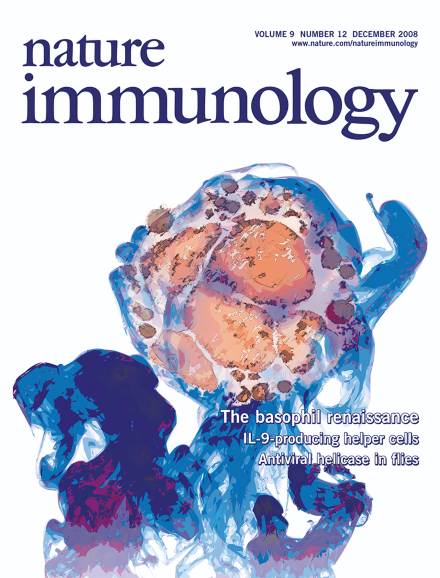
About the coverEditorial
A case of junk science, conflict and hype - p1317
doi:10.1038/ni1208-1317
Despite accumulating evidence that vaccines are safe, vaccination uptake is falling, driving a resurgence in old scourges of society.
Full Text - A case of junk science, conflict and hype | PDF (188 KB) - A case of junk science, conflict and hype
Commentary
Immunology in India: an emerging story - pp1319 - 1322
Kanury V S Rao
doi:10.1038/ni1208-1319
Although immunological research is of only recent origin in India, it is nevertheless rapidly becoming an area of choice for young researchers in this country.
Full Text - Immunology in India: an emerging story | PDF (424 KB) - Immunology in India: an emerging story
News and Views
Alternative lifestyles of T cells - pp1323 - 1325
Cristina M Tato & Daniel J Cua
doi:10.1038/ni1208-1323
T cells are intrinsically more malleable than previously thought. Two studies now show that existing T helper type 2 cells can be converted into alternative CD4+ T helper cells that coexpress interleukins 9 and 10.
Full Text - Alternative lifestyles of T cells | PDF (284 KB) - Alternative lifestyles of T cells
See also: Article by Veldhoen et al. | Article by Dardalhon et al.
Self-termination of the terminator - pp1325 - 1327
David Wallach & Andrew Kovalenko
doi:10.1038/ni1208-1325
The protein kinase NIK is regulated by a complex of ubiquitin ligases that destroys it. When NIK-activating receptors are triggered, the ubiquitin ligase complex self-destructs.
Full Text - Self-termination of the terminator | PDF (1,516 KB) - Self-termination of the terminator
See also: Article by Vallabhapurapu et al. | Article by Zarnegar et al.
RIG-I-like antiviral protein in flies - pp1327 - 1328
Osamu Takeuchi & Shizuo Akira
doi:10.1038/ni1208-1327
The function of gene expression in the response of drosophila to viral infection is poorly understood. A report now demonstrates that the helicase Dicer-2 controls antiviral gene expression in addition to RNA interference–mediated gene silencing.
Full Text - RIG-I-like antiviral protein in flies | PDF (223 KB) - RIG-I-like antiviral protein in flies
See also: Article by Deddouche et al.
Nervous about immunity: neuronal signals control innate immune system - pp1329 - 1330
Cheng-Yuan Kao, Ferdinand C O Los & Raffi V Aroian
doi:10.1038/ni1208-1329
The molecular mechanisms by which the nervous system influences innate immunity to pathogens remain mysterious. Two new studies show that neuronal products modulate established innate immune signaling pathways operative in the Caenorhabditis elegans intestine.
Full Text - Nervous about immunity: neuronal signals control innate immune system | PDF (459 KB) - Nervous about immunity: neuronal signals control innate immune system
See also: Article by Kawli & Tan
Research Highlights - p1331
doi:10.1038/ni1208-1331
Full Text - Research Highlights | PDF (117 KB) - Research Highlights
Review
Basophils: what they 'can do' versus what they 'actually do' - pp1333 - 1339
Booki Min
doi:10.1038/ni.f.217
Abstract - | Full Text - Basophils: what they 'can do' versus what they 'actually do' | PDF (797 KB) - Basophils: what they 'can do' versus what they 'actually do'
Articles
Transforming growth factor-
'reprograms' the differentiation of T helper 2 cells and promotes an interleukin 9–producing subset - pp1341 - 1346
Marc Veldhoen, Catherine Uyttenhove, Jacques van Snick, Helena Helmby, Astrid Westendorf, Jan Buer, Bruno Martin, Christoph Wilhelm & Brigitta Stockinger
doi:10.1038/ni.1659
TGF-
promotes the differentiation of TH-17 and regulatory T cells. Stockinger and colleagues show that TGF-
also directs differentiation of a unique interleukin 9–producing T cell subset.
Abstract - | Full Text - Transforming growth factor-
'reprograms' the differentiation of T helper 2 cells and promotes an interleukin 9–producing subset | PDF (491 KB) - Transforming growth factor-
'reprograms' the differentiation of T helper 2 cells and promotes an interleukin 9–producing subset | Supplementary information
See also: News and Views by Tato & Cua | Article by Dardalhon et al.
IL-4 inhibits TGF-
-induced Foxp3+ T cells and, together with TGF-
, generates IL-9+ IL-10+ Foxp3- effector T cells - pp1347 - 1355
Valérie Dardalhon, Amit Awasthi, Hyoung Kwon, George Galileos, Wenda Gao, Raymond A Sobel, Meike Mitsdoerffer, Terry B Strom, Wassim Elyaman, I-Cheng Ho, Samia Khoury, Mohamed Oukka & Vijay K Kuchroo
doi:10.1038/ni.1677
Foxp3 is required for the generation and function of regulatory T cells. Kuchroo and colleagues find that interleukin 4 blocks the generation of these cells but promotes T helper cells that produce interleukins 9 and 10.
Abstract - | Full Text - IL-4 inhibits TGF-
-induced Foxp3+ T cells and, together with TGF-
, generates IL-9+ IL-10+ Foxp3- effector T cells | PDF (704 KB) - IL-4 inhibits TGF-
-induced Foxp3+ T cells and, together with TGF-
, generates IL-9+ IL-10+ Foxp3- effector T cells | Supplementary information
See also: News and Views by Tato & Cua | Article by Veldhoen et al.
Nedd4 augments the adaptive immune response by promoting ubiquitin-mediated degradation of Cbl-b in activated T cells - pp1356 - 1363
Baoli Yang, Denise L Gay, Megan K L MacLeod, Xiao Cao, Tamara Hala, Eileen M Sweezer, John Kappler, Philippa Marrack & Paula M Oliver
doi:10.1038/ni.1670
The E3 ubiquitin ligases Itch and Nedd4 target similar proteins in vitro. Oliver and colleagues find that unlike hyper-responsive Itch-mutant T cells, Nedd4-deficient T cells are hyporesponsive and contain excess Cbl-b.
Abstract - | Full Text - Nedd4 augments the adaptive immune response by promoting ubiquitin-mediated degradation of Cbl-b in activated T cells | PDF (713 KB) - Nedd4 augments the adaptive immune response by promoting ubiquitin-mediated degradation of Cbl-b in activated T cells | Supplementary information
Nonredundant and complementary functions of TRAF2 and TRAF3 in a ubiquitination cascade that activates NIK-dependent alternative NF-
B signaling - pp1364 - 1370
Sivakumar Vallabhapurapu, Atsushi Matsuzawa, WeiZhou Zhang, Ping-Hui Tseng, Jonathan J Keats, Haopeng Wang, Dario A A Vignali, P Leif Bergsagel & Michael Karin
doi:10.1038/ni.1678
Suppression of the kinase NIK prevents NF-
B signaling. The Cheng and Karin labs demonstrate that adaptor proteins TRAF2 and TRAF3 and ubiquitin ligases cIAP1 and cIAP2 regulate NIK degradation.
Abstract - | Full Text - Nonredundant and complementary functions of TRAF2 and TRAF3 in a ubiquitination cascade that activates NIK-dependent alternative NF-
B signaling | PDF (573 KB) - Nonredundant and complementary functions of TRAF2 and TRAF3 in a ubiquitination cascade that activates NIK-dependent alternative NF-
B signaling | Supplementary information
See also: News and Views by Wallach & Kovalenko | Article by Zarnegar et al.
Noncanonical NF-
B activation requires coordinated assembly of a regulatory complex of the adaptors cIAP1, cIAP2, TRAF2 and TRAF3 and the kinase NIK - pp1371 - 1378
Brian J Zarnegar, Yaya Wang, Douglas J Mahoney, Paul W Dempsey, Herman H Cheung, Jeannie He, Travis Shiba, Xiaolu Yang, Wen-chen Yeh, Tak W Mak, Robert G Korneluk & Genhong Cheng
doi:10.1038/ni.1676
Suppression of the kinase NIK prevents NF-
B signaling. The Cheng and Karin labs demonstrate that adaptor proteins TRAF2 and TRAF3 and ubiquitin ligases cIAP1 and cIAP2 regulate NIK degradation.
Abstract - | Full Text - Noncanonical NF-
B activation requires coordinated assembly of a regulatory complex of the adaptors cIAP1, cIAP2, TRAF2 and TRAF3 and the kinase NIK | PDF (604 KB) - Noncanonical NF-
B activation requires coordinated assembly of a regulatory complex of the adaptors cIAP1, cIAP2, TRAF2 and TRAF3 and the kinase NIK | Supplementary information
See also: News and Views by Wallach & Kovalenko | Article by Vallabhapurapu et al.
Tonic B cell antigen receptor signals supply an NF-
B substrate for prosurvival BLyS signaling - pp1379 - 1387
Jason E Stadanlick, Mary Kaileh, Fredrick G Karnell, Jean L Scholz, Juli P Miller, William J Quinn III, Randall J Brezski, Laura S Treml, Kimberly A Jordan, John G Monroe, Ranjan Sen & Michael P Cancro
doi:10.1038/ni.1666
Mature B cell survival requires signals from the BCR and from the BLyS receptor BR3. Michael Cancro and colleagues demonstrate crosstalk between these pathways, as BCR signals supply a substrate needed for BR3 signal transmission.
Abstract - | Full Text - Tonic B cell antigen receptor signals supply an NF-
B substrate for prosurvival BLyS signaling | PDF (735 KB) - Tonic B cell antigen receptor signals supply an NF-
B substrate for prosurvival BLyS signaling | Supplementary information
Distinct functions for the transcription factor Foxo1 at various stages of B cell differentiation - pp1388 - 1398
Hart S Dengler, Gisele V Baracho, Sidne A Omori, Shane Bruckner, Karen C Arden, Diego H Castrillon, Ronald A DePinho & Robert C Rickert
doi:10.1038/ni.1667
Foxo transcription factors are linked to complex regulatory circuits governed by the availability of phosphatidylinositol-3,4,5-trisphosphate. Rickert and colleagues show that Foxo1 has nonredundant functions at many stages of B cell development.
Abstract - | Full Text - Distinct functions for the transcription factor Foxo1 at various stages of B cell differentiation | PDF (1,360 KB) - Distinct functions for the transcription factor Foxo1 at various stages of B cell differentiation | Supplementary information
Toll-like receptor–induced arginase 1 in macrophages thwarts effective immunity against intracellular pathogens - pp1399 - 1406
Karim C El Kasmi, Joseph E Qualls, John T Pesce, Amber M Smith, Robert W Thompson, Marcela Henao-Tamayo, Randall J Basaraba, Till König, Ulrike Schleicher, Mi-Sun Koo, Gilla Kaplan, Katherine A Fitzgerald, Elaine I Tuomanen, Ian M Orme, Thirumala-Devi Kanneganti, Christian Bogdan, Thomas A Wynn & Peter J Murray
doi:10.1038/ni.1671
Classically activated macrophages are targets of intracellular bacteria such as Mycobacteria tuberculosis. Murray and colleagues find that such pathogens induce arginase 1 in these macrophages to block the production of antibacterial nitric oxide.
Abstract - | Full Text - Toll-like receptor–induced arginase 1 in macrophages thwarts effective immunity against intracellular pathogens | PDF (904 KB) - Toll-like receptor–induced arginase 1 in macrophages thwarts effective immunity against intracellular pathogens | Supplementary information
Proteolytic cleavage in an endolysosomal compartment is required for activation of Toll-like receptor 9 - pp1407 - 1414
Boyoun Park, Melanie M Brinkmann, Eric Spooner, Clarissa C Lee, You-Me Kim & Hidde L Ploegh
doi:10.1038/ni.1669
TLR9 binds unmethylated CpG DNA and sends signals from endolysosomes. Ploegh and colloeagues find that cleavage mediated by endolysosomal cathepsins is required for TLR9 activation.
Abstract - | Full Text - Proteolytic cleavage in an endolysosomal compartment is required for activation of Toll-like receptor 9 | PDF (665 KB) - Proteolytic cleavage in an endolysosomal compartment is required for activation of Toll-like receptor 9 | Supplementary information
Neuroendocrine signals modulate the innate immunity of Caenorhabditis elegans through insulin signaling - pp1415 - 1424
Trupti Kawli & Man-Wah Tan
doi:10.1038/ni.1672
In a variety of organisms, signals from the nervous system influence adaptive immunity. Tan and Kawli now show the importance of neuroendocrine inputs in the innate immunity of Caenorhabditis elegans to bacterial pathogens.
Abstract - | Full Text - Neuroendocrine signals modulate the innate immunity of Caenorhabditis elegans through insulin signaling | PDF (1,053 KB) - Neuroendocrine signals modulate the innate immunity of Caenorhabditis elegans through insulin signaling | Supplementary information
See also: News and Views by Kao et al.
The DExD/H-box helicase Dicer-2 mediates the induction of antiviral activity in drosophila - pp1425 - 1432
Safia Deddouche, Nicolas Matt, Aidan Budd, Stefanie Mueller, Cordula Kemp, Delphine Galiana-Arnoux, Catherine Dostert, Christophe Antoniewski, Jules A Hoffmann & Jean-Luc Imler
doi:10.1038/ni.1664
Dicer proteins direct RNA-interference activities. Imler and colleagues show that Dicer-2 induces Vago-dependent antiviral response in flies and that Dicer proteins are related to RIG-I viral sensors.
Abstract - | Full Text - The DExD/H-box helicase Dicer-2 mediates the induction of antiviral activity in drosophila | PDF (678 KB) - The DExD/H-box helicase Dicer-2 mediates the induction of antiviral activity in drosophila | Supplementary information
See also: News and Views by Takeuchi & Akira