Table of contents
July 2009, Volume 10 No 7 pp667-793
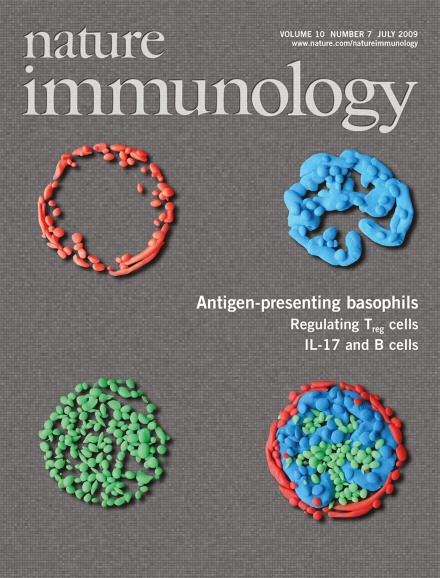
About the coverEditorial
Biotech bailout? - p667
doi:10.1038/ni0709-667
A rescue of some sort will be needed to save a large subset of the US biotechnology industry.
Full Text - Biotech bailout? | PDF (101 KB) - Biotech bailout?
Meeting Report
NKT cells turn ten - pp669 - 671
Peter D Burrows, Mitchell Kronenberg & Masaru Taniguchi
doi:10.1038/ni0709-669
It has been 10 years since the first workshop on natural killer T cells helped to launch a growth phase for this field of research.
Full Text - NKT cells turn ten | PDF (542 KB) - NKT cells turn ten
Commentary
NIAID workshop on immunity to malaria: addressing immunological challenges - pp673 - 678
Alison Deckhut Augustine, B Fenton Hall, Wolfgang W Leitner, Annie X Mo, Tonu M Wali & Anthony S Fauci
doi:10.1038/ni0709-673
The US National Institute of Allergy and Infectious Diseases convened a workshop of malaria investigators and immunologists to foster collaborations and attract more immunologists into malaria research. Discussions highlighted research gaps and underscored the incomplete understanding of basic immune mechanisms that contribute to the pathogenesis of or protection against malaria.
Full Text - NIAID workshop on immunity to malaria: addressing immunological challenges | PDF (751 KB) - NIAID workshop on immunity to malaria: addressing immunological challenges
News and Views
Basophils trump dendritic cells as APCs for TH2 responses - pp679 - 681
Thomas A Wynn
doi:10.1038/ni0709-679
Dendritic cells are best known as antigen-presenting cells that initiate adaptive immune responses. Three new papers suggest that basophils initiate allergen- and helminth-driven CD4+ T helper type 2 responses by functioning as antigen-presenting cells in draining lymph nodes.
Full Text - Basophils trump dendritic cells as APCs for TH2 responses | PDF (496 KB) - Basophils trump dendritic cells as APCs for TH2 responses
See also: Article by Perrigoue et al. | Article by Yoshimoto et al. | Article by Sokol et al.
CSF-1R, DAP12 and
-catenin: a ménage à trois - pp681 - 683
Daniel W McVicar & Giorgio Trinchieri
doi:10.1038/ni0709-681
DAP12-coupled receptors influence signals emanating from Toll-like receptors, integrins and receptors for cytokines and growth factors. New findings indicate that DAP12 also facilitates the ability of CSF-1R, the receptor for M-CSF, to induce the stabilization and nuclear translocation of
-catenin.
Full Text - CSF-1R, DAP12 and
-catenin: a ménage à trois | PDF (465 KB) - CSF-1R, DAP12 and
-catenin: a ménage à trois
See also: Article by Otero et al.
ASMase: the tailor of cytotoxic T cell granule exocytosis - pp683 - 685
Christian Bogdan
doi:10.1038/ni0709-683
Deficiency in acid sphingomyelinase causes lysosomal storage of sphingomyelin, mediates resistance to stress-induced apoptosis and alters susceptibility to certain infections. New work links acid sphingomyelinase to the granule exocytosis of cytotoxic T cells.
Full Text - ASMase: the tailor of cytotoxic T cell granule exocytosis | PDF (350 KB) - ASMase: the tailor of cytotoxic T cell granule exocytosis
See also: Article by Herz et al.
A novel modifier of regulatory T cells - pp685 - 686
Naganari Ohkura & Shimon Sakaguchi
doi:10.1038/ni0709-685
The receptor for the lipid mediator sphingosine 1-phosphate is critical for T cell trafficking. New data show that signaling mediated by this receptor critically controls the development, maintenance and suppressive activity of natural regulatory T cells that express the transcription factor Foxp3.
Full Text - A novel modifier of regulatory T cells | PDF (379 KB) - A novel modifier of regulatory T cells
See also: Article by Liu et al.
Research Highlights
Research Highlights - p687
doi:10.1038/ni0709-687
Full Text - Research Highlights | PDF (71 KB) - Research Highlights
Review
Foxp3+ regulatory T cells: differentiation, specification, subphenotypes - pp689 - 695
Markus Feuerer, Jonathan A Hill, Diane Mathis & Christophe Benoist
doi:10.1038/ni.1760
Abstract - | Full Text - Foxp3+ regulatory T cells: differentiation, specification, subphenotypes | PDF (587 KB) - Foxp3+ regulatory T cells: differentiation, specification, subphenotypes
Articles
MHC class II–dependent basophil–CD4+ T cell interactions promote TH2 cytokine–dependent immunity - pp697 - 705
Jacqueline G Perrigoue, Steven A Saenz, Mark C Siracusa, Eric J Allenspach, Betsy C Taylor, Paul R Giacomin, Meera G Nair, Yurong Du, Colby Zaph, Nico van Rooijen, Michael R Comeau, Edward J Pearce, Terri M Laufer & David Artis
doi:10.1038/ni.1740
Basophils act as effector cells in immunoglobulin E–mediated hypersensitivity responses. Artis, Nakanishi and Medzhitov and their colleagues report that basophils present antigen and induce T helper type 2 responses to helminths, allergens and immunoglobulin E immune complexes.
Abstract - | Full Text - MHC class II–dependent basophil–CD4+ T cell interactions promote TH2 cytokine–dependent immunity | PDF (728 KB) - MHC class II–dependent basophil–CD4+ T cell interactions promote TH2 cytokine–dependent immunity | Supplementary information
See also: News and Views by Wynn | Article by Yoshimoto et al. | Article by Sokol et al.
Basophils contribute to TH2-IgE responses in vivo via IL-4 production and presentation of peptide–MHC class II complexes to CD4+ T cells - pp706 - 712
Tomohiro Yoshimoto, Koubun Yasuda, Hidehisa Tanaka, Masakiyo Nakahira, Yasutomo Imai, Yoshihiro Fujimori & Kenji Nakanishi
doi:10.1038/ni.1737
Basophils act as effector cells in immunoglobulin E–mediated hypersensitivity responses. Artis, Nakanishi and Medzhitov and their colleagues report that basophils present antigen and induce T helper type 2 responses to helminths, allergens and immunoglobulin E immune complexes.
Abstract - | Full Text - Basophils contribute to TH2-IgE responses in vivo via IL-4 production and presentation of peptide–MHC class II complexes to CD4+ T cells | PDF (575 KB) - Basophils contribute to TH2-IgE responses in vivo via IL-4 production and presentation of peptide–MHC class II complexes to CD4+ T cells | Supplementary information
See also: News and Views by Wynn | Article by Perrigoue et al. | Article by Sokol et al.
Basophils function as antigen-presenting cells for an allergen-induced T helper type 2 response - pp713 - 720
Caroline L Sokol, Ngoc-Quynh Chu, Shuang Yu, Simone A Nish, Terri M Laufer & Ruslan Medzhitov
doi:10.1038/ni.1738
Basophils act as effector cells in immunoglobulin E–mediated hypersensitivity responses. Artis, Nakanishi and Medzhitov and their colleagues report that basophils present antigen and induce T helper type 2 responses to helminths, allergens and immunoglobulin E immune complexes.
Abstract - | Full Text - Basophils function as antigen-presenting cells for an allergen-induced T helper type 2 response | PDF (444 KB) - Basophils function as antigen-presenting cells for an allergen-induced T helper type 2 response | Supplementary information
See also: News and Views by Wynn | Article by Perrigoue et al. | Article by Yoshimoto et al.
Structural and functional implications of the alternative complement pathway C3 convertase stabilized by a staphylococcal inhibitor - pp721 - 727
Suzan H M Rooijakkers, Jin Wu, Maartje Ruyken, Robert van Domselaar, Karel L Planken, Apostolia Tzekou, Daniel Ricklin, John D Lambris, Bert J C Janssen, Jos A G van Strijp & Piet Gros
doi:10.1038/ni.1756
Complement forms an ancient innate immune defense. Gros and colleagues provide new insight into the interactions between complement convertase C3b and its regulator factor H and with the staphylococcal inhibitor SCIN.
Abstract - | Full Text - Structural and functional implications of the alternative complement pathway C3 convertase stabilized by a staphylococcal inhibitor | PDF (931 KB) - Structural and functional implications of the alternative complement pathway C3 convertase stabilized by a staphylococcal inhibitor | Supplementary information
Structure of complement fragment C3b–factor H and implications for host protection by complement regulators - pp728 - 733
Jin Wu, You-Qiang Wu, Daniel Ricklin, Bert J C Janssen, John D Lambris & Piet Gros
doi:10.1038/ni.1755
Complement forms an ancient innate immune defense. Gros and colleagues provide new insight into the interactions between complement convertase C3b and its regulator factor H and with the staphylococcal inhibitor SCIN.
Abstract - | Full Text - Structure of complement fragment C3b–factor H and implications for host protection by complement regulators | PDF (706 KB) - Structure of complement fragment C3b–factor H and implications for host protection by complement regulators | Supplementary information
Macrophage colony-stimulating factor induces the proliferation and survival of macrophages via a pathway involving DAP12 and
-catenin - pp734 - 743
Karel Otero, Isaiah R Turnbull, Pietro Luigi Poliani, William Vermi, Elisa Cerutti, Taiki Aoshi, Ilaria Tassi, Toshiyuki Takai, Samuel L Stanley, Mark Miller, Andrey S Shaw & Marco Colonna
doi:10.1038/ni.1744
Macrophage colony-stimulating factor (M-CSF) induces the proliferation of mononuclear phagocytes, and DAP12 is needed for their function. Colonna and colleagues show that DAP12 is also needed for M-CSF-induced stabilization of
-catenin.
Abstract - | Full Text - Macrophage colony-stimulating factor induces the proliferation and survival of macrophages via a pathway involving DAP12 and
-catenin | PDF (678 KB) - Macrophage colony-stimulating factor induces the proliferation and survival of macrophages via a pathway involving DAP12 and
-catenin | Supplementary information
See also: News and Views by McVicar & Trinchieri
The E3 ubiquitin ligase Nrdp1 'preferentially' promotes TLR-mediated production of type I interferon - pp744 - 752
Chen Wang, Taoyong Chen, Jia Zhang, Mingjin Yang, Nan Li, Xiongfei Xu & Xuetao Cao
doi:10.1038/ni.1742
E3 ubiquitin ligases are critical for innate and adaptive immunity. Cao and colleagues show that the E3 ubiquitin ligase Nrdp inhibits the production of proinflammatory cytokines while promoting the release of interferon-
in Toll-like receptor–triggered macrophages.
Abstract - | Full Text - The E3 ubiquitin ligase Nrdp1 'preferentially' promotes TLR-mediated production of type I interferon | PDF (665 KB) - The E3 ubiquitin ligase Nrdp1 'preferentially' promotes TLR-mediated production of type I interferon | Supplementary information
Immunological synapse formation inhibits, via NF-
B and FOXO1, the apoptosis of dendritic cells - pp753 - 760
Lorena Riol-Blanco, Cristina Delgado-Martín, Noelia Sánchez-Sánchez, Luis M Alonso-C, María Dolores Gutiérrez-López, Gloria Martínez del Hoyo, Joaquín Navarro, Francisco Sánchez-Madrid, Carlos Cabañas, Paloma Sánchez-Mateos & José Luis Rodríguez-Fernández
doi:10.1038/ni.1750
Immunological synapses (IS) involving surface receptors form between dendritic cells (DC) and T cells. Rodriguez-Fernandez and colleagues show that IS-induced signals activate Akt and NF-
B and suppress Foxo1 to promote DC survival.
Abstract - | Full Text - Immunological synapse formation inhibits, via NF-
B and FOXO1, the apoptosis of dendritic cells | PDF (678 KB) - Immunological synapse formation inhibits, via NF-
B and FOXO1, the apoptosis of dendritic cells | Supplementary information
Acid sphingomyelinase is a key regulator of cytotoxic granule secretion by primary T lymphocytes - pp761 - 768
Jasmin Herz, Julian Pardo, Hamid Kashkar, Michael Schramm, Elza Kuzmenkina, Erik Bos, Katja Wiegmann, Reinhard Wallich, Peter J Peters, Stefan Herzig, Elmon Schmelzer, Martin Krönke, Markus M Simon & Olaf Utermöhlen
doi:10.1038/ni.1757
Granules containing perforin and granzymes are secreted from cytotoxic T lymphocytes. Krönke and co-workers find that acid sphingomyelase is needed for granule shrinkage just before exocytosis in this process.
Abstract - | Full Text - Acid sphingomyelinase is a key regulator of cytotoxic granule secretion by primary T lymphocytes | PDF (680 KB) - Acid sphingomyelinase is a key regulator of cytotoxic granule secretion by primary T lymphocytes | Supplementary information
See also: News and Views by Bogdan
The receptor S1P1 overrides regulatory T cell–mediated immune suppression through Akt-mTOR - pp769 - 777
Guangwei Liu, Samir Burns, Gonghua Huang, Kelli Boyd, Richard L Proia, Richard A Flavell & Hongbo Chi
doi:10.1038/ni.1743
Regulatory T cells (Treg cells) are necessary for maintaining peripheral tolerance. Chi and colleagues show that the receptor S1P1 negatively regulates thymic Treg cell production and blocks Treg cell activity via an Akt-mTor pathway.
Abstract - | Full Text - The receptor S1P1 overrides regulatory T cell–mediated immune suppression through Akt-mTOR | PDF (976 KB) - The receptor S1P1 overrides regulatory T cell–mediated immune suppression through Akt-mTOR | Supplementary information
See also: News and Views by Ohkura & Sakaguchi
Interleukin 17 acts in synergy with B cell–activating factor to influence B cell biology and the pathophysiology of systemic lupus erythematosus - pp778 - 785
Agnès Doreau, Alexandre Belot, Jérémy Bastid, Benjamin Riche, Marie-Claude Trescol-Biemont, Bruno Ranchin, Nicole Fabien, Pierre Cochat, Claire Pouteil-Noble, Pierre Trolliet, Isabelle Durieu, Jacques Tebib, Berhouz Kassai, Stéphane Ansieau, Alain Puisieux, Jean-François Eliaou & Nathalie Bonnefoy-Bérard
doi:10.1038/ni.1741
How interleukin 17 influences B cell biology is unclear. Bonnefoy-Bérard and colleagues find that interleukin 17 alone or in combination with B cell–activating factor controls the survival, proliferation of human B cells and their differentiation into immunoglobulin-secreting cells.
Abstract - | Full Text - Interleukin 17 acts in synergy with B cell–activating factor to influence B cell biology and the pathophysiology of systemic lupus erythematosus | PDF (587 KB) - Interleukin 17 acts in synergy with B cell–activating factor to influence B cell biology and the pathophysiology of systemic lupus erythematosus | Supplementary information
Immune complex relay by subcapsular sinus macrophages and noncognate B cells drives antibody affinity maturation - pp786 - 793
Tri Giang Phan, Jesse A Green, Elizabeth E Gray, Ying Xu & Jason G Cyster
doi:10.1038/ni.1745
Immune complexes are captured from lymph by subcapsular macrophages. Cyster and colleagues show that an intricate relay shuttles antigen into germinal centers to drive affinity maturation.
Abstract - | Full Text - Immune complex relay by subcapsular sinus macrophages and noncognate B cells drives antibody affinity maturation | PDF (969 KB) - Immune complex relay by subcapsular sinus macrophages and noncognate B cells drives antibody affinity maturation | Supplementary information