Table of contents
March 2009, Volume 10 No 3 pp225-324
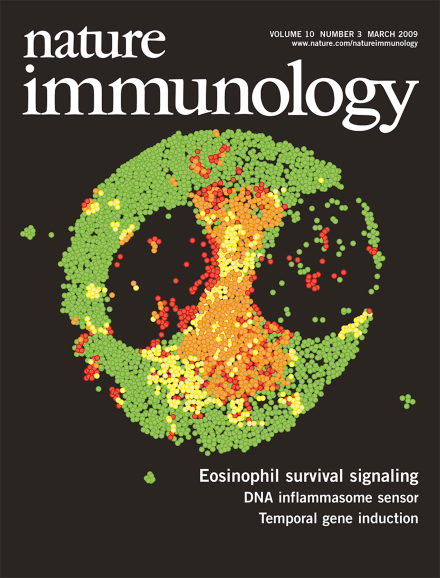
About the coverEditorial
Borrowing words, or claiming them? - p225
doi:10.1038/ni0309-225
Journals are taking steps to stem of the practice of plagiarism.
Full Text - Borrowing words, or claiming them? | PDF (192 KB) - Borrowing words, or claiming them?
Commentary
Revolving doors: from academia to industry and back again - pp227 - 229
Ross M Kedl
doi:10.1038/ni0309-227
Is it possible to return from the industrial sector back to academia? Although academic scientists have traditionally perceived this to be akin to winning the Nobel prize, the personal experience of Ross Kedl suggests that the reality is something quite different altogether.
Full Text - Revolving doors: from academia to industry and back again | PDF (308 KB) - Revolving doors: from academia to industry and back again
News and Views
Developing NKT cells need their calcium - pp231 - 233
Dale I Godfrey, Sanda Stankovic & Alan G Baxter
doi:10.1038/ni0309-231
Although the development of natural killer T cells is a T cell antigen receptor–dependent process, the signaling pathways involved are poorly defined. New data demonstrate that the calcineurin–transcription factor NFAT pathway exerts a critical influence on this process by controlling the transcription factor Egr2.
Full Text - Developing NKT cells need their calcium | PDF (419 KB) - Developing NKT cells need their calcium
See also: Article by Lazarevic et al.
Intrinsic mRNA stability helps compose the inflammatory symphony - pp233 - 234
Paul Anderson
doi:10.1038/ni0309-233
The intrinsic stability of mRNA is important in the regulation of gene expression. New data show that the intrinsic stability of tumor necrosis factor–induced mRNA transcripts strongly influences the coordinated expression of genes that promote distinct phases of the inflammatory response.
Full Text - Intrinsic mRNA stability helps compose the inflammatory symphony | PDF (276 KB) - Intrinsic mRNA stability helps compose the inflammatory symphony
See also: Article by Hao & Baltimore
Deciding the decider: Mef2c in hematopoiesis - pp235 - 236
Rachel M Gerstein
doi:10.1038/ni0309-235
Factors influencing progenitor cell 'choice' between lymphoid and myeloid lineage fates are incompletely understood. New work implicates the transcription factor Mef2c as one component needed to promote lymphoid and suppress myeloid lineage differentiation.
Full Text - Deciding the decider: Mef2c in hematopoiesis | PDF (224 KB) - Deciding the decider: Mef2c in hematopoiesis
See also: Article by Stehling-Sun et al.
Don't leave home without it: the IL-23 visa to TH-17 cells - pp236 - 238
Yeonseok Chung & Chen Dong
doi:10.1038/ni0309-236
Interleukin 23 is tightly associated with TH-17 cell–mediated inflammation and autoimmunity. A new study of mice deficient in its receptor shows that interleukin 23 is required for the terminal differentiation of TH-17 cells in vivo.
Full Text - Don't leave home without it: the IL-23 visa to TH-17 cells | PDF (378 KB) - Don't leave home without it: the IL-23 visa to TH-17 cells
See also: Article by McGeachy et al.
Research Highlights
Research Highlights - p239
doi:10.1038/ni0309-239
Full Text - Research Highlights | PDF (115 KB) - Research Highlights
Review
The inflammasome: a caspase-1-activation platform that regulates immune responses and disease pathogenesis - pp241 - 247
Luigi Franchi, Tatjana Eigenbrod, Raúl Muñoz-Planillo & Gabriel Nuñez
doi:10.1038/ni.1703
Abstract - | Full Text - The inflammasome: a caspase-1-activation platform that regulates immune responses and disease pathogenesis | PDF (449 KB) - The inflammasome: a caspase-1-activation platform that regulates immune responses and disease pathogenesis
Articles
Neuroimmune regulation of antimicrobial peptide expression by a noncanonical TGF-
signaling pathway in Caenorhabditis elegans epidermis - pp249 - 256
Olivier Zugasti & Jonathan J Ewbank
doi:10.1038/ni.1700
In worms, antimicrobial peptides contribute to the defense against pathogen infection. Ewbank and colleagues describe a noncanonical signaling pathway required for the induction of one particular family of antimicrobial peptides.
Abstract - | Full Text - Neuroimmune regulation of antimicrobial peptide expression by a noncanonical TGF-
signaling pathway in Caenorhabditis elegans epidermis | PDF (557 KB) - Neuroimmune regulation of antimicrobial peptide expression by a noncanonical TGF-
signaling pathway in Caenorhabditis elegans epidermis | Supplementary information
The peptidyl-prolyl isomerase Pin1 facilitates cytokine-induced survival of eosinophils by suppressing Bax activation - pp257 - 265
Zhong-Jian Shen, Stephane Esnault, Anna Schinzel, Christoph Borner & James S Malter
doi:10.1038/ni.1697
The mechanism by which cytokines suppress Bax activation and eosinophil apoptosis are not well understood. Malter and colleagues pinpoint a function for the peptidyl-prolyl isomerase Pin1 in mediating cytokine-induced suppression of Bax activation.
Abstract - | Full Text - The peptidyl-prolyl isomerase Pin1 facilitates cytokine-induced survival of eosinophils by suppressing Bax activation | PDF (687 KB) - The peptidyl-prolyl isomerase Pin1 facilitates cytokine-induced survival of eosinophils by suppressing Bax activation | Supplementary information
An orthogonal proteomic-genomic screen identifies AIM2 as a cytoplasmic DNA sensor for the inflammasome - pp266 - 272
Tilmann Bürckstümmer, Christoph Baumann, Stephan Blüml, Evelyn Dixit, Gerhard Dürnberger, Hannah Jahn, Melanie Planyavsky, Martin Bilban, Jacques Colinge, Keiryn L Bennett & Giulio Superti-Furga
doi:10.1038/ni.1702
The identity of the cytoplasmic DNA receptor that activates the inflammasome has remained elusive. Superti-Furga and colleagues use a proteomics screen to identity AIM2 as the DNA sensor for the inflammasome.
Abstract - | Full Text - An orthogonal proteomic-genomic screen identifies AIM2 as a cytoplasmic DNA sensor for the inflammasome | PDF (967 KB) - An orthogonal proteomic-genomic screen identifies AIM2 as a cytoplasmic DNA sensor for the inflammasome | Supplementary information
Cholesterol depletion associated with Leishmania major infection alters macrophage CD40 signalosome composition and effector function - pp273 - 280
Abdur Rub, Ranadhir Dey, Meenakshi Jadhav, Rohan Kamat, Santhosh Chakkaramakkil, Subrata Majumdar, Robin Mukhopadhyaya & Bhaskar Saha
doi:10.1038/ni.1705
CD40 signals induce the production of interleukin 12 and interleukin 10 in uninfected and Leishmania major–infected macrophages, respectively. Saha and colleagues suggest that L. major–induced cholesterol depletion facilitates the assembly of distinct CD40 signalosomes.
Abstract - | Full Text - Cholesterol depletion associated with Leishmania major infection alters macrophage CD40 signalosome composition and effector function | PDF (728 KB) - Cholesterol depletion associated with Leishmania major infection alters macrophage CD40 signalosome composition and effector function | Supplementary information
The stability of mRNA influences the temporal order of the induction of genes encoding inflammatory molecules - pp281 - 288
Shengli Hao & David Baltimore
doi:10.1038/ni.1699
Genes induced by inflammatory stimuli are expressed in a precise temporal order. Baltimore and colleagues show that mRNA stability exerts strong influence over the kinetics of the induction of genes encoding inflammatory molecules.
Abstract - | Full Text - The stability of mRNA influences the temporal order of the induction of genes encoding inflammatory molecules | PDF (521 KB) - The stability of mRNA influences the temporal order of the induction of genes encoding inflammatory molecules | Supplementary information
See also: News and Views by Anderson
Regulation of lymphoid versus myeloid fate 'choice' by the transcription factor Mef2c - pp289 - 296
Sandra Stehling-Sun, Jessica Dade, Stephen L Nutt, Rodney P DeKoter & Fernando D Camargo
doi:10.1038/ni.1694
Myeloid and lymphoid cells are derived from the same multipotent progenitor cell. Camargo and colleagues show that the transcription factor Mef2c restricts myeloid differentiation to favor production of B, T and natural killer cells.
Abstract - | Full Text - Regulation of lymphoid versus myeloid fate 'choice' by the transcription factor Mef2c | PDF (927 KB) - Regulation of lymphoid versus myeloid fate 'choice' by the transcription factor Mef2c | Supplementary information
See also: News and Views by Gerstein
Influence of CRACC, a SLAM family receptor coupled to the adaptor EAT-2, on natural killer cell function - pp297 - 305
Mario-Ernesto Cruz-Munoz, Zhongjun Dong, Xiaochu Shi, Shaohua Zhang & André Veillette
doi:10.1038/ni.1693
The biological function of the SLAM family receptor CRACC is not known. Using a CRACC-deficient mouse, Veillette and colleagues show that CRACC can activate or inhibit natural killer cells, depending on the availability of the adaptor EAT-2.
Abstract - | Full Text - Influence of CRACC, a SLAM family receptor coupled to the adaptor EAT-2, on natural killer cell function | PDF (749 KB) - Influence of CRACC, a SLAM family receptor coupled to the adaptor EAT-2, on natural killer cell function | Supplementary information
The gene encoding early growth response 2, a target of the transcription factor NFAT, is required for the development and maturation of natural killer T cells - pp306 - 313
Vanja Lazarevic, Alfred J Zullo, Michelle N Schweitzer, Tracy L Staton, Elena M Gallo, Gerald R Crabtree & Laurie H Glimcher
doi:10.1038/ni.1696
The signals that regulate the development of natural killer T cells are not completely understood. Glimcher and colleagues document an essential function for the transcription factor Egr2 in the maturation of these cells.
Abstract - | Full Text - The gene encoding early growth response 2, a target of the transcription factor NFAT, is required for the development and maturation of natural killer T cells | PDF (755 KB) - The gene encoding early growth response 2, a target of the transcription factor NFAT, is required for the development and maturation of natural killer T cells | Supplementary information
See also: News and Views by Godfrey et al.
The interleukin 23 receptor is essential for the terminal differentiation of interleukin 17–producing effector T helper cells in vivo - pp314 - 324
Mandy J McGeachy, Yi Chen, Cristina M Tato, Arian Laurence, Barbara Joyce-Shaikh, Wendy M Blumenschein, Terrill K McClanahan, John J O'Shea & Daniel J Cua
doi:10.1038/ni.1698
Whether interleukin 23 (IL-23) affects the differentiation of or simply the maintenance of IL-17–producing helper T cells (TH-17 cells) is unclear. Cua and colleagues show that IL-23 is required for the full differentiation and proliferation of effector TH-17 cells in vivo.
Abstract - | Full Text - The interleukin 23 receptor is essential for the terminal differentiation of interleukin 17–producing effector T helper cells in vivo | PDF (884 KB) - The interleukin 23 receptor is essential for the terminal differentiation of interleukin 17–producing effector T helper cells in vivo | Supplementary information
See also: News and Views by Chung & Dong