Table of contents
Focus
Sea Level
- Focus issue:
- July 2009 Volume 2 No 7 pp447-528
In their report published in 2007, the Intergovernmental Panel on Climate Change projected that sea level is likely to rise between 18 and 59 centimetres by 2100, threatening the homes and livelihoods of millions who live in low-lying and deltaic regions. This focus draws together studies of past and present sea-level change, and predictions for future fluctuations, as well as presenting insights into the challenges facing coastal communities.
Editorial
Focus: Sea Level
Adjustable adaptation - p447
doi:10.1038/ngeo576
Humans have been responding to fluctuating sea levels for millennia. Adapting to future change will require a swift start on developing innovative infrastructure while keeping the option to adjust in the long term.
Full Text - Adjustable adaptation | PDF (303 KB) - Adjustable adaptation
Correspondence
Cyclone Nargis storm surge in Myanmar - pp448 - 449
Hermann M. Fritz, Christopher D. Blount, Swe Thwin, Moe Kyaw Thu & Nyein Chan
doi:10.1038/ngeo558
Full Text - Cyclone Nargis storm surge in Myanmar | PDF (176 KB) - Cyclone Nargis storm surge in Myanmar | Supplementary information
See also: related Backstory
Commentaries
Focus: Sea Level
Dutch coasts in transition - pp450 - 452
Pavel Kabat, Louise O. Fresco, Marcel J. F. Stive, Cees P. Veerman, Jos S. L. J. van Alphen, Bart W. A. H. Parmet, Wilco Hazeleger & Caroline A. Katsman
doi:10.1038/ngeo572
The Netherlands has a long and varied history of coastal and river flood management. The anticipation of sea-level rise during the twenty-first century has renewed the push for sustainable solutions to coastal vulnerability.
Full Text - Dutch coasts in transition | PDF (697 KB) - Dutch coasts in transition
Focus: Sea Level
Land waters and sea level - pp452 - 454
Dennis P. Lettenmaier & P. C. D. Milly
doi:10.1038/ngeo567
Changes in continental water stores, largely human-induced, affect sea level. Better hydrological models and observations could clarify the land's role in sea-level variations.
Full Text - Land waters and sea level | PDF (279 KB) - Land waters and sea level
Feature
Focus: Sea Level
Relocating Odysseus' homeland - pp455 - 458
John R. Underhill
doi:10.1038/ngeo562
Homer's Ithaca had been viewed as a work of poetic licence and imprecise geography. However, as recent research shows the island's form may have been disguised over the past two millennia by catastrophic rockfalls, co-seismic uplift events and relative sea-level change.
Full Text - Relocating Odysseus' homeland | PDF (491 KB) - Relocating Odysseus' homeland
Books and Arts
Focus: Sea Level
Living on the edge - p459
Robert Nicholls reviews The Rising Sea by Orrin H. Pilkey & Rob Young
doi:10.1038/ngeo571
Full Text - Living on the edge | PDF (101 KB) - Living on the edge
Research Highlights
Our choice from the recent literature - p460
doi:10.1038/ngeo575
Full Text - Our choice from the recent literature | PDF (149 KB) - Our choice from the recent literature
News and Views
Atmospheric science: Underestimating ammonia - pp461 - 462
La Toya Myles
doi:10.1038/ngeo565
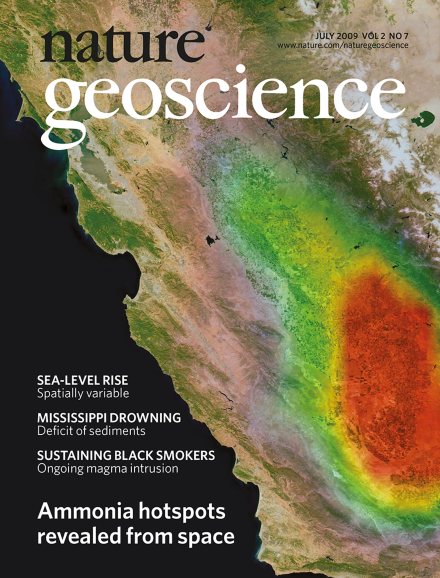
Ammonia is a significant atmospheric pollutant whose global distribution is poorly understood. Satellite measurements highlight ammonia hotspots across the globe and indicate that current inventories may underestimate emissions in the Northern Hemisphere.
Full Text - Atmospheric scienceUnderestimating ammonia | PDF (240 KB) - Atmospheric scienceUnderestimating ammonia
Subject Category: Atmospheric science
See also: Letter by Clarisse et al.
Atmospheric chemistry: Cool mercury - pp462 - 463
Rolf Weller
doi:10.1038/ngeo560
It is unclear whether the modern processes of mercury cycling — such as mercury deposition in polar regions — operated before anthropogenic emissions. Ice-core records from Antarctica now reveal strikingly high mercury concentrations during the coldest glacial periods.
Full Text - Atmospheric chemistryCool mercury | PDF (191 KB) - Atmospheric chemistryCool mercury
Subject Category: Atmospheric science
See also: Letter by Jitaru et al.
Marine geophysics: Where there's smoke there's fire - pp463 - 464
Maya Tolstoy
doi:10.1038/ngeo564
Seafloor vents spewing mineral-rich plumes of hydrothermal fluid — termed black smokers — can persist at mid-ocean ridges for decades or longer. Earthquake data indicate that ongoing magma injection may determine their locations.
Full Text - Marine geophysicsWhere there's smoke there's fire | PDF (294 KB) - Marine geophysicsWhere there's smoke there's fire
Subject Categories: Seismology | Structural geology, tectonics and geodynamics
See also: Letter by Wilcock et al.
Focus: Sea Level
Palaeoceanography: Broken greenhouse windows - pp465 - 466
Kenneth G. Miller
doi:10.1038/ngeo563
Large and rapid global sea-level changes indicate that polar ice sheets may have ephemerally existed during the Cretaceous greenhouse climate. Two oxygen isotopic studies provide evidence for and against this conclusion.
Full Text - PalaeoceanographyBroken greenhouse windows | PDF (200 KB) - PalaeoceanographyBroken greenhouse windows
Subject Category: Palaeoclimate and palaeoceanography
Glaciology: Melt revisions - p466
Alicia Newton
doi:10.1038/ngeo573
Full Text - GlaciologyMelt revisions | PDF (147 KB) - GlaciologyMelt revisions
Subject Category: Cryospheric science
Climate change: Terrestrial ecosystem inertia - pp467 - 468
Gian-Kasper Plattner
doi:10.1038/ngeo570
Some components of the climate system continue to adjust long after atmospheric greenhouse-gas levels have stopped changing. A coupled climate–vegetation model shows that forests can be committed to die-back or expansion before change is observed.
Full Text - Climate changeTerrestrial ecosystem inertia | PDF (116 KB) - Climate changeTerrestrial ecosystem inertia
Subject Category: Ecology
See also: Letter by Jones et al.
Palaeoclimate: Lessons from the past millennium - pp468 - 470
Johann H. Jungclaus
doi:10.1038/ngeo559
Understanding millennial-scale climate variability provides context for present and future climate change. It now emerges that temperatures were spatially and seasonally more heterogeneous over the past 1,000 years than previously thought.
Full Text - PalaeoclimateLessons from the past millennium | PDF (190 KB) - PalaeoclimateLessons from the past millennium
Subject Category: Palaeoclimate and palaeoceanography
Review
Focus: Sea Level
Identifying the causes of sea-level change - pp471 - 478
Glenn A. Milne, W. Roland Gehrels, Chris W. Hughes & Mark E. Tamisiea
doi:10.1038/ngeo544
Global mean sea-level change has increased from a few centimetres per century over recent millennia to a few tens of centimetres per century in recent decades. A review of the latest work shows that global mean sea-level rise is unlikely to exceed one metre over the twenty-first century, but regional departures from this global mean could reach several decimetres.
Abstract - Identifying the causes of sea-level change | Full Text - Identifying the causes of sea-level change | PDF (442 KB) - Identifying the causes of sea-level change
Subject Categories: Climate science | Oceanography
Letters
Global ammonia distribution derived from infrared satellite observations - pp479 - 483
Lieven Clarisse, Cathy Clerbaux, Frank Dentener, Daniel Hurtmans & Pierre-François Coheur
doi:10.1038/ngeo551
Ammonia is a significant atmospheric pollutant, accelerating the formation of particulate matter and damaging aquatic and terrestrial ecosystems. Infrared measurements of ammonia concentrations, obtained by the IASI/MetOp satellite, suggest that ammonia emissions in the Northern Hemisphere have been markedly underestimated.
First Paragraph - Global ammonia distribution derived from infrared satellite observations | Full Text - Global ammonia distribution derived from infrared satellite observations | PDF (21,630 KB) - Global ammonia distribution derived from infrared satellite observations | Supplementary information
Subject Category: Atmospheric science
See also: News and Views by Myles
Committed terrestrial ecosystem changes due to climate change - pp484 - 487
Chris Jones, Jason Lowe, Spencer Liddicoat & Richard Betts
doi:10.1038/ngeo555
Some aspects of the Earth system—such as global mean temperatures, and sea-level rise due to thermal expansion or melting of large ice sheets—continue to respond to climate change long after the stabilization of radiative forcing. Simulations with a coupled climate–vegetation model show that similarly ecosystems may be committed to significant change after climate stabilization.
First Paragraph - Committed terrestrial ecosystem changes due to climate change | Full Text - Committed terrestrial ecosystem changes due to climate change | PDF (480 KB) - Committed terrestrial ecosystem changes due to climate change | Supplementary information
Subject Categories: Climate science | Ecology
See also: News and Views by Plattner
Focus: Sea Level
Drowning of the Mississippi Delta due to insufficient sediment supply and global sea-level rise - pp488 - 491
Michael D. Blum & Harry H. Roberts
doi:10.1038/ngeo553
Global sea-level rise, reduced sediment supply and subsidence threaten the stability of the Mississippi Delta. Calculations of riverine sediment load and storage indicate that 10,000–13,500 km2 of the delta could be submerged by AD 2100.
First Paragraph - Drowning of the Mississippi Delta due to insufficient sediment supply and global sea-level rise | Full Text - Drowning of the Mississippi Delta due to insufficient sediment supply and global sea-level rise | PDF (897 KB) - Drowning of the Mississippi Delta due to insufficient sediment supply and global sea-level rise | Supplementary information
Subject Categories: Climate science | Geomorphology
Surface-temperature trends and variability in the low-latitude North Atlantic since 1552 - pp492 - 495
Casey Saenger, Anne L. Cohen, Delia W. Oppo, Robert B. Halley & Jessica E. Carilli
doi:10.1038/ngeo552
For the past few centuries, multidecadal climate variability in North Atlantic sea surface temperatures has been modulated by the Atlantic Multidecadal Oscillation (AMO). A coral-based temperature reconstruction reveals that the AMO is a transient climate feature that only became significant after AD 1730.
First Paragraph - Surface-temperature trends and variability in the low-latitude North Atlantic since 1552 | Full Text - Surface-temperature trends and variability in the low-latitude North Atlantic since 1552 | PDF (812 KB) - Surface-temperature trends and variability in the low-latitude North Atlantic since 1552 | Supplementary information
Subject Category: Palaeoclimate and palaeoceanography
Focus: Sea Level
Rapid early Holocene retreat of a Laurentide outlet glacier through an Arctic fjord - pp496 - 499
Jason P. Briner, Aaron C. Bini & Robert S. Anderson
doi:10.1038/ngeo556
Marine-terminating outlet glaciers control the stability of ice sheets. Exposure ages and radiocarbon dates show that an Arctic outlet glacier of the Laurentide ice sheet rapidly retreated about 9,500 years ago, and imply strong feedbacks between bathymetry and ice movement.
First Paragraph - Rapid early Holocene retreat of a Laurentide outlet glacier through an Arctic fjord | Full Text - Rapid early Holocene retreat of a Laurentide outlet glacier through an Arctic fjord | PDF (1,216 KB) - Rapid early Holocene retreat of a Laurentide outlet glacier through an Arctic fjord | Supplementary information
Subject Categories: Cryospheric science | Palaeoclimate and palaeoceanography
Focus: Sea Level
Antarctic temperature and global sea level closely coupled over the past five glacial cycles - pp500 - 504
E. J. Rohling, K. Grant, M. Bolshaw, A. P. Roberts, M. Siddall, Ch. Hemleben & M. Kucera
doi:10.1038/ngeo557
Sea level has varied by over one hundred metres across glacial–interglacial cycles over the past 520,000 years. An extended sea-level reconstruction shows a strong coupling between these sea-level changes and Antarctic surface temperatures over the past five glacial cycles.
First Paragraph - Antarctic temperature and global sea level closely coupled over the past five glacial cycles | Full Text - Antarctic temperature and global sea level closely coupled over the past five glacial cycles | PDF (4,921 KB) - Antarctic temperature and global sea level closely coupled over the past five glacial cycles | Supplementary information
Subject Category: Palaeoclimate and palaeoceanography
Atmospheric depletion of mercury over Antarctica during glacial periods - pp505 - 508
Petru Jitaru, Paolo Gabrielli, Alexandrine Marteel, John M. C. Plane, Fréderic A. M. Planchon, Pierre-Alexis Gauchard, Christophe P. Ferrari, Claude F. Boutron, Freddy C. Adams, Sungmin Hong, Paolo Cescon & Carlo Barbante
doi:10.1038/ngeo549
Over the past two decades, seasonal periods of rapid atmospheric mercury deposition over Antarctica have been described. Ice core records show that similar events have occurred during previous glacial periods, probably as a result of interactions between sea salts and mineral dust in the polar atmosphere.
First Paragraph - Atmospheric depletion of mercury over Antarctica during glacial periods | Full Text - Atmospheric depletion of mercury over Antarctica during glacial periods | PDF (686 KB) - Atmospheric depletion of mercury over Antarctica during glacial periods | Supplementary information
Subject Categories: Atmospheric science | Biogeochemistry | Palaeoclimate and palaeoceanography
See also: related Backstory | News and Views by Weller
The role of magma injection in localizing black-smoker activity - pp509 - 513
William S. D. Wilcock, Emilie E. E. Hooft, Douglas R. Toomey, Paul R. McGill, Andrew H. Barclay, Debra S. Stakes & Tony M. Ramirez
doi:10.1038/ngeo550
The mechanisms for localization of black-smoker systems at mid-ocean ridges remain to be fully understood. Seismic data for a segment of the Juan de Fuca ridge with long-lived black-smoker vents reveal ongoing magma recharge into the crustal magma chamber, thereby providing an explanation for the localization.
First Paragraph - The role of magma injection in localizing black-smoker activity | Full Text - The role of magma injection in localizing black-smoker activity | PDF (22,121 KB) - The role of magma injection in localizing black-smoker activity | Supplementary information
Subject Categories: Oceanography | Seismology | Structural geology, tectonics and geodynamics
See also: related Backstory | News and Views by Tolstoy
Iron isotope fractionation in the Earth's lower mantle - pp514 - 518
James R. Rustad & Qing-Zhu Yin
doi:10.1038/ngeo546
The two main iron-bearing silicate phases in the mantle—ferroperovskite and ferropericlase—are expected to partition iron isotopes differently. Theoretical calculations suggest that the spin state of iron strongly influences the iron isotopic composition of ferropericlase, whereas the iron isotopic composition of ferroperovskite is almost independent of spin state.
First Paragraph - Iron isotope fractionation in the Earth/'s lower mantle | Full Text - Iron isotope fractionation in the Earth's lower mantle | PDF (1,776 KB) - Iron isotope fractionation in the Earth's lower mantle
Subject Categories: Geochemistry | Structural geology, tectonics and geodynamics | Volcanology, mineralogy and petrology
Article
Southward movement of the Pacific intertropical convergence zone AD 1400–1850 - pp519 - 525
Julian P. Sachs, Dirk Sachse, Rienk H. Smittenberg, Zhaohui Zhang, David S. Battisti & Stjepko Golubic
doi:10.1038/ngeo554
Seasonal changes in tropical rainfall patterns are associated with changes in the position of the intertropical convergence zone. Microbiological, molecular and hydrogen isotopic evidence from island lake sediments shows that the Pacific intertropical convergence zone was south of its modern position by as much as 500 km during the Little Ice Age.
Abstract - Southward movement of the Pacific intertropical convergence zone : AD: [thinsp]1400-1850 | Full Text - Southward movement of the Pacific intertropical convergence zone AD 1400–1850 | PDF (1,673 KB) - Southward movement of the Pacific intertropical convergence zone AD 1400–1850 | Supplementary information
Subject Categories: Climate science | Palaeoclimate and palaeoceanography
Erratum
Insight despite imperfection - p470
Mat Collins
doi:10.1038/ngeo561
Full Text - Insight despite imperfection | PDF (92 KB) - Insight despite imperfection
Backstory
After the storm - p528
doi:10.1038/ngeo568
Hermann M. Fritz and colleagues travelled by cargo boat through the Ayeyarwady delta in Myanmar to document the damage after cyclone Nargis.
Full Text - After the storm | PDF (228 KB) - After the storm
See also: Correspondence by Fritz et al.
Sensing the sea bed - pE11
doi:10.1038/ngeo566
William Wilcock and a team of scientists and engineers drilled holes in the sea floor, and inadvertently provided a breeding ground for octopuses, in their attempt to understand deep-ocean hydrothermal venting.
Full Text - Sensing the sea bed | PDF (170 KB) - Sensing the sea bed
See also: Letter by Wilcock et al.
Mopping up mercury - pE12
doi:10.1038/ngeo569
Paolo Gabrielli and colleagues dug deeply — and extremely cautiously — into Antarctic ice, to see whether the poles acted as a sink for mercury in the geological past.
Full Text - Mopping up mercury | PDF (150 KB) - Mopping up mercury
See also: Letter by Jitaru et al.