Table of contents
June 2008, Volume 1 No 6 pp339-406
About the coverEditorial
Drilling back in time - p339
doi:10.1038/ngeo220
The recently published 800,000-year greenhouse-gas records from Dome C, Antarctica, show that old ice still bears surprises. As long as the records challenge our understanding, we should go back for more.
Full Text - Drilling back in time | PDF (208 KB) - Drilling back in time
Research Highlights
Arctic permafrost thawing, Jurassic carbon dioxide and more - p341
doi:10.1038/ngeo216
Full Text - Arctic permafrost thawing, Jurassic carbon dioxide and more | PDF (201 KB) - Arctic permafrost thawing, Jurassic carbon dioxide and more
News and Views
Geomorphology: Where glaciers cut deep - pp343 - 344
Johan Kleman
doi:10.1038/ngeo210
Stunning images of fjords are familiar to geologists, but their origins are less well known. A simple model suggests that topographic steering of ice and erosion proportional to ice discharge are sufficient to explain fjord formation during the Quaternary period.
Full Text - GeomorphologyWhere glaciers cut deep | PDF (465 KB) - GeomorphologyWhere glaciers cut deep
Subject Category: Geomorphology
See also: Letter by Kessler et al.
Climate Science: Globalized carbon emissions - p344
Heike Langenberg
doi:10.1038/ngeo219
Full Text - Climate ScienceGlobalized carbon emissions | PDF (364 KB) - Climate ScienceGlobalized carbon emissions
Palaeomagnetism: Core message - pp345 - 346
Gauthier Hulot
doi:10.1038/ngeo213
Archaean and early Proterozoic rocks reveal that the Earth's magnetic field two billion years ago behaved differently than over most of the past 200 million years. Do these changes relate to the growth of the inner core?
Full Text - PalaeomagnetismCore message | PDF (338 KB) - PalaeomagnetismCore message
Subject Category: Geomagnetism, palaeomagnetism and core processes
See also: Letter by Biggin et al.
Edward Lorenz (1917–2008): Chaotic beginnings - p346
Richard Webb
doi:10.1038/ngeo211
Full Text - Edward Lorenz (1917–2008)Chaotic beginnings | PDF (169 KB) - Edward Lorenz (1917–2008)Chaotic beginnings
Atmospheric science: The answer is blowing in the wind - pp347 - 348
P. W. Thorne
doi:10.1038/ngeo209
Uncertainty over tropical tropospheric temperature change has loomed large over the last two decades. Use of wind data to infer temperature change offers a new avenue of investigation.
Full Text - Atmospheric scienceThe answer is blowing in the wind | PDF (138 KB) - Atmospheric scienceThe answer is blowing in the wind
Subject Category: Atmospheric science
See also: Article by Allen & Sherwood
Planetary Science: Organic burial site on Mars? - pp348 - 350
Vincent Chevrier
doi:10.1038/ngeo212
The Nili Fossae region on Mars is one of the places earmarked for the search of evidence for life. A combination of geomorphological and mineralogical data from the area suggest ideal conditions for the burial of organic matter.
Full Text - Planetary ScienceOrganic burial site on Mars? | PDF (293 KB) - Planetary ScienceOrganic burial site on Mars?
Subject Category: Planetary science
See also: Letter by Ehlmann et al.
Geochemistry: Seeing through tectonic plates - pp350 - 351
Tatiana Churikova
doi:10.1038/ngeo215
Two overlapping oceanic plates are sinking into the mantle underneath central Japan where they dehydrate, releasing water-rich fluids that enhance mantle melting. Geochemical work helps determine the relative contribution of each plate to the overall fluid budget.
Full Text - GeochemistrySeeing through tectonic plates | PDF (149 KB) - GeochemistrySeeing through tectonic plates
Subject Category: Geochemistry
See also: Letter by Nakamura et al.
Palaeoclimate: Marinoan meltdown - pp351 - 353
Graham Anthony Shields
doi:10.1038/ngeo214
The termination of the Marinoan glaciation 635 million years ago is one of the most spectacular climate change events ever recorded. Methane release from equatorial permafrost might have triggered this global meltdown.
Full Text - PalaeoclimateMarinoan meltdown | PDF (274 KB) - PalaeoclimateMarinoan meltdown
Subject Category: Palaeoclimate and palaeoceanography
See also: related Backstory
Letters
Clay minerals in delta deposits and organic preservation potential on Mars - pp355 - 358
Bethany L. Ehlmann, John F. Mustard, Caleb I. Fassett, Samuel C. Schon, James W. Head III, David J. Des Marais, John A. Grant & Scott L. Murchie
doi:10.1038/ngeo207
High-resolution data from the Mars Reconnaissance Orbiter are used to identify clay-rich fluvial-lacustrine sediments in an open lake basin on Mars near the 45-km-diameter Jezero crater. The basin contains sedimentary deposits of hydrous minerals sourced from a smectite-rich catchment in the Nili Fossae region, which are well suited for the sequestration and preservation of organic material.
First Paragraph - | Full Text - Clay minerals in delta deposits and organic preservation potential on Mars | PDF (2,318 KB) - Clay minerals in delta deposits and organic preservation potential on Mars | Supplementary information
Subject Category: Planetary science
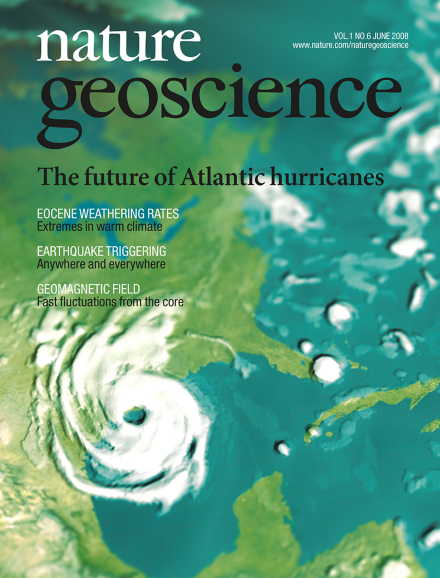
Simulated reduction in Atlantic hurricane frequency under twenty-first-century warming conditions - pp359 - 364
Thomas R. Knutson, Joseph J. Sirutis, Stephen T. Garner, Gabriel A. Vecchi & Isaac M. Held
doi:10.1038/ngeo202
Using projected boundary conditions for the end of the twenty-first century, the frequency of Atlantic tropical cyclones and hurricanes in a regional climate model of the Atlantic basin is reduced compared with observed boundary conditions at the end of the twentieth century. This is inconsistent with the idea that higher levels of atmospheric greenhouse gases will result in increased Atlantic hurricane activity.
First Paragraph - | Full Text - Simulated reduction in Atlantic hurricane frequency under twenty-first-century warming conditions | PDF (445 KB) - Simulated reduction in Atlantic hurricane frequency under twenty-first-century warming conditions | Supplementary information
Subject Categories: Atmospheric science | Climate science
Fjord insertion into continental margins driven by topographic steering of ice - pp365 - 369
Mark A. Kessler, Robert S. Anderson & Jason P. Briner
doi:10.1038/ngeo201
Fjords line mountainous continental margins where icesheets and glaciers once stood. A two-dimensional model simulation suggests that fjords can be eroded within one million years, primarily in response to topographic ice steering and erosion from ice discharge. Subsequent glaciers that form on these landscapes are smaller and exhibit greater responses to climate change.
First Paragraph - | Full Text - Fjord insertion into continental margins driven by topographic steering of ice | PDF (769 KB) - Fjord insertion into continental margins driven by topographic steering of ice
Subject Categories: Geomorphology | Cryospheric science
Elevated weathering rates in the Rocky Mountains during the Early Eocene Climatic Optimum - pp370 - 374
M. Elliot Smith, Alan R. Carroll & Erich R. Mueller
doi:10.1038/ngeo205
Silicate weathering reactions remove carbon dioxide from the atmosphere and store it in carbonate minerals. During the high atmospheric carbon dioxide conditions of the Early Eocene Climatic Optimum, rates of chemical weathering, physical erosion and denudation in the western USA were equivalent to the highest recorded rates in the non-glacial Quaternary.
First Paragraph - | Full Text - Elevated weathering rates in the Rocky Mountains during the Early Eocene Climatic Optimum | PDF (1,390 KB) - Elevated weathering rates in the Rocky Mountains during the Early Eocene Climatic Optimum | Supplementary information
Subject Category: Geomorphology
Global ubiquity of dynamic earthquake triggering - pp375 - 379
Aaron A. Velasco, Stephen Hernandez, Tom Parsons & Kris Pankow
doi:10.1038/ngeo204
Surface waves that were generated by 12 out of 15 earthquakes with magnitudes greater than 7 since 1990 led to a global increase in the number of small earthquakes. This suggests that dynamic triggering of earthquakes is common and is independent of the tectonic environment.
First Paragraph - | Full Text - Global ubiquity of dynamic earthquake triggering | PDF (904 KB) - Global ubiquity of dynamic earthquake triggering | Supplementary information
Subject Category: Seismology
Geochemical evidence for enhanced fluid flux due to overlapping subducting plates - pp380 - 384
Hitomi Nakamura, Hikaru Iwamori & Jun-Ichi Kimura
doi:10.1038/ngeo200
Overlapping subduction of the Pacific and Philippines Sea plates leads to an enhanced fluid flux to the mantle source of arc volcanoes in central Japan. Spatial variability in the amount of fluid that each plate contributes is determined by the configuration of the subducting plates.
First Paragraph - | Full Text - Geochemical evidence for enhanced fluid flux due to overlapping subducting plates | PDF (808 KB) - Geochemical evidence for enhanced fluid flux due to overlapping subducting plates | Supplementary information
Subject Categories: Geochemistry | Structural geology, tectonics and geodynamics
See also: related Backstory
Coupled caldera subsidence and stirring inferred from analogue models - pp385 - 389
Ben M. Kennedy, A. Mark Jellinek & John Stix
doi:10.1038/ngeo206
Analogue modelling of caldera-forming eruptions suggests that sinking of the magma chamber roof is variable in space and time, leading to substantial stirring and mixing of magma. This can explain the common occurrence of geochemical zonation and magma mingling in deposits erupted from calderas.
First Paragraph - | Full Text - Coupled caldera subsidence and stirring inferred from analogue models | PDF (456 KB) - Coupled caldera subsidence and stirring inferred from analogue models
Subject Category: Volcanology, mineralogy and petrology
Rapidly changing flows in the Earth's core - pp390 - 394
Nils Olsen & Mioara Mandea
doi:10.1038/ngeo203
Variations in the Earth's magnetic field over a span of a few months can be resolved despite the potential filtering effects of the electrically conducting mantle, and are indicative of rapid flow in the Earth's outer core.
First Paragraph - | Full Text - Rapidly changing flows in the Earth's core | PDF (794 KB) - Rapidly changing flows in the Earth's core | Supplementary information
Subject Category: Geomagnetism, palaeomagnetism and core processes
Evidence for a very-long-term trend in geomagnetic secular variation - pp395 - 398
Andrew J. Biggin, Geert H. M. A. Strik & Cor G. Langereis
doi:10.1038/ngeo181
Reconstructions of palaeosecular variation suggest that the Earth's magnetic field reversed less frequently 2.82 to 2.45 billion years ago, relative to the Cenozoic era. This suggests a long-term trend of decreasing geodynamo stability since the Archaean eon.
First Paragraph - | Full Text - Evidence for a very-long-term trend in geomagnetic secular variation | PDF (267 KB) - Evidence for a very-long-term trend in geomagnetic secular variation | Supplementary information
Subject Category: Geomagnetism, palaeomagnetism and core processes
Article
Warming maximum in the tropical upper troposphere deduced from thermal winds - pp399 - 403
Robert J. Allen & Steven C. Sherwood
doi:10.1038/ngeo208
There has been a strong disagreement between model predictions of troposphere warming and observations of temperature trends from radiosondes and satellites. However, when tropospheric temperature reconstructions are generated from thermal-wind measurements and the thermal-wind equation for 1970–2005, the results show a strong tropospheric warming trend, in agreement with model predictions.
Abstract - | Full Text - Warming maximum in the tropical upper troposphere deduced from thermal winds | PDF (346 KB) - Warming maximum in the tropical upper troposphere deduced from thermal winds | Supplementary information
Subject Category: Climate science
Backstory
Tracking subduction fluids - p406
doi:10.1038/ngeo221
Hitomi Nakamura, sometimes on her own, braved remote ravines and thick jungles in order to sample volcanic rocks that help reveal the complex geometry of two overlapping plates subducting into the mantle beneath central Japan.
Full Text - Tracking subduction fluids | PDF (294 KB) - Tracking subduction fluids
Snowballs from the past - pE10
doi:10.1038/ngeo222
Martin Kennedy and colleagues searched the Australian outback for clues to the transition out of Snowball Earth. The answer, as it turns out, was much closer to home.
Full Text - Snowballs from the past | PDF (233 KB) - Snowballs from the past