Table of contents

ARTICLE NAVIGATION - ISSUE
January 2009, Volume 12 No 1 pp1-98
About the coverEditorial
Striving for excellence in peer review - p1
doi:10.1038/nn0109-1
Scientific publishing depends on expert peer reviewers. Instead of perpetually arguing about the reliability and fairness of peer review, authors, editors and referees should seek to optimize this time-tested system.
Full Text - Striving for excellence in peer review | PDF (303 KB) - Striving for excellence in peer review
Book Review
New aids for learning and memory - p3
Ingrid Ehrlich & Andreas Lüthi review Learning & Memory by Howard Eichenbaum
doi:10.1038/nn0109-3
Full Text - New aids for learning and memory | PDF (208 KB) - New aids for learning and memory
News and Views
Retinitis pigmentosa: cone photoreceptors starving to death - pp5 - 6
Paola Bovolenta & Elsa Cisneros
doi:10.1038/nn0109-5
In retinitis pigmentosa, rod and cone photoreceptors die. Although rods die as a consequence of rod-specific genetic mutations, there is no clear explanation for the progressive loss of cones. A new study in this issue suggests that changes in the insulin/mTOR pathway and cell starvation can partially account for cone death in this disease.
Full Text - Retinitis pigmentosa: cone photoreceptors starving to death | PDF (1,231 KB) - Retinitis pigmentosa: cone photoreceptors starving to death
See also: Article by Punzo et al.
Sniffing out a function for prion proteins - pp7 - 8
Donald A Wilson & Ralph A Nixon
doi:10.1038/nn0109-7
When prion proteins go wrong, they can do serious damage, but little is known about their normal function, despite their ubiquitous expression in the brain. A new report in this issue suggests a critical role for prions in olfactory discrimination.
Full Text - Sniffing out a function for prion proteins | PDF (642 KB) - Sniffing out a function for prion proteins
See also: Article by Le Pichon et al.
Hyperactive interneurons impair learning in a neurofibromatosis model - pp8 - 10
Kevin J Staley & Anne E Anderson
doi:10.1038/nn0109-8
Neurofibromatosis type I is often associated with learning disabilities. Recent work shows that lack of neurofibromin impairs memory because overactive ERK signaling in hippocampal interneurons causes excessive GABA release.
Full Text - Hyperactive interneurons impair learning in a neurofibromatosis model | PDF (585 KB) - Hyperactive interneurons impair learning in a neurofibromatosis model
Spikes are making waves in the visual cortex - pp10 - 11
Harvey A Swadlow & Jose-Manuel Alonso
doi:10.1038/nn0109-10
Cortical and thalamic contribution to V1 neuron response properties is thought to be fixed. New work overturns this assumption, showing that the spread of corticocortical activation can be strongly modulated by stimulus strength.
Full Text - Spikes are making waves in the visual cortex | PDF (235 KB) - Spikes are making waves in the visual cortex
See also: Article by Nauhaus et al.
Pulling an all-nighter - pp12 - 13
Todd W Troyer & Christopher M Glaze
doi:10.1038/nn0109-12
Research indicates that sleep influences learning, but little is known about the mechanisms involved. A recent article suggests that sleep modifies the firing patterns of sensorimotor neurons before there is improvement in performance.
Full Text - Pulling an all-nighter | PDF (884 KB) - Pulling an all-nighter
Review
Bidirectional modulation of synaptic functions by Eph/ephrin signaling - pp15 - 20
Rüdiger Klein
doi:10.1038/nn.2231
This review discusses new work that explores how Eph/ephrin forward and reverse signaling affect spine maturation, synaptogenesis and synaptic long-term potentiation.
First Paragraph - | Full Text - Bidirectional modulation of synaptic functions by Eph/ephrin signaling | PDF (528 KB) - Bidirectional modulation of synaptic functions by Eph/ephrin signaling
Brief Communications
Interneurons hyperpolarize pyramidal cells along their entire somatodendritic axis - pp21 - 23
Lindsey L Glickfeld, J David Roberts, Peter Somogyi & Massimo Scanziani
doi:10.1038/nn.2230
Activation of GABAA receptors can depolarize specific neuronal compartments, causing excitation. The authors report that hippocampal interneurons hyperpolarize pyramidal cells, irrespective of the location of their synapses, along the entire somato-dendritic axis.
Abstract - | Full Text - Interneurons hyperpolarize pyramidal cells along their entire somatodendritic axis | PDF (495 KB) - Interneurons hyperpolarize pyramidal cells along their entire somatodendritic axis | Supplementary information
Feature-based attention modulates feedforward visual processing - pp24 - 25
Weiwei Zhang & Steven J Luck
doi:10.1038/nn.2223
Attention is thought to select nonspatial features later than spatial location. This study uses ERPs to show that color-based attention effects manifest themselves as early as 100 ms, similar to spatial attention effects.
Abstract - | Full Text - Feature-based attention modulates feedforward visual processing | PDF (286 KB) - Feature-based attention modulates feedforward visual processing | Supplementary information
Developmentally degraded cortical temporal processing restored by training - pp26 - 28
Xiaoming Zhou & Michael M Merzenich
doi:10.1038/nn.2239
Neuronal response selectivity and perceptual discrimination can be affected by acoustic experience during development. Here the authors show that intensive discrimination training in adult animals can restore normal cortical response patterns.
Abstract - | Full Text - Developmentally degraded cortical temporal processing restored by training | PDF (337 KB) - Developmentally degraded cortical temporal processing restored by training | Supplementary information
Reduced structural connectivity in ventral visual cortex in congenital prosopagnosia - pp29 - 31
Cibu Thomas, Galia Avidan, Kate Humphreys, Kwan-jin Jung, Fuqiang Gao & Marlene Behrmann
doi:10.1038/nn.2224
Prosopagnosics have impaired face recognition, but make relatively normal responses to face stimuli in core brain regions for face recognition. The authors now report that it is the connectivity among these regions that is being disrupted in the disorder.
Abstract - | Full Text - Reduced structural connectivity in ventral visual cortex in congenital prosopagnosia | PDF (406 KB) - Reduced structural connectivity in ventral visual cortex in congenital prosopagnosia | Supplementary information
Connectivity-based segregation of the human striatum predicts personality characteristics - pp32 - 34
Michael X Cohen, Jan-Christoph Schoene-Bake, Christian E Elger & Bernd Weber
doi:10.1038/nn.2228
The striatum receives projections to a number of cortical and subcortical areas. The authors report here that fiber tracts from prefrontal cortex are correlated with individual differences in reward dependence and that tracts from the hippocampus, amygdala and ventral striatum are correlated with individual differences in novelty seeking.
Abstract - | Full Text - Connectivity-based segregation of the human striatum predicts personality characteristics | PDF (357 KB) - Connectivity-based segregation of the human striatum predicts personality characteristics | Supplementary information
Articles
Transient neurites of retinal horizontal cells exhibit columnar tiling via homotypic interactions - pp35 - 43
Rachel M Huckfeldt, Timm Schubert, Josh L Morgan, Leanne Godinho, Graziella Di Cristo, Z Josh Huang & Rachel O L Wong
doi:10.1038/nn.2236
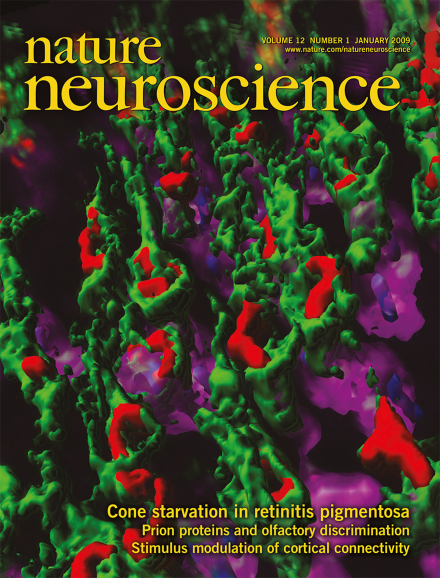
Tiling describes the arrangement of neuronal processes in a pattern with little or no overlap with those of neighboring neurons. It is unclear how this is mediated in the vertebrate retina, whose mosaic cell body distribution of horizontal cells is accompanied by extensively overlapping dendrites. A study by Huckfeldt et al. now shows that the nonrandom distribution of the horizontal cells is correlated with repulsive homotypic interactions between developmentally transient processes, leading to the development of initial territories of horizontal cell.
Abstract - | Full Text - Transient neurites of retinal horizontal cells exhibit columnar tiling via homotypic interactions | PDF (7,621 KB) - Transient neurites of retinal horizontal cells exhibit columnar tiling via homotypic interactions | Supplementary information
Stimulation of the insulin/mTOR pathway delays cone death in a mouse model of retinitis pigmentosa - pp44 - 52
Claudio Punzo, Karl Kornacker & Constance L Cepko
doi:10.1038/nn.2234
The retinal degeneration disease retinitis pigmentosa is characterized by an initial loss of rod photoreceptors followed by a progressive loss of cones. Providing a mechanism behind the long delay of cone death in retinitis pigmentosa, Punzo et al. identify and characterize the involvement of an insulin/mTOR pathway, indicating that cell starvation of cones can partially account for the nonautonomous photoreceptor death in retinitis pigmentosa.
Abstract - | Full Text - Stimulation of the insulin/mTOR pathway delays cone death in a mouse model of retinitis pigmentosa | PDF (1,340 KB) - Stimulation of the insulin/mTOR pathway delays cone death in a mouse model of retinitis pigmentosa | Supplementary information
See also: News and Views by Bovolenta & Cisneros
The GABAergic anterior paired lateral neuron suppresses and is suppressed by olfactory learning - pp53 - 59
Xu Liu & Ronald L Davis
doi:10.1038/nn.2235
Liu and Davis identify a GABAergic neuron, the anterior paired lateral neuron, that innervates the mushroom body neuropil and elaborate on the reciprocal relationship between GABA signaling and Drosophila olfactory memory.
Abstract - | Full Text - The GABAergic anterior paired lateral neuron suppresses and is suppressed by olfactory learning | PDF (1,139 KB) - The GABAergic anterior paired lateral neuron suppresses and is suppressed by olfactory learning | Supplementary information
Olfactory behavior and physiology are disrupted in prion protein knockout mice - pp60 - 69
Claire E Le Pichon, Matthew T Valley, Magdalini Polymenidou, Alexander T Chesler, Botir T Sagdullaev, Adriano Aguzzi & Stuart Firestein
doi:10.1038/nn.2238
The normal physiological function of the prion protein PrPC remains unknown. Here, the authors report that PrP knockout mice show altered behavior in two olfactory tasks and that PrP deficiency affects oscillatory activity in the olfactory bulb. Both the behavioral and electrophysiological phenotypes could be rescued by transgenic neuronal-specific expression of PrPC.
Abstract - | Full Text - Olfactory behavior and physiology are disrupted in prion protein knockout mice | PDF (1,378 KB) - Olfactory behavior and physiology are disrupted in prion protein knockout mice | Supplementary information
See also: News and Views by Wilson & Nixon
Stimulus contrast modulates functional connectivity in visual cortex - pp70 - 76
Ian Nauhaus, Laura Busse, Matteo Carandini & Dario L Ringach
doi:10.1038/nn.2232
By simultaneously recording spikes and local field potentials (LFPs) in cat and monkey visual cortex, the authors demonstrate that the magnitude and spread of LFP waves from the originating spike are reduced with increasing stimulus contrast. This suggests that visual cortex functional connectivity is not fixed, but is instead modulated by stimulus contrast.
Abstract - | Full Text - Stimulus contrast modulates functional connectivity in visual cortex | PDF (1,220 KB) - Stimulus contrast modulates functional connectivity in visual cortex | Supplementary information
See also: News and Views by Swadlow & Alonso
Representation of negative motivational value in the primate lateral habenula - pp77 - 84
Masayuki Matsumoto & Okihide Hikosaka
doi:10.1038/nn.2233
The authors report that the population of lateral habenula neurons responds most strongly for the most unpleasant outcome in a particular context: either the absence of reward when rewards are available or the presence of punishment when punishments are feared.
Abstract - | Full Text - Representation of negative motivational value in the primate lateral habenula | PDF (1,433 KB) - Representation of negative motivational value in the primate lateral habenula | Supplementary information
Task-specific signal transmission from prefrontal cortex in visual selective attention - pp85 - 91
Yosuke Morishima, Rei Akaishi, Yohei Yamada, Jiro Okuda, Keiichiro Toma & Katsuyuki Sakai
doi:10.1038/nn.2237
This study combines transcranial magnetic stimulation (TMS) and electroencephalography (EEG) and finds that TMS over frontal eye fields affects EEG over more posterior areas. This effect was modulated by the task and attentional preparation and provides causal evidence for the existence of a prefrontal top-down control signal.
Abstract - | Full Text - Task-specific signal transmission from prefrontal cortex in visual selective attention | PDF (1,499 KB) - Task-specific signal transmission from prefrontal cortex in visual selective attention | Supplementary information
Trait anxiety and impoverished prefrontal control of attention - pp92 - 98
Sonia J Bishop
doi:10.1038/nn.2242
Previous work links hyper-responsive threat detection to anxiety. Using fMRI, this study finds that highly anxious individuals had reduced prefrontal cortex activity and slower target identification during a response conflict task when the task did not fully use up their attentional resources. Trait anxiety is therefore linked to less prefrontal attentional control, even when there are no threatening stimuli.
Abstract - | Full Text - Trait anxiety and impoverished prefrontal control of attention | PDF (537 KB) - Trait anxiety and impoverished prefrontal control of attention | Supplementary information