In this issue - pv
doi:10.1038/nchembio1107-v
doi:10.1038/nchembio1107-679
Although we are updating the formats of our original research papers, publishing top-quality chemical biology research remains our primary aim.
Full Text - Plus ça change | PDF (1,416 KB) - Plus ça change
David S Goodsell
doi:10.1038/nchembio1107-681
There is a gap between the nanoscale level of molecular structure and the micron-sized level of cellular ultrastructure that is difficult to probe experimentally. New techniques and simulated images are revealing its secrets.
Full Text - Making the step from chemistry to biology and back | PDF (3,075 KB) - Making the step from chemistry to biology and back
Catherine Goodman
doi:10.1038/nchembio1107-685
By questioning the very nature of how ion channels, brains and societies form and function, Nobel laureate Jean-Marie Lehn has changed our understanding of the chemical basis of self-organization.
Full Text - Jean-Marie Lehn | PDF (1,387 KB) - Jean-Marie Lehn
Martin Feelisch
doi:10.1038/nchembio1107-687
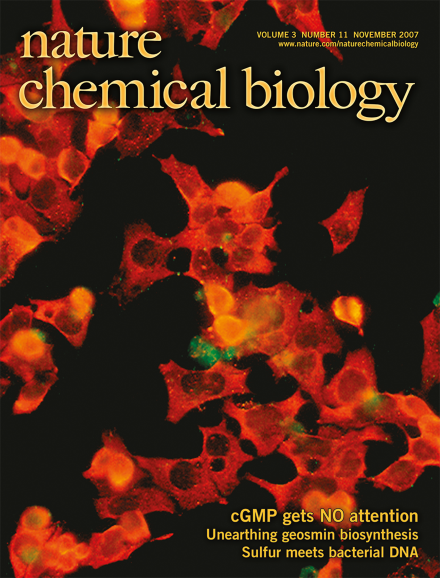
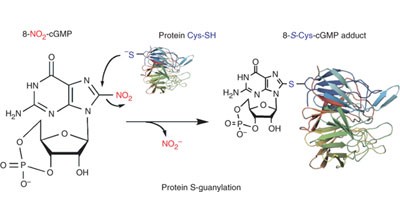
Nitric oxide–mediated production of cyclic guanosine 3',5'-monophosphate (cGMP) is a crucial signal transduction pathway that controls a wide array of biological functions. A new layer of complexity in mammalian cell regulation is revealed by the discovery of a redox-active nitrated cGMP derivative with the ability to post-translationally modify protein thiol residues by S-guanylation.
Full Text - Nitrated cyclic GMP as a new cellular signal | PDF (2,819 KB) - Nitrated cyclic GMP as a new cellular signal
See also: Article by Sawa et al.
Fritz Eckstein
doi:10.1038/nchembio1107-689
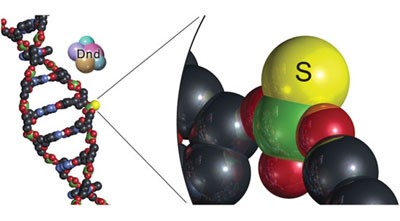
A phosphorothioate modification of DNA has been identified in bacteria. This first observed alteration of the DNA phosphate backbone opens many questions about the mechanism of sulfur incorporation and the function of this modification.
Full Text - Phosphorothioation of DNA in bacteria | PDF (2,796 KB) - Phosphorothioation of DNA in bacteria
See also: Brief Communication by Wang et al.
Joseph P Noel
doi:10.1038/nchembio1107-690
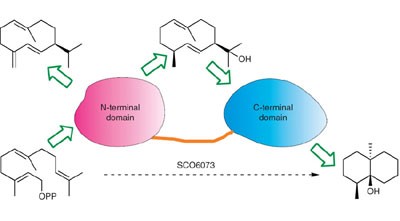
The C12 'earthy' odorant geosmin is derived from the C15 metabolite farnesyl diphosphate. Metabolic transformation now seems to be catalyzed by a bifunctional protein having two operatively independent sesquiterpene synthase domains. The domains are catalytically linked through the passive diffusion of a C15 alcohol product of the N-terminal catalytic domain to the C-terminal catalytic domain for the final steps of geosmin formation.
Full Text - Digging for answers, smelling a hint of success and tasting triumph | PDF (2,811 KB) - Digging for answers, smelling a hint of success and tasting triumph
See also: Letter by Jiang et al.
Nigel J Robinson
doi:10.1038/nchembio1107-692
An emerging view is that high-fidelity metal selection by the proteins involved in metal homeostasis is pivotal to ensure that the correct metals bind to nascent metalloproteins. A new study demonstrates that the AztA zinc exporter performs this function by using tandem metal-binding domains to entrap some of the wrong metals in nonproductive complexes.
Full Text - A more discerning zinc exporter | PDF (3,137 KB) - A more discerning zinc exporter
Victoria J DeRose
doi:10.1038/nchembio1107-693
A recently characterized 'M-box' genetic switch from bacteria is proposed to directly sense cellular Mg2+ levels through the conformation of its newly synthesized RNA. This Mg2+-sensing riboswitch controls transcription termination in front of a Mg2+ transporter gene, thus introducing a new and direct level of genetic regulation to metal ion homeostasis.
Full Text - Sensing cellular magnesium with RNA | PDF (2,896 KB) - Sensing cellular magnesium with RNA
doi:10.1038/nchembio1107-695
Full Text - Research Highlights | PDF (1,388 KB) - Research Highlights
Kerry Routenberg Love, André Catic, Christian Schlieker & Hidde L Ploegh
doi:10.1038/nchembio.2007.43

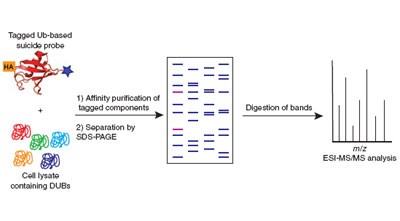
Abstract - Mechanisms, biology and inhibitors of deubiquitinating enzymes | Full Text - Mechanisms, biology and inhibitors of deubiquitinating enzymes | PDF (1,916 KB) - Mechanisms, biology and inhibitors of deubiquitinating enzymes
Maximilian W Popp, John M Antos, Gijsbert M Grotenbreg, Eric Spooner & Hidde L Ploegh
doi:10.1038/nchembio.2007.31

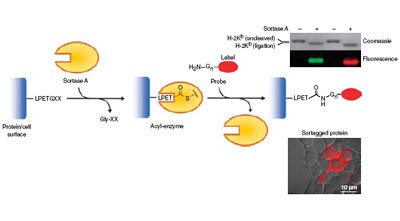
Abstract - Sortagging: a versatile method for protein labeling | Full Text - Sortagging: a versatile method for protein labeling | PDF (1,468 KB) - Sortagging: a versatile method for protein labeling | Supplementary information | Chemical compounds
Lianrong Wang, Shi Chen, Tiegang Xu, Koli Taghizadeh, John S Wishnok, Xiufen Zhou, Delin You, Zixin Deng & Peter C Dedon
doi:10.1038/nchembio.2007.39

Abstract - Phosphorothioation of DNA in bacteria by : dnd: genes | Full Text - Phosphorothioation of DNA in bacteria by dnd genes | PDF (1,469 KB) - Phosphorothioation of DNA in bacteria by dnd genes | Supplementary information | Chemical compounds
See also: News and Views by Eckstein
Jiaoyang Jiang, Xiaofei He & David E Cane
doi:10.1038/nchembio.2007.29

First Paragraph - Biosynthesis of the earthy odorant geosmin by a bifunctional : Streptomyces coelicolor: enzyme | Full Text - Biosynthesis of the earthy odorant geosmin by a bifunctional Streptomyces coelicolor enzyme | PDF (1,534 KB) - Biosynthesis of the earthy odorant geosmin by a bifunctional Streptomyces coelicolor enzyme | Supplementary information | Chemical compounds
See also: News and Views by Noel
Yang Zhao, Tszfung F Chow, Rachel S Puckrin, Simon E Alfred, Albert K Korir, Cynthia K Larive & Sean R Cutler
doi:10.1038/nchembio.2007.32

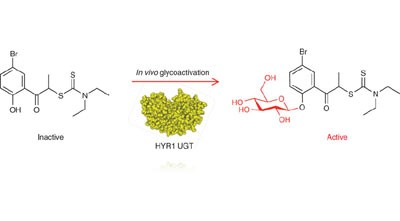
First Paragraph - Chemical genetic interrogation of natural variation uncovers a molecule that is glycoactivated | Full Text - Chemical genetic interrogation of natural variation uncovers a molecule that is glycoactivated | PDF (1,628 KB) - Chemical genetic interrogation of natural variation uncovers a molecule that is glycoactivated | Supplementary information | Chemical compounds
Lusong Luo, Cynthia A Parrish, Neysa Nevins, Dean E McNulty, Amita M Chaudhari, Jeffery D Carson, Valery Sudakin, Antony N Shaw, Ruth Lehr, Huizhen Zhao, Sharon Sweitzer, Latesh Lad, Kenneth W Wood, Roman Sakowicz, Roland S Annan, Pearl S Huang, Jeffrey R Jackson, Dashyant Dhanak, Robert A Copeland & Kurt R Auger
doi:10.1038/nchembio.2007.34

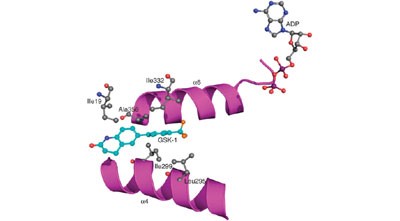
First Paragraph - ATP-competitive inhibitors of the mitotic kinesin KSP that function via an allosteric mechanism | Full Text - ATP-competitive inhibitors of the mitotic kinesin KSP that function via an allosteric mechanism | PDF (1,668 KB) - ATP-competitive inhibitors of the mitotic kinesin KSP that function via an allosteric mechanism | Supplementary information | Chemical compounds
Tomohiro Sawa, Mohammad Hasan Zaki, Tatsuya Okamoto, Teruo Akuta, Yoshiko Tokutomi, Shokei Kim-Mitsuyama, Hideshi Ihara, Akira Kobayashi, Masayuki Yamamoto, Shigemoto Fujii, Hirokazu Arimoto & Takaaki Akaike
doi:10.1038/nchembio.2007.33

Abstract - Protein S-guanylation by the biological signal 8-nitroguanosine 3[prime],5[prime]-cyclic monophosphate | Full Text - Protein S-guanylation by the biological signal 8-nitroguanosine 3',5'-cyclic monophosphate | PDF (1,791 KB) - Protein S-guanylation by the biological signal 8-nitroguanosine 3',5'-cyclic monophosphate | Supplementary information | Chemical compounds
See also: News and Views by Feelisch
This Challenge is looking for novel approaches to protein and nucleic acid detection. This is an Id...
The analysis of adaptation with a population is a frequently encountered computational modeling scen...