In This Issue - pv
doi:10.1038/nchembio0306-v
Adrian Whitty & Gnanasambandam Kumaravel
doi:10.1038/nchembio0306-112
Developing small-molecule inhibitors against protein-protein interaction targets is among the most difficult challenges in contemporary drug discovery. Recent developments in our understanding of this problem, and in the knowledge and tools available to address it, give cause for renewed hope, but substantial challenges remain.
Full Text - Between a rock and a hard place? | PDF (451 KB) - Between a rock and a hard place?
Thomas W Marshall, Liang Cai & James E Bear
doi:10.1038/nchembio0306-119
Chemical biology continues to find its way into biomedical research in new and exciting ways. The recent American Society of Cell Biology meeting showed how this discipline is making an impact in areas such as cell biology.
Full Text - Chemistry comes to the cell: ASCB 2005 | PDF (604 KB) - Chemistry comes to the cell: ASCB 2005
George D Rose
doi:10.1038/nchembio0306-123
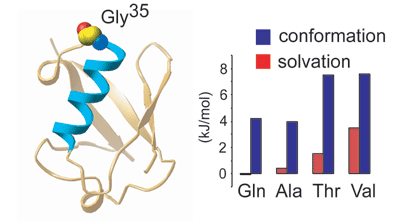
Protein
-helices often terminate in recognizable helix-capping motifs. The origin of thermodynamic stability for one such motif is now well understood.
Full Text - Lifting the lid on helix-capping | PDF (123 KB) - Lifting the lid on helix-capping
See also: Letter by Bang et al.
Peter A Tipton
doi:10.1038/nchembio0306-124
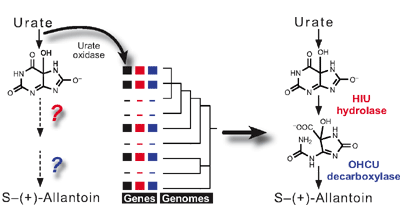
Enzymes that catalyze the formation of (S)-allantoin from the product of the urate oxidase reaction have been identified. This finding answers the longstanding question of how living organisms produce a single enantiomer of allantoin.
Full Text - Urate to allantoin, specifically (S)-allantoin | PDF (109 KB) - Urate to allantoin, specifically (S)-allantoin
See also: Letter by Ramazzina et al.
Nicola L Pohl
doi:10.1038/nchembio0306-125
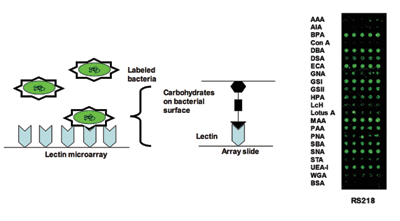
Bacteria are covered in sugars that facilitate the establishment of pathogenic or symbiotic relationships with other cells. Microarrays of carbohydrate-binding proteins now can provide quick snapshots of these sugar coats as they change during the bacterial life cycle and differ among bacterial strains.
Full Text - Array methodology singles out pathogenic bacteria | PDF (1,110 KB) - Array methodology singles out pathogenic bacteria
See also: Letter by Hsu et al.
Mark Howarth & Alice Y Ting
doi:10.1038/nchembio0306-127
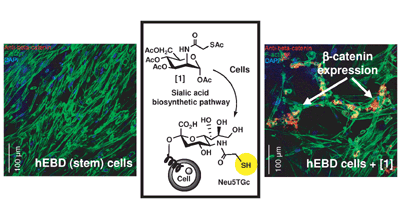
Looked at from the outside of the cell, proteins are often hidden behind a forest of sugar chains. Using a sugar analog to introduce thiols onto the tips of the branches of this forest alters cell attachment and has unexpected consequences for cell differentiation.
Full Text - Giving cells a new sugar-coating | PDF (214 KB) - Giving cells a new sugar-coating
See also: Letter by Sampathkumar et al.
Myles H Akabas
doi:10.1038/nchembio0306-128
Using single-molecule biophysical studies in an ion channel, the protonation state of engineered basic amino acids was measured in real time, making it possible to calculate the pKas of the substituted residues and creating a unique, comprehensive dataset for theorists studying the effects of an electrostatic environment on integral membrane protein function.
Full Text - Watching single protons bind | PDF (256 KB) - Watching single protons bind
doi:10.1038/nchembio0306-131
Full Text - Research Highlights | PDF (112 KB) - Research Highlights
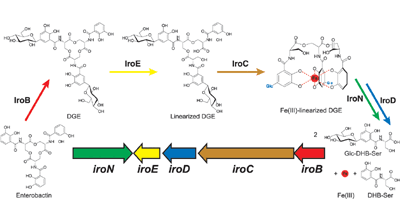
Michael A Fischbach, Hening Lin, David R Liu & Christopher T Walsh
doi:10.1038/nchembio771

Abstract - How pathogenic bacteria evade mammalian sabotage in the battle for iron | Full Text - How pathogenic bacteria evade mammalian sabotage in the battle for iron | PDF (394 KB) - How pathogenic bacteria evade mammalian sabotage in the battle for iron
-helix C-cap termination through chemical protein synthesis - pp139 - 143Duhee Bang, Alexey V Gribenko, Valentina Tereshko, Anthony A Kossiakoff, Stephen B Kent & George I Makhatadze
doi:10.1038/nchembio766

First Paragraph - Dissecting the energetics of protein [alpha]-helix C-cap termination through chemical protein synthesis | Full Text - Dissecting the energetics of protein
-helix C-cap termination through chemical protein synthesis | PDF (367 KB) - Dissecting the energetics of protein
-helix C-cap termination through chemical protein synthesis | Supplementary information
See also: News and Views by Rose
Ileana Ramazzina, Claudia Folli, Andrea Secchi, Rodolfo Berni & Riccardo Percudani
doi:10.1038/nchembio768

First Paragraph - Completing the uric acid degradation pathway through phylogenetic comparison of whole genomes | Full Text - Completing the uric acid degradation pathway through phylogenetic comparison of whole genomes | PDF (507 KB) - Completing the uric acid degradation pathway through phylogenetic comparison of whole genomes | Supplementary information | Chemical compounds
See also: News and Views by Tipton
Srinivasa-Gopalan Sampathkumar, Adrienne V Li, Mark B Jones, Zhonghui Sun & Kevin J Yarema
doi:10.1038/nchembio770

First Paragraph - Metabolic installation of thiols into sialic acid modulates adhesion and stem cell biology | Full Text - Metabolic installation of thiols into sialic acid modulates adhesion and stem cell biology | PDF (476 KB) - Metabolic installation of thiols into sialic acid modulates adhesion and stem cell biology | Supplementary information | Chemical compounds
See also: News and Views by Howarth & Ting
Ku-Lung Hsu, Kanoelani T Pilobello & Lara K Mahal
doi:10.1038/nchembio767

First Paragraph - Analyzing the dynamic bacterial glycome with a lectin microarray approach | Full Text - Analyzing the dynamic bacterial glycome with a lectin microarray approach | PDF (319 KB) - Analyzing the dynamic bacterial glycome with a lectin microarray approach | Supplementary information
See also: News and Views by Pohl
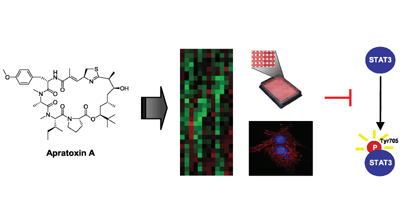
Hendrik Luesch, Sumit K Chanda, R Marina Raya, Paul D DeJesus, Anthony P Orth, John R Walker, Juan Carlos Izpisúa Belmonte & Peter G Schultz
doi:10.1038/nchembio769

Abstract - A functional genomics approach to the mode of action of apratoxin A | Full Text - A functional genomics approach to the mode of action of apratoxin A | PDF (508 KB) - A functional genomics approach to the mode of action of apratoxin A | Supplementary information | Chemical compounds
Brian P English, Wei Min, Antoine M van Oijen, Kang Taek Lee, Guobin Luo, Hongye Sun, Binny J Cherayil, S C Kou & X Sunney Xie
doi:10.1038/nchembio0306-168
Full Text - Ever-fluctuating single enzyme molecules: Michaelis-Menten equation revisited | PDF (50 KB) - Ever-fluctuating single enzyme molecules: Michaelis-Menten equation revisited
Nature Chemical Biology
ISSN: 1552-4450
EISSN: 1548-7105