Table of contents
February 2009, Volume 11 No 2 pp111-226
About the coverEditorial
Darwin's legacy - p111
doi:10.1038/ncb0209-111
The double anniversary of Darwin's bicentenary and 150 years since publication of On the Origin of Species by Means of Natural Selection provides the perfect pretext to enhance the public understanding of evolution.
Full Text - Darwin's legacy | PDF (190 KB) - Darwin's legacy
News and Views
Cytokinesis: mind the GAP - pp112 - 114
Pier Paolo D'Avino & David M. Glover
doi:10.1038/ncb0209-112
Cytokinesis ensures proper partitioning of genomic and cytoplasmic material between dividing cells. A key regulator of this process is the centralspindlin complex. Two recent papers report that GAP activity of one of the members of this complex regulates the function of Rho family GTPases during cytokinesis.
Full Text - Cytokinesis: mind the GAP | PDF (249 KB) - Cytokinesis: mind the GAP
Alzheimer's dementia by circulation disorders: when trees hide the forest - pp114 - 116
Carlos G. Dotti & Bart De Strooper
doi:10.1038/ncb0209-114
Deposition of amyloid
-peptide in cerebral vessel walls, termed cerebral amyloid angiopathy (CAA), enhances the cognitive deficits associated with Alzheimer's disease. The molecular details by which circulatory defects with hypoxia alter peptide clearance, contributing to brain deposition and AD, are beginning to be elucidated.
Full Text - Alzheimer's dementia by circulation disorders: when trees hide the forest | PDF (255 KB) - Alzheimer's dementia by circulation disorders: when trees hide the forest
See also: Article by Bell et al.
Linear polyubiquitylation: the missing link in NF–
B signalling - pp116 - 118
Arthur L. Haas
doi:10.1038/ncb0209-116
Metazoan cells respond to external stress or infection through multiple signalling pathways that converge on NF–
B activation, initiating a program designed to promote survival or trigger cell death. Recent evidence reveals a mechanism for NF-
B activation that requires assembly of linear polyubiquitin chains as scaffolds to recruit the activation complex.
Full Text - Linear polyubiquitylation: the missing link in NF–
B signalling | PDF (405 KB) - Linear polyubiquitylation: the missing link in NF–
B signalling
See also: Article by Tokunaga et al.
Casting back to stem cells - pp118 - 120
Shosei Yoshida
doi:10.1038/ncb0209-118
In the classical view, adult stem cells and their differentiating progeny are considered to be distinct entities in an irreversible sequence of development. However, emerging evidence suggests that this distinction may not be so definitive. Recent work in the mouse shows that a population of differentiating spermatogonia, when transplanted, can 'de-differentiate' into functional self-renewing stem cells.
Full Text - Casting back to stem cells | PDF (2,014 KB) - Casting back to stem cells
See also: Letter by Barroca et al.
Research Highlights
Research highlights - p121
Silvia Grisendi, Nathalie Le Bot, Christina Karlsson Rosenthal & Sowmya Swaminathan
doi:10.1038/ncb0209-121
Full Text - Research highlights | PDF (157 KB) - Research highlights
Articles
Involvement of linear polyubiquitylation of NEMO in NF-
B activation - pp123 - 132
Fuminori Tokunaga, Shin-ichi Sakata, Yasushi Saeki, Yoshinori Satomi, Takayoshi Kirisako, Kiyoko Kamei, Tomoko Nakagawa, Michiko Kato, Shigeo Murata, Shoji Yamaoka, Masahiro Yamamoto, Shizuo Akira, Toshifumi Takao, Keiji Tanaka & Kazuhiro Iwai
doi:10.1038/ncb1821
NF-
B signalling protein NEMO is the first physiological substrate for linear head-to-tail polyubiquitin chains. The heterodimeric ubiquitin ligase LUBAC catalyses the reaction and mice lacking a LUBAC subunit show defects in NF-
B signalling.
Abstract - | Full Text - Involvement of linear polyubiquitylation of NEMO in NF-
B activation | PDF (1,404 KB) - Involvement of linear polyubiquitylation of NEMO in NF-
B activation | Supplementary information
See also: News and Views by Haas
The prolyl-isomerase Pin1 is a Notch1 target that enhances Notch1 activation in cancer - pp133 - 142
Alessandra Rustighi, Luca Tiberi, Alessia Soldano, Marco Napoli, Paolo Nuciforo, Antonio Rosato, Fred Kaplan, Anthony Capobianco, Salvatore Pece, Pier Paolo Di Fiore & Giannino Del Sal
doi:10.1038/ncb1822
Pin1 interacts with Notch1 to increases its cleavage by
-secretase and thus its transcriptional activity. In a feedback loop, Notch1 controls Pin1 expression, which results in enhanced Notch1 tumorigenic activity.
Abstract - | Full Text - The prolyl-isomerase Pin1 is a Notch1 target that enhances Notch1 activation in cancer | PDF (1,185 KB) - The prolyl-isomerase Pin1 is a Notch1 target that enhances Notch1 activation in cancer | Supplementary information
SRF and myocardin regulate LRP-mediated amyloid-
clearance in brain vascular cells - pp143 - 153
Robert D. Bell, Rashid Deane, Nienwen Chow, Xiaochun Long, Abhay Sagare, Itender Singh, Jeffrey W. Streb, Huang Guo, Anna Rubio, William Van Nostrand, Joseph M. Miano & Berislav V. Zlokovic
doi:10.1038/ncb1819
Accumulation of amyloid
peptide in cerebral blood vessels has been linked to brain dysfunction. SRF and myocardin transcription factors are induced by cerebral hypoxia and reduce amyloid clearance by regulating SREBP2, a transcriptional repressor that acts on the amyloid aggregate clearance factor LRP1.
Abstract - | Full Text - SRF and myocardin regulate LRP-mediated amyloid-
clearance in brain vascular cells | PDF (1,651 KB) - SRF and myocardin regulate LRP-mediated amyloid-
clearance in brain vascular cells | Supplementary information
See also: News and Views by Dotti & Strooper
Interaction between TAK1–TAB1–TAB2 and RCAN1–calcineurin defines a signalling nodal control point - pp154 - 161
Qinghang Liu, Jennifer Caldwell Busby & Jeffery D. Molkentin
doi:10.1038/ncb1823
RCAN1, the regulator of calcineurin phosphatase, interacts with TAK1 kinase binding protein 2 (TAB2). This leads to formation of the signalling complex TAK1-TAB1-TAB2, which phosphorylates RCAN1 and converts it to an activator of the calcineurin-NFAT pathway. Activated calcineurin then switches the signal off by dephopshorylating TAK1 and TAB1.
Abstract - | Full Text - Interaction between TAK1–TAB1–TAB2 and RCAN1–calcineurin defines a signalling nodal control point | PDF (933 KB) - Interaction between TAK1–TAB1–TAB2 and RCAN1–calcineurin defines a signalling nodal control point | Supplementary information
Nuclear signalling by tumour-associated antigen EpCAM - pp162 - 171
Dorothea Maetzel, Sabine Denzel, Brigitte Mack, Martin Canis, Philip Went, Michael Benk, Cuong Kieu, Peer Papior, Patrick A. Baeuerle, Markus Munz & Olivier Gires
doi:10.1038/ncb1824
The intracellular fragment of the adhesion molecule EpCAM, which is generated by the proteases TACE and presenilin-2, increases cell proliferation and acts in a complex with
-catenin and Lef-1 to regulate gene expression.
Abstract - | Full Text - Nuclear signalling by tumour-associated antigen EpCAM | PDF (1,362 KB) - Nuclear signalling by tumour-associated antigen EpCAM | Supplementary information
CHD8 suppresses p53-mediated apoptosis through histone H1 recruitment during early embryogenesis - pp172 - 182
Masaaki Nishiyama, Kiyotaka Oshikawa, Yu-ichi Tsukada, Tadashi Nakagawa, Shun-ichiro Iemura, Tohru Natsume, Yuhong Fan, Akira Kikuchi, Arthur I. Skoultchi & Keiichi I. Nakayama
doi:10.1038/ncb1831
The DNA-binding chromodomain helicase CHD8 regulates gene expression but how it acts on specific genes has been unclear. During early embryogenesis in mice, CHD8 recruits histone H1 to the p53-dependent promotors of apoptotic genes and thereby prevents massive cell death at this stage of development.
Abstract - | Full Text - CHD8 suppresses p53-mediated apoptosis through histone H1 recruitment during early embryogenesis | PDF (1,581 KB) - CHD8 suppresses p53-mediated apoptosis through histone H1 recruitment during early embryogenesis | Supplementary information
Letters
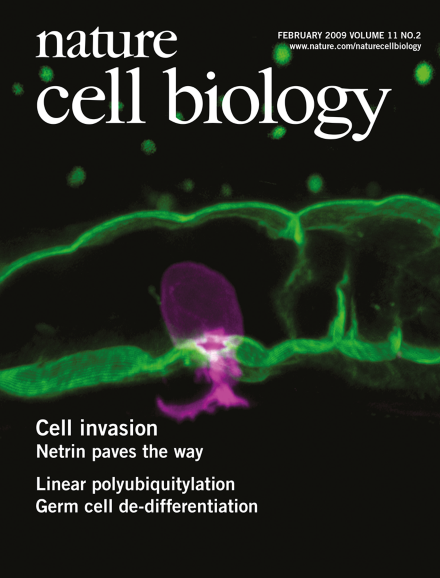
UNC-6 (netrin) orients the invasive membrane of the anchor cell in C. elegans - pp183 - 189
Joshua W. Ziel, Elliott J. Hagedorn, Anjon Audhya & David R. Sherwood
doi:10.1038/ncb1825
The C.elegans anchor cell is a model for cellular invasion through the basement membrane. Now netrin (UNC-6) is found to polarize the actin regulators Ena/VASP and PtdIns (4,5)P2 towards the basement membrane to promote anchor cell invasion.
First Paragraph - | Full Text - UNC-6 (netrin) orients the invasive membrane of the anchor cell in C. elegans | PDF (1,112 KB) - UNC-6 (netrin) orients the invasive membrane of the anchor cell in C. elegans | Supplementary information
Mouse differentiating spermatogonia can generate germinal stem cells in vivo - pp190 - 196
Vilma Barroca, Bruno Lassalle, Mathieu Coureuil, Jean Paul Louis, Florence Le Page, Jacques Testart, Isabelle Allemand, Lydia Riou & Pierre Fouchet
doi:10.1038/ncb1826
When transplanted into adult mice, purified mouse spermatogonial progenitors that are committed to differentiation can revert to functional germinal stem cells, with the ability to repopulate germ-cell-depleted testes.
First Paragraph - | Full Text - Mouse differentiating spermatogonia can generate germinal stem cells in vivo | PDF (977 KB) - Mouse differentiating spermatogonia can generate germinal stem cells in vivo | Supplementary information
See also: News and Views by Yoshida
Reprogramming of fibroblasts into induced pluripotent stem cells with orphan nuclear receptor Esrrb - pp197 - 203
Bo Feng, Jianming Jiang, Petra Kraus, Jia-Hui Ng, Jian-Chien Dominic Heng, Yun-Shen Chan, Lai-Ping Yaw, Weiwei Zhang, Yuin-Han Loh, Jianyong Han, Vinsensius B. Vega, Valere Cacheux-Rataboul, Bing Lim, Thomas Lufkin & Huck-Hui Ng
doi:10.1038/ncb1827
The orphan nuclear receptor Esrrb induces reprogramming of mouse embryonic fibroblasts to pluripotent stem cells in cooperation with Oct4 and Sox2.
First Paragraph - | Full Text - Reprogramming of fibroblasts into induced pluripotent stem cells with orphan nuclear receptor Esrrb | PDF (1,265 KB) - Reprogramming of fibroblasts into induced pluripotent stem cells with orphan nuclear receptor Esrrb | Supplementary information
Topoisomerase II
controls the decatenation checkpoint - pp204 - 210
Kuntian Luo, Jian Yuan, Junjie Chen & Zhenkun Lou
doi:10.1038/ncb1828
Separation of intertwined sister chromatids, mediated by topoisomerase II, is essential for mitosis. In a separate mechanism, phosphorylation of topoisomerase II at Ser 1524 during the G2/M phase of the cell cycle recruits MDC1 to activate the decatenation checkpoint required for genomic stability.
First Paragraph - | Full Text - Topoisomerase II
controls the decatenation checkpoint | PDF (807 KB) - Topoisomerase II
controls the decatenation checkpoint | Supplementary information
Phosphorylation of ATM by Cdk5 mediates DNA damage signalling and regulates neuronal death - pp211 - 218
Bo Tian, Qian Yang & Zixu Mao
doi:10.1038/ncb1829
CDK5 kinase regulates the neuronal stress response, whereas the DNA damage response kinase ATM induces apoptosis in postmitotic neurons. Now, CDK5 activated by DNA damage is shown to directly activate ATM to induce neuronal cell death.
First Paragraph - | Full Text - Phosphorylation of ATM by Cdk5 mediates DNA damage signalling and regulates neuronal death | PDF (1,059 KB) - Phosphorylation of ATM by Cdk5 mediates DNA damage signalling and regulates neuronal death | Supplementary information
Cytoplasmic penetration and persistent infection of mammalian cells by polyglutamine aggregates - pp219 - 225
Pei-Hsien Ren, Jane E. Lauckner, Ioulia Kachirskaia, John E. Heuser, Ronald Melki & Ron R. Kopito
doi:10.1038/ncb1830
Fibrillar polyglutamine aggregates are taken up by mammalian cells in culture and associate with aggresomes that contain both proteasome subunits and chaperones. Aggresomes also recruit soluble proteins that share the same amyloidogenic sequences as the internalised polyglutamine aggregates.
First Paragraph - | Full Text - Cytoplasmic penetration and persistent infection of mammalian cells by polyglutamine aggregates | PDF (1,015 KB) - Cytoplasmic penetration and persistent infection of mammalian cells by polyglutamine aggregates | Supplementary information
Erratum
Apoptotic histone modification inhibits nuclear transport by regulating RCC1 - p226
Chi-Hang Wong, Hei Chan, Chin-Yee Ho, Soak-Kuan Lai, Kheng-Sze Chan, Cheng-Gee Koh & Hoi-Yeung Li
doi:10.1038/ncb0209-226
Full Text - Apoptotic histone modification inhibits nuclear transport by regulating RCC1 | PDF (320 KB) - Apoptotic histone modification inhibits nuclear transport by regulating RCC1