Table of contents
Volume 461 Number 7268 pp1173-1312
(this content only available online) indicates content that is available online only
Editorials
Gene therapy deserves a fresh chance p1173
Initial interest in gene therapy waned after the technology failed to live up to expectation. Progress made since has received little attention, but suggests that the pervading sense of disillusionment is misplaced.
doi:10.1038/4611173a
Darwin and culture p1173
A new series of essays traces the astounding variety of reactions to the theory of evolution.
doi:10.1038/4611173b
Mind the spin p1174
Scientists — and their institutions — should resist the ever-present temptation to hype their results.
doi:10.1038/4611174a
Research Highlights
Biology: Chill out p1176
doi:10.1038/4611176a
Physics: Quantum speed limit p1176
doi:10.1038/4611176b
Biology: How cockroaches steer p1176
doi:10.1038/4611176c
Nanotoxicology: Lung penetration p1176
doi:10.1038/4611176d
Climate change: Stormy warming weather p1176
doi:10.1038/4611176e
Cancer biology: Double protection p1176
doi:10.1038/4611176f
Biophysics: All seeing eye p1177
doi:10.1038/4611177a
Neuroscience: Brain signal source p1177
doi:10.1038/4611177b
Sexual selection: Intruder alert! p1177
doi:10.1038/4611177c
Astronomy: Galaxy size matters p1177
doi:10.1038/4611177d
News
News briefing: 29 October 2009 p1178
The week in science
doi:10.1038/4611178a
African science feels the pinch p1180
Recession dampens donors' enthusiasm.
Linda Nordling
doi:10.1038/4611180a
Woo Suk Hwang convicted, but not of fraud p1181
Cloning pioneer gets two years for embezzlement and bioethics breach.
David Cyranoski
doi:10.1038/4611181a
US physicists propose astrophysics goals p1181
Dark energy and dark matter prove popular choices for funding.
Eric Hand
doi:10.1038/4611181b
Dark energy rips cosmos and agencies p1182
An international space mission to study an astronomical mystery is foundering.
Eric Hand
doi:10.1038/4611182a
Ozone protocol squares up to climate p1184
Europeans back efforts to amend the Montreal Protocol to address global warming.
Jeff Tollefson
doi:10.1038/4611184a
University tightens oversight of sensitive research p1185
Conviction prompts rethink of data rules.
Elie Dolgin
doi:10.1038/4611185a
Jury still out on HIV vaccine results p1187
Some experts see hope in trial findings, but others say that the data do not back up such optimism.
Declan Butler
doi:10.1038/4611187a
Correction p1187
doi:10.1038/4611187b
News Features
Decision-making: Risk school p1189
Can the general public learn to evaluate risks accurately, or do authorities need to steer it towards correct decisions? Michael Bond talks to the two opposing camps.
doi:10.1038/4611189a
Neuroscience: Shooting pain p1194
Sean Mackey inflicts pain on people in the hope of learning how to relieve it. Erik Vance gets on the receiving end.
doi:10.1038/4611194a
Correspondence
Brainstem tests not adequate to diagnose death in organ donors p1198
David W. Evans
doi:10.1038/4611198a
Funding on 'Sheriff of Nottingham' model could cut productivity p1198
David Currie
doi:10.1038/4611198b
A playful side to twelfth-century mathematics p1198
Ram Ramaswamy & Rohini Godbole
doi:10.1038/4611198c
Weighing up NICE against private health-care schemes p1198
Todd A. Gibson
doi:10.1038/4611198d
Opinion
Global Darwin: Eastern enchantment p1200
People from Egypt to Japan used Darwin's ideas to reinvent and reignite their core philosophies and religions, says Marwa Elshakry in the first of four weekly pieces on how evolution was received around the world.
Marwa Elshakry
doi:10.1038/4611200a
The day the Internet age began p1202
Forty years ago today the first message was sent between computers on the ARPANET. Vinton G. Cerf, who was a principal programmer on the project, reflects on how our online world was shaped by its innovative origins.
Vinton G. Cerf
doi:10.1038/4611202a
Autumn Books
Reassessing the father of chemistry p1205
Robert Boyle's character is often obscured by the shadow of Isaac Newton, but a masterful biography reveals him as larger than life, explains Peter Anstey.
Peter Anstey reviews Boyle: Between God and Science by Michael Hunter
doi:10.1038/4611205a
New in paperback p1205
doi:10.1038/4611205b
Capturing digital lives p1206
Fred Turner reviews Total Recall: How the E-Memory Revolution Will Change Everything by Gordon Bell & Jim Gemmell and Delete: The Virtue of Forgetting in the Digital Age by Viktor Mayer-Schönberger
doi:10.1038/4611206a
Explorer of the deep p1209
Jean Vacelet reviews Jacques Cousteau: The Sea King by Brad Matsen
doi:10.1038/4611209a
Darwin's puppy love p1210
Clive Wynne reviews Darwin's Dogs: How Darwin's Pets Helped Form a World-Changing Theory of Evolution by Emma Townshend
doi:10.1038/4611210a
Forgotten treasure seeker p1211
Jennifer Rohn reviews The Fossil Hunter: Dinosaurs, Evolution, and the Woman Whose Discoveries Changed The World by Shelley Emling and Remarkable Creatures by Tracy Chevalier
doi:10.1038/4611211a
History of the hard stuff p1213
Jim Lapsley reviews Uncorking the Past: The Quest for Wine, Beer, and Other Alcoholic Beverages by Patrick E. McGovern
doi:10.1038/4611213a
Living by the calendar p1214
Serge Daan reviews The Seasons of Life: The Biological Rhythms that Living Things Need to Thrive and Survive by Russell Foster & Leon Kreitzman
doi:10.1038/4611214a
Unmeasurable verse p1216
doi:10.1038/4611216a
News and Views
Quantum information: Caught at the finishing line p1217
Quantum systems habitually leak information, limiting their usefulness for practical applications. By optimally reversing the leak, this information loss has been reduced to a trickle in the solid state.
Bob B. Buckley & David D. Awschalom
doi:10.1038/4611217a
See also: Editor's summary
Materials science: Emerging routes to multiferroics p1218
Materials that combine ferroic properties — such as ferromagnetism and ferroelectricity — are highly desirable, but rare. A new class of multiferroic solids heralds a fresh approach for making such materials.
Ramamoorthy Ramesh
doi:10.1038/4611218a
Evolutionary biology: Arrhythmia of tempo and mode p1219
An exercise in experimental evolution using bacteria has been running for more than 20 years and 40,000 generations. The results to date provide a glimpse of a new world, and are cause for both delight and unease.
Paul B. Rainey
doi:10.1038/4611219a
See also: Editor's summary
Astrophysics: Most distant cosmic blast seen p1221
The most distant
-ray burst yet sighted is the earliest astronomical object ever observed in cosmic history. This ancient beacon offers a glimpse of the little-known cosmic dark ages.
Bing Zhang
doi:10.1038/4611221a
See also: Editor's summary
Catalysis: Bond control in surface reactions p1223
Catalysts steer reactions towards certain products — but the basis of their control is often unclear. Quantum chemical calculations reveal which parameters control bond formation in a network of catalytic reactions.
Jens K. Nørskov & Frank Abild-Pedersen
doi:10.1038/4611223a
Structural biology: DNA binding shapes up p1225
DNA-binding proteins have the daunting task of finding their binding sites among the 3 billion base pairs of the human genome. The shape of DNA, and not just its sequence, may offer proteins much-needed direction.
Tom Tullius
doi:10.1038/4611225a
See also: Editor's summary
Statistical physics: Swirled by light p1226
A micrometre-sized particle immersed in a liquid can be trapped by light. An experiment shows that the trapping can be accompanied by a whirling whose direction can be reversed by changing the light intensity.
Mark I. Dykman
doi:10.1038/4611226a
Progress
Volatile accretion history of the terrestrial planets and dynamic implications p1227
Francis Albarède
doi:10.1038/nature08477
First paragraph | Full Text | PDF (674K)
See also: Editor's summary
Review
What recent ribosome structures have revealed about the mechanism of translation p1234
T. Martin Schmeing & V. Ramakrishnan
doi:10.1038/nature08403
First paragraph | Full Text | PDF (1,331K)
See also: Editor's summary
Articles
Genome evolution and adaptation in a long-term experiment with Escherichia coli p1243
Here, in order to gain insight into the relationship between rates of genomic evolution and organismal adaptation, genomes sampled through 40,000 generations are sequenced from a laboratory population of Escherichia coli. The results indicate that the coupling between genomic and adaptive evolution is complex and can be counterintuitive even in a constant environment, with beneficial mutations surprisingly uniform over time whereas neutral substitutions were highly variable.
Jeffrey E. Barrick, Dong Su Yu, Sung Ho Yoon, Haeyoung Jeong, Tae Kwang Oh, Dominique Schneider, Richard E. Lenski & Jihyun F. Kim
doi:10.1038/nature08480
Abstract | Full Text | PDF (376K) | Supplementary information
See also: Editor's summary | News and Views by Rainey
The role of DNA shape in protein–DNA recognition p1248
The question of how proteins recognize specific DNA sequences in the face of vastly higher concentrations of non-specific DNA remains unclear. One suggested mechanism involves the formation of hydrogen bonds with specific bases, primarily in the major groove. The comprehensive analysis of the three-dimensional structures of protein–DNA complexes now shows that the binding of arginine residues to narrow minor grooves is a widely used mode for protein–DNA recognition.
Remo Rohs, Sean M. West, Alona Sosinsky, Peng Liu, Richard S. Mann & Barry Honig
doi:10.1038/nature08473
Abstract | Full Text | PDF (769K) | Supplementary information
See also: Editor's summary | News and Views by Tullius
Letters
A
-ray burst at a redshift of z
8.2 p1254
Long-duration
-ray bursts (GRBs), thought to result from the explosions of certain massive stars, are bright enough that some of them should be observable out to redshifts of z > 20. So far, the highest redshift measured for any object has been z = 6.96, for a Lyman-
emitting galaxy. Here, and in an accompanying paper, GRB 090423 is reported to lie at a redshift of z
8.2, implying that massive stars were being produced and dying as GRBs approximately 620 million years after the Big Bang.
N. R. Tanvir, D. B. Fox, A. J. Levan, E. Berger, K. Wiersema, J. P. U. Fynbo, A. Cucchiara, T. Krühler, N. Gehrels, J. S. Bloom, J. Greiner, P. A. Evans, E. Rol, F. Olivares, J. Hjorth, P. Jakobsson, J. Farihi, R. Willingale, R. L. C. Starling, S. B. Cenko, D. Perley, J. R. Maund, J. Duke, R. A. M. J. Wijers, A. J. Adamson, A. Allan, M. N. Bremer, D. N. Burrows, A. J. Castro-Tirado, B. Cavanagh, A. de Ugarte Postigo, M. A. Dopita, T. A. Fatkhullin, A. S. Fruchter, R. J. Foley, J. Gorosabel, J. Kennea, T. Kerr, S. Klose, H. A. Krimm, V. N. Komarova, S. R. Kulkarni, A. S. Moskvitin, C. G. Mundell, T. Naylor, K. Page, B. E. Penprase, M. Perri, P. Podsiadlowski, K. Roth, R. E. Rutledge, T. Sakamoto, P. Schady, B. P. Schmidt, A. M. Soderberg, J. Sollerman, A. W. Stephens, G. Stratta, T. N. Ukwatta, D. Watson, E. Westra, T. Wold & C. Wolf
doi:10.1038/nature08459
First paragraph | Full Text | PDF (379K) | Supplementary information
See also: Editor's summary | News and Views by Zhang
GRB 090423 at a redshift of z
8.1 p1258
Long-duration
-ray bursts (GRBs), thought to result from the explosions of certain massive stars, are bright enough that some of them should be observable out to redshifts of z > 20. So far, the highest redshift measured for any object has been z = 6.96, for a Lyman-
emitting galaxy. Here, and in an accompanying paper, GRB 090423 is reported to lie at a redshift of z
8.2, implying that massive stars were being produced and dying as GRBs approximately 620 million years after the Big Bang.
R. Salvaterra, M. Della Valle, S. Campana, G. Chincarini, S. Covino, P. D'Avanzo, A. Fernández-Soto, C. Guidorzi, F. Mannucci, R. Margutti, C. C. Thöne, L. A. Antonelli, S. D. Barthelmy, M. De Pasquale, V. D'Elia, F. Fiore, D. Fugazza, L. K. Hunt, E. Maiorano, S. Marinoni, F. E. Marshall, E. Molinari, J. Nousek, E. Pian, J. L. Racusin, L. Stella, L. Amati, G. Andreuzzi, G. Cusumano, E. E. Fenimore, P. Ferrero, P. Giommi, D. Guetta, S. T. Holland, K. Hurley, G. L. Israel, J. Mao, C. B. Markwardt, N. Masetti, C. Pagani, E. Palazzi, D. M. Palmer, S. Piranomonte, G. Tagliaferri & V. Testa
doi:10.1038/nature08445
First paragraph | Full Text | PDF (454K) | Supplementary information
See also: Editor's summary | News and Views by Zhang
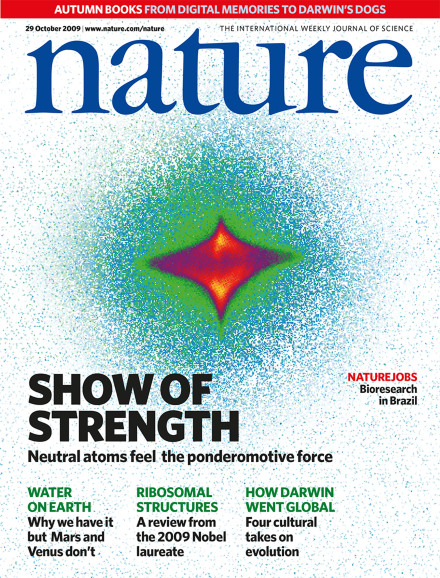
Acceleration of neutral atoms in strong short-pulse laser fields p1261
The force experienced by a charged particle in an oscillating electric field is proportional to the cycle-averaged intensity gradient. This 'ponderomotive' force plays a major part in a variety of physical situations. Extremely strong kinematic forces are now observed on neutral atoms in short-pulse laser fields; the ponderomotive force on electrons is identified as the driving mechanism, leading to probably the highest observed acceleration on neutral atoms in an external field to date.
U. Eichmann, T. Nubbemeyer, H. Rottke & W. Sandner
doi:10.1038/nature08481
First paragraph | Full Text | PDF (475K)
See also: Editor's summary
Preserving electron spin coherence in solids by optimal dynamical decoupling p1265
For the quantum coherence of electron spins in solid materials to be exploited in future technologies such as quantum computing, the problem of spin decoherence due to electron spins coupling to the noisy environment must first be solved. Here, pulsed electron paramagnetic resonance is used to demonstrate experimentally optimal dynamical decoupling for preserving electron spin coherence in irradiated malonic acid crystals at temperatures from 50 K to room temperature.
Jiangfeng Du, Xing Rong, Nan Zhao, Ya Wang, Jiahui Yang & R. B. Liu
doi:10.1038/nature08470
First paragraph | Full Text | PDF (499K) | Supplementary information
See also: Editor's summary | News and Views by Buckley & Awschalom
A dearth of intermediate melts at subduction zone volcanoes and the petrogenesis of arc andesites p1269
A large proportion of the magmas erupted at continental arc volcanoes are andesites, which are regarded as a major component in the formation of continental crust — consequently, it is important to understand andesite petrogenesis. Here, an alternative view of andesite petrogenesis is presented, based on a review of quenched glassy melt inclusions trapped in phenocrysts, whole-rock chemistry, and high-pressure and high-temperature experiments; this new view resolves several puzzling aspects of arc volcanism.
Olivier Reubi & Jon Blundy
doi:10.1038/nature08510
First paragraph | Full Text | PDF (1,833K)
See also: Editor's summary
Visual but not trigeminal mediation of magnetic compass information in a migratory bird p1274
How do birds find their way home? Magnetic compass information is known to have a key role in bird orientation, but how birds are able to sense the Earth's magnetic field remains unresolved, although two hypotheses have been proposed — the iron-mineral-based hypothesis and the light-dependent hypothesis. Here, reported data from European robins strongly suggest that a vision-mediated mechanism underlies the magnetic compass in this migratory songbird.
Manuela Zapka, Dominik Heyers, Christine M. Hein, Svenja Engels, Nils-Lasse Schneider, Jörg Hans, Simon Weiler, David Dreyer, Dmitry Kishkinev, J. Martin Wild & Henrik Mouritsen
doi:10.1038/nature08528
First paragraph | Full Text | PDF (529K) | Supplementary information
See also: Editor's summary
Regulation of cortical microcircuits by unitary GABA-mediated volume transmission p1278
Excess neurotransmitter diffuses out of the synaptic cleft, where it can activate neurotransmitter receptors outside the postsynaptic density. However, neurotransmitter reuptake is thought to limit the significance of such extrasynaptic, or 'volume', transmission. Individual neurogliaform cells are now shown to release enough GABA for volume transmission within the axonal cloud; these cells do not require synapses to produce inhibitory responses in nearby neurons.
Szabolcs Oláh, Miklós Füle, Gergely Komlósi, Csaba Varga, Rita Báldi, Pál Barzó & Gábor Tamás
doi:10.1038/nature08503
First paragraph | Full Text | PDF (552K) | Supplementary information
See also: Editor's summary
Regulation of inflammatory responses by gut microbiota and chemoattractant receptor GPR43 p1282
Recent evidence indicates that normal intestinal microbiota may positively influence immune responses and protect against the development of inflammatory diseases. One of the potential protective elements in this process are short-chain fatty acids (SCFAs), which are produced by fermentation of dietary fibre by intestinal microbiota and bind the G-protein-coupled receptor 43 (GPR43). Here it is shown that SCFA–GPR43 interactions profoundly affect inflammatory responses in mice.
Kendle M. Maslowski, Angelica T. Vieira, Aylwin Ng, Jan Kranich, Frederic Sierro, Di Yu, Heidi C. Schilter, Michael S. Rolph, Fabienne Mackay, David Artis, Ramnik J. Xavier, Mauro M. Teixeira & Charles R. Mackay
doi:10.1038/nature08530
First paragraph | Full Text | PDF (735K) | Supplementary information
See also: Editor's summary
Resolvin D2 is a potent regulator of leukocytes and controls microbial sepsis p1287
Evidence indicates that resolution of acute inflammation is an active process, and resolvins — a family of lipid mediators enzymatically generated within resolution networks — possess unique and specific functions to orchestrate catabasis, the phase in which disease declines. Resolvin D2 is now shown to reduce excessive neutrophil trafficking to inflammatory sites and to decrease leukocyte interactions with endothelial cells in a nitric-oxide-dependent manner.
Matthew Spite, Lucy V. Norling, Lisa Summers, Rong Yang, Dianne Cooper, Nicos A. Petasis, Roderick J. Flower, Mauro Perretti & Charles N. Serhan
doi:10.1038/nature08541
First paragraph | Full Text | PDF (523K) | Supplementary information
See also: Editor's summary
Epigenetic reversion of post-implantation epiblast to pluripotent embryonic stem cells p1292
The pluripotent state is first established in the primitive ectoderm cells of blastocysts but is progressively and irreversibly lost during development. For example, the transition from primitive ectoderm cell to epiblast cell, post implantation, involves significant transcriptional and epigenetic changes. A technique for reprogramming advanced epiblast cells from embryonic day 5.5–7.5 mouse embryos to embryonic-stem-cell-like cells — representing a return to pluripotency — is now demonstrated.
Siqin Bao, Fuchou Tang, Xihe Li, Katsuhiko Hayashi, Astrid Gillich, Kaiqin Lao & M. Azim Surani
doi:10.1038/nature08534
First paragraph | Full Text | PDF (916K) | Supplementary information
See also: Editor's summary
A regulatory circuit for piwi by the large Maf gene traffic jam in Drosophila p1296
PIWI-interacting RNAs (piRNAs) are a class of small RNAs that are known to associate with the PIWI proteins Argonaute 3, Aubergine and Piwi to silence retrotransposons in Drosophila germ lines. However, the primary processing pathway, one of two systems to produce piRNAs in Drosophila, remains incompletely characterized. Primary piRNA processing in a Drosophila ovarian somatic cell line is now analysed to reveal the large Maf gene traffic jam as a new piRNA cluster.
Kuniaki Saito, Sachi Inagaki, Toutai Mituyama, Yoshinori Kawamura, Yukiteru Ono, Eri Sakota, Hazuki Kotani, Kiyoshi Asai, Haruhiko Siomi & Mikiko C. Siomi
doi:10.1038/nature08501
First paragraph | Full Text | PDF (849K) | Supplementary information
See also: Editor's summary
Exploitation of binding energy for catalysis and design p1300
Enzymes use substrate-binding energy to promote ground-state association and to selectively stabilize the reaction transition state. Mutations in the amino-terminal domain of the monomeric homing endonuclease I-AniI, which cleaves with high sequence specificity in the centre of a 20-base-pair DNA target site, are now found to have different effects on the kinetic parameters of the enzyme than those in the carboxy-terminal domain, revealing an unexpected asymmetry in the use of enzyme–substrate binding energy for catalysis.
Summer B. Thyme, Jordan Jarjour, Ryo Takeuchi, James J. Havranek, Justin Ashworth, Andrew M. Scharenberg, Barry L. Stoddard & David Baker
doi:10.1038/nature08508
First paragraph | Full Text | PDF (971K) | Supplementary information
See also: Editor's summary
Naturejobs
Careers Q&AIan Anderson p1307
An ecologist at the University of Western Sydney, Australia, Anderson has won the first annual ProSPER.NET-Scopus Young Scientist award for agriculture and natural resources.
Virginia Gewin
doi:10.1038/nj7268-1307a
Postdoc journal
The many hats of science p1307
I need to collect them all.
Bryan Venters
doi:10.1038/nj7268-1307b
In Brief
Women honoured p1307
Winners of women-in-life-sciences award announced.
doi:10.1038/nj7268-1307c
Geoscientist shortfall p1307
US needs more researchers to address environment and climate-change issues.
doi:10.1038/nj7268-1307d
Burnham expands south p1307
California research institute opens Florida branch with university as co-tenant.
doi:10.1038/nj7268-1307e
Region
Fertile grounds p1308
Can Brazil use its booming economy and abundant natural resources to become a life-sciences juggernaut? Gene Russo finds out.
Gene Russo
doi:10.1038/nj7268-1308a
Correction
Correction p1309
doi:10.1038/nj7268-1309a