doi:10.1038/461320a
Table of contents
Volume 461 Number 7262 pp315-438
(this content only available online) indicates content that is available online only
Editorials
Trust, but verify p315
Collaborations between researchers and industry are essential to biomedical progress. But relations have to be completely open.
doi:10.1038/461315a
Taking the NICE path p315
The United States can learn from the UK body that rates the effectiveness of medical procedures.
doi:10.1038/461315b
SETI at 50 p316
Despite the long odds against success, the search for extraterrestrial intelligence has come a long way.
doi:10.1038/461316a
Research Highlights
Cancer biology: Now you see it p318
doi:10.1038/461318a
Technology: Lightning-fast memory p318
doi:10.1038/461318b
Genetics: Yeast joins the club at last p318
doi:10.1038/461318c
Chemistry: Aluminium arches p318
doi:10.1038/461318d
Acoustic science: A sonic one-way street p318
doi:10.1038/461318e
Atmospheric science: Alien sprites p318
doi:10.1038/461318f
Biology: Turning tail p319
doi:10.1038/461319a
Microbiology: Sussing Shewanella p319
doi:10.1038/461319b
Materials science: Hard-headed theories p319
doi:10.1038/461319c
Neurobiology: Teamwork rewarded p319
doi:10.1038/461319d
News
News briefing: 17 September 2009 p320
Vaccine venture boosts health hopes p323
Industry and academia join forces to develop cheap jabs against diseases that afflict the poorest.
Declan Butler
doi:10.1038/461323a
Ear to the Universe starts listening p324
US radio array starts its search for extraterrestrial life.
Eric Hand
doi:10.1038/461324a
Ghosts still present in the medical machine p325
Unattributed authors remain an issue for journals.
Nicola Jones
doi:10.1038/461325a
Q&A: Choon Fong Shih p326
The first president of Saudia Arabia's King Abdullah University of Science and Technology talks.
Daniel Cressey
doi:10.1038/461326a
RIKEN scientist arrested p327
Japanese researcher allegedly misused institutional funds.
David Cyranoski
doi:10.1038/461327a
Wonder weed plans fail to flourish p328
The first of four weekly articles on biofuels looks at how investment in jatropha is slowing, as investors realize that basic research is needed.
Katharine Sanderson
doi:10.1038/461328a
News Features
Money in biomedicine: The senator's sleuth p330
Paul Thacker, a reporter-turned-Congressional-investigator, has disrupted the careers of several top researchers with lucrative industry ties. Meredith Wadman tracks his effect on US science.
Meredith Wadman
doi:10.1038/461330a
Health economics: Life in the balance p336
How do researchers and policy-makers decide on the value of health? Daniel Cressey looks at Britain's National Institute for Health and Clinical Excellence.
Daniel Cressey
doi:10.1038/461336a
Correspondence
Non-lethal weapons and the civilian death toll in war time p340
Michael L. Gross
doi:10.1038/461340a
Don't overlook the rigorously reviewed novel work in patents p340
Donald F. Weaver & Christopher Barden
doi:10.1038/461340b
Keeping track of the Earth's carbon-cycle components p340
José Achache
doi:10.1038/461340c
Were crocodiles responsible for the stones we call tools? p341
Patrick Dempsey
doi:10.1038/461341a
Ethical concerns over use of new cloning technique in humans p341
Hans-Werner Denker
doi:10.1038/461341b
The need for a fresh symbol to designate copernicium p341
Juris Meija
doi:10.1038/461341c
Opinion
Plan B for Copenhagen p342
In 11 days the curtain will rise in Bangkok for the penultimate round of negotiations before the climate change conference in Copenhagen. David Victor warns of the dangers of a rushed, stapled-together deal.
David Victor
doi:10.1038/461342a
An alien concept p345
Fifty years ago this week, a Nature paper legitimized the idea that there could be civilizations elsewhere, able to communicate and wanting to contact us. Fred Kaplan reflects on its origins, impacts and legacy.
Fred Kaplan
doi:10.1038/461345a
Ocean fertilization: time to move on p347
Adding iron to the ocean is not an effective way to fight climate change, and we don't need further research to establish that, say Aaron Strong, Sallie Chisholm, Charles Miller and John Cullen.
Aaron Strong, Sallie Chisholm, Charles Miller & John Cullen
doi:10.1038/461347a
Books and Arts
On the origin of technology p349
An overdue theory of how machines and tools evolve downplays human creativity, argues Jon Agar.
Jon Agar reviews The Nature of Technology: What It Is and How It Evolves by W. Brian Arthur
doi:10.1038/461349a
Sound for the masses p350
Peter Border reviews Perfecting Sound Forever: An Aural History of Recorded Music by Greg Milner
doi:10.1038/461350a
Q&A: The inventor with an ear for the past p351
Engineer Duncan Miller has spent decades reviving the lost art of acoustic recording to wax cylinders, a technique pioneered by Thomas Edison. Nature finds out how his Vulcan Cylinder Record Company, based in Sheffield, UK, has combined sleuthing and modern chemistry to craft a new repertoire for the hand-cranked phonograph.
Jascha Hoffman
doi:10.1038/461351a
News and Views
Atmospheric chemistry: Thwarting the seeds of clouds p353
Atmospheric oxidation of hydrocarbons emitted from plants leads to the formation of aerosol particles that affect cloud properties. Contrary to what was thought, this process might add to global warming.
Paul J. Ziemann
doi:10.1038/461353a
See also: Editor's summary
Developmental biology: Asexual healing p354
The development of healthy monkeys from embryos in which the egg contains nuclear DNA from one donor and mitochondrial DNA from another suggests a method to prevent inheritance of certain human diseases.
Eric A. Shoubridge
doi:10.1038/461354a
See also: Editor's summary
50 & 100 years ago p355
doi:10.1038/461355a
Fluid dynamics: To merge or not to merge ... p356
... that is the dilemma addressed in a study of oppositely charged liquid drops controlled by an electric field. Contrary to conventional wisdom, beyond a critical charge, the drops fail to merge.
Frieder Mugele
doi:10.1038/461356a
See also: Editor's summary
Genomics: Hepatitis C virus gets personal p357
Many people infected with the hepatitis C virus are not cured despite gruelling therapy. A human genetic variant that predicts successful treatment has been identified. So is personalized therapy now a possibility?
Shawn P. Iadonato & Michael G. Katze
doi:10.1038/461357a
See also: Editor's summary
Biological chemistry: Beyond radical thinking p358
Radiation-induced DNA damage has been attributed to hydroxyl radicals, which form when water absorbs high-energy photons or charged particles. But another product of water's radiolysis might be the real culprit.
Léon Sanche
doi:10.1038/461358a
Epigenetics: Ready for the marks p359
Genomic imprinting, in which genes are expressed from either the maternal or paternal genome, involves the addition of methyl marks to DNA. Paradoxically, demethylation of histone proteins is an essential first step.
Robert Feil
doi:10.1038/461359a
See also: Editor's summary
Microbiology: Showering with bacteria p360
Shannon Amoils
doi:10.1038/461360a
Brief Communications Arising
VEGFR1-activity-independent metastasis formation pE4
Michelle R. Dawson, Dan G. Duda, Dai Fukumura & Rakesh K. Jain
doi:10.1038/nature08254
First paragraph | Full Text | PDF (311K)
Kaplan et al. reply pE5
Rosandra N. Kaplan, Rebecca D. Riba, Stergios Zacharoulis, Anna H. Bramley, Loïc Vincent, Carla Costa, Daniel D. MacDonald, David K. Jin, Koji Shido, Scott A. Kerns, Zhenping Zhu, Daniel Hicklin, Yan Wu, Jeffrey L. Port, Nasser Altorki, Elisa R. Port, Davide Ruggero, Sergey V. Shmelkov, Kristian K. Jensen, Shahin Rafii, David Lyden & J. Wels
doi:10.1038/nature08261
First paragraph | Full Text | PDF (311K)
Articles
The structural basis of tail-anchored membrane protein recognition by Get3 p361
Nearly 5% of membrane proteins are 'tail-anchored' to the endoplasmic reticulum by a single carboxy-terminal transmembrane domain. These tail-anchored proteins are targeted post-translationally by the ATPase Get3, but the mechanism of recognition and targeting by Get3 is not known. Here, the crystal structures of yeast Get3 in a nucleotide-free 'open' state and a nucleotide-bound 'closed' state are presented.
Agnieszka Mateja, Anna Szlachcic, Maureen E. Downing, Malgorzata Dobosz, Malaiyalam Mariappan, Ramanujan S. Hegde & Robert J. Keenan
doi:10.1038/nature08319
Abstract | Full Text | PDF (967K) | Supplementary information
See also: Editor's summary
Mitochondrial gene replacement in primate offspring and embryonic stem cells p367
The mitochondrial genome is of maternal origin and mutations in mitochondrial DNA are the cause of many human diseases. The efficient replacement of the mitochondrial genome in mature non-human primate oocytes is now demonstrated. This approach may offer a reproductive option to prevent the transmission of diseases caused by mutations in mitochondrial DNA in affected families.
Masahito Tachibana, Michelle Sparman, Hathaitip Sritanaudomchai, Hong Ma, Lisa Clepper, Joy Woodward, Ying Li, Cathy Ramsey, Olena Kolotushkina & Shoukhrat Mitalipov
doi:10.1038/nature08368
Abstract | Full Text | PDF (585K) | Supplementary information
See also: Editor's summary | News and Views by Shoubridge
Letters
Misaligned spin and orbital axes cause the anomalous precession of DI Herculis p373
For most binary stars, the theoretical and observed precession rates are in agreement, but the observed precession rate for the DI Herculis system is a factor of four slower than the theoretical rate, a disagreement that once was interpreted as evidence for a failure of general relativity. Here, both stars of DI Herculis are reported to rotate with their spin axes nearly perpendicular to the orbital axis, an observation that leads to the reconciliation of the theoretical and observed precession rates.
Simon Albrecht, Sabine Reffert, Ignas A. G. Snellen & Joshua N. Winn
doi:10.1038/nature08408
First paragraph | Full Text | PDF (358K) | Supplementary information
See also: Editor's summary
Non-coalescence of oppositely charged drops p377
Adjacent drops of fluid coalesce, and oppositely charged drops have long been assumed to experience an attractive force that favours their coalescence. However, here it is observed that oppositely charged drops moving towards each other in a strong electric field do not coalesce when the field strength exceeds a certain value but rather 'bounce' off one another. This observation calls for a re-evaluation of our understanding of processes such as storm cloud formation and ink-jet printing, which involve electrically induced droplet motion.
W. D. Ristenpart, J. C. Bird, A. Belmonte, F. Dollar & H. A. Stone
doi:10.1038/nature08294
First paragraph | Full Text | PDF (754K) | Supplementary information
See also: Editor's summary | News and Views by Mugele
New particle formation in forests inhibited by isoprene emissions p381
Volatile organic compounds, such as isoprene and monoterpenes, are emitted by terrestrial vegetation and have been suggested to be involved in organic aerosol formation, which in turn affects radiative forcing and climate. Simulation experiments conducted in a plant chamber now reveal that isoprene can significantly inhibit new particle formation; this may explain the observed seasonality in the frequency of aerosol nucleation events.
Astrid Kiendler-Scharr, Jürgen Wildt, Miikka Dal Maso, Thorsten Hohaus, Einhard Kleist, Thomas F. Mentel, Ralf Tillmann, Ricarda Uerlings, Uli Schurr & Andreas Wahner
doi:10.1038/nature08292
First paragraph | Full Text | PDF (206K) | Supplementary information
See also: Editor's summary | News and Views by Ziemann
Holocene thinning of the Greenland ice sheet p385
The response of the Greenland ice sheet (GIS) to changes in climate remains uncertain. During the Holocene climatic optimum — an unusually warm period from about 9,000 to 6,000 years ago — changes in Greenland appear inconsistent with the rest of the Northern Hemisphere. Here, the Greenland Holocene temperature history and the evolution of GIS surface elevation are extracted from four GIS locations; the results may resolve this disparity.
B. M. Vinther, S. L. Buchardt, H. B. Clausen, D. Dahl-Jensen, S. J. Johnsen, D. A. Fisher, R. M. Koerner, D. Raynaud, V. Lipenkov, K. K. Andersen, T. Blunier, S. O. Rasmussen, J. P. Steffensen & A. M. Svensson
doi:10.1038/nature08355
First paragraph | Full Text | PDF (2,286K) | Supplementary information
See also: Editor's summary
Genotypic sex determination enabled adaptive radiations of extinct marine reptiles p389
Adaptive radiations often follow the evolution of key traits. The mechanism by which a species determines the sex of its offspring has been linked to critical ecological and life-history traits but not to major adaptive radiations. A coevolutionary relationship is now established in 94 amniote species between the sex-determining mechanism and whether a species bears live young or lays eggs. This is used to predict the evolution of genotypic sex determination before the acquisition of live birth in three extinct marine reptiles.
Chris L. Organ, Daniel E. Janes, Andrew Meade & Mark Pagel
doi:10.1038/nature08350
First paragraph | Full Text | PDF (448K) | Supplementary information
See also: Editor's summary
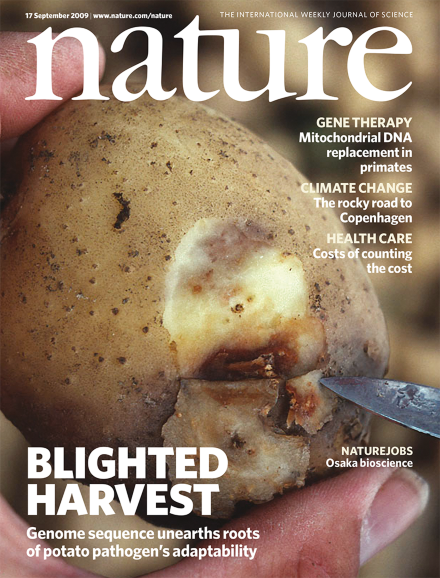
Genome sequence and analysis of the Irish potato famine pathogen Phytophthora infestans p393
Phytophthora infestans is a fungus-like eukaryote and the most destructive pathogen of potato, with current annual worldwide potato crop losses due to late blight estimated at $6.7 billion. Here, the sequence of the P. infestans genome is reported. Comparison with two other Phytophthora genomes showed rapid turnover and extensive expansion of certain secreted disease effector proteins, probably explaining the rapid adaptability of the pathogen to host plants.
Brian J. Haas, Sophien Kamoun, Michael C. Zody, Rays H. Y. Jiang, Robert E. Handsaker, Liliana M. Cano, Manfred Grabherr, Chinnappa D. Kodira, Sylvain Raffaele, Trudy Torto-Alalibo, Tolga O. Bozkurt, Audrey M. V. Ah-Fong, Lucia Alvarado, Vicky L. Anderson, Miles R. Armstrong, Anna Avrova, Laura Baxter, Jim Beynon, Petra C. Boevink, Stephanie R. Bollmann, Jorunn I. B. Bos, Vincent Bulone, Guohong Cai, Cahid Cakir, James C. Carrington, Megan Chawner, Lucio Conti, Stefano Costanzo, Richard Ewan, Noah Fahlgren, Michael A. Fischbach, Johanna Fugelstad, Eleanor M. Gilroy, Sante Gnerre, Pamela J. Green, Laura J. Grenville-Briggs, John Griffith, Niklaus J. Grünwald, Karolyn Horn, Neil R. Horner, Chia-Hui Hu, Edgar Huitema, Dong-Hoon Jeong, Alexandra M. E. Jones, Jonathan D. G. Jones, Richard W. Jones, Elinor K. Karlsson, Sridhara G. Kunjeti, Kurt Lamour, Zhenyu Liu, LiJun Ma, Daniel MacLean, Marcus C. Chibucos, Hayes McDonald, Jessica McWalters, Harold J. G. Meijer, William Morgan, Paul F. Morris, Carol A. Munro, Keith O'Neill, Manuel Ospina-Giraldo, Andrés Pinzón, Leighton Pritchard, Bernard Ramsahoye, Qinghu Ren, Silvia Restrepo, Sourav Roy, Ari Sadanandom, Alon Savidor, Sebastian Schornack, David C. Schwartz, Ulrike D. Schumann, Ben Schwessinger, Lauren Seyer, Ted Sharpe, Cristina Silvar, Jing Song, David J. Studholme, Sean Sykes, Marco Thines, Peter J. I. van de Vondervoort, Vipaporn Phuntumart, Stephan Wawra, Rob Weide, Joe Win, Carolyn Young, Shiguo Zhou, William Fry, Blake C. Meyers, Pieter van West, Jean Ristaino, Francine Govers, Paul R. J. Birch, Stephen C. Whisson, Howard S. Judelson & Chad Nusbaum
doi:10.1038/nature08358
First paragraph | Full Text | PDF (1,152K) | Supplementary information
See also: Editor's summary
Genetic variation in IL28B predicts hepatitis C treatment-induced viral clearance p399
170 million people worldwide are chronically infected with hepatitis C virus (HCV), which is the leading cause of cirrhosis in North America. Many patients are not cured by the current recommended treatment regime, with patients of European ancestry having a higher probability of being cured than those of African ancestry. Here, a genetic polymorphism near the IL28B gene is found to be associated with a better response to treatment; it occurs with higher frequency in European populations.
Dongliang Ge, Jacques Fellay, Alexander J. Thompson, Jason S. Simon, Kevin V. Shianna, Thomas J. Urban, Erin L. Heinzen, Ping Qiu, Arthur H. Bertelsen, Andrew J. Muir, Mark Sulkowski, John G. McHutchison & David B. Goldstein
doi:10.1038/nature08309
First paragraph | Full Text | PDF (393K) | Supplementary information
See also: Editor's summary | News and Views by Iadonato & Katze
Modelling pathogenesis and treatment of familial dysautonomia using patient-specific iPSCs p402
The derivation and differentiation of disease-specific human induced pluripotent stem cells (iPSCs) offers a new strategy for modelling disease. Familial dysautonomia (FD) is a rare but fatal peripheral neuropathy caused by a mutation in the IKBKAP gene. Here, patient-specific FD-iPSCs are derived and differentiated into cells of all three germ layers, including peripheral neurons; the cells are then analysed for mechanism of disease specificity and response to candidate drugs.
Gabsang Lee, Eirini P. Papapetrou, Hyesoo Kim, Stuart M. Chambers, Mark J. Tomishima, Christopher A. Fasano, Yosif M. Ganat, Jayanthi Menon, Fumiko Shimizu, Agnes Viale, Viviane Tabar, Michel Sadelain & Lorenz Studer
doi:10.1038/nature08320
First paragraph | Full Text | PDF (1,060K) | Supplementary information
See also: Editor's summary
Optogenetic dissection of a behavioural module in the vertebrate spinal cord p407
In vertebrates, the excitatory synaptic drive for inducing spinal central pattern generators (CPGs) — which are responsible for generating rhythmic movements — can originate from either supraspinal glutamatergic inputs or from within the spinal cord. A spinal input to the CPG is now identified using a combination of intersectional gene expression and optogenetics in zebrafish larvae; the results reveal that during early development Kolmer–Agduhr cells provide a positive drive to the spinal CPG for spontaneous locomotion.
Claire Wyart, Filippo Del Bene, Erica Warp, Ethan K. Scott, Dirk Trauner, Herwig Baier & Ehud Y. Isacoff
doi:10.1038/nature08323
First paragraph | Full Text | PDF (870K) | Supplementary information
See also: Editor's summary
Response and resistance to MEK inhibition in leukaemias initiated by hyperactive Ras p411
In human cancers with deregulated Ras signalling, including tumours that have inactivated the Nf1 tumour suppressor, the cascade comprising Raf, mitogen-activated protein kinase kinase (MEK) and extracellular signal-regulated kinase (ERK) is a therapeutic target. Here, in mice, the effects of inhibitors of MEK in a model of myeloproliferative disorder initiated by inactivating Nf1 and in a model of acute myeloid leukaemia are compared.
Jennifer O. Lauchle, Doris Kim, Doan T. Le, Keiko Akagi, Michael Crone, Kimberly Krisman, Kegan Warner, Jeannette M. Bonifas, Qing Li, Kristen M. Coakley, Ernesto Diaz-Flores, Matthew Gorman, Sally Przybranowski, Mary Tran, Scott C. Kogan, Jeroen P. Roose, Neal G. Copeland, Nancy A. Jenkins, Luis Parada, Linda Wolff, Judith Sebolt-Leopold & Kevin Shannon
doi:10.1038/nature08279
First paragraph | Full Text | PDF (587K) | Supplementary information
See also: Editor's summary
KDM1B is a histone H3K4 demethylase required to establish maternal genomic imprints p415
In mammals, the parental origin-specific expression of imprinted genes is known to be regulated by differential DNA methylation of paternal and maternal alleles, but it is unclear how particular imprinted loci are selected for de novo DNA methylation during gametogenesis. Here it is shown that AOF1, or KDM1B under new nomenclature, functions as a histone H3 lysine 4 demethylase and is required for de novo DNA methylation of some imprinted genes in oocytes.
David N. Ciccone, Hui Su, Sarah Hevi, Frédérique Gay, Hong Lei, Jeffrey Bajko, Guoliang Xu, En Li & Taiping Chen
doi:10.1038/nature08315
First paragraph | Full Text | PDF (717K) | Supplementary information
See also: Editor's summary | News and Views by Feil
Histone H2A.Z cooperates with RNAi and heterochromatin factors to suppress antisense RNAs p419
Unregulated transcription of noncoding and antisense RNAs is potentially deleterious to a cell and the accumulation of these transcripts is suppressed by several mechanisms. How cells differentiate coding RNAs from transcripts targeted for degradation is not clear. The variant histone H2A.Z, in cooperation with heterochromatin and RNAi factors, is now found to mediate suppression of antisense transcripts in the fission yeast Schizosaccharomyces pombe.
Martin Zofall, Tamás Fischer, Ke Zhang, Ming Zhou, Bowen Cui, Timothy D. Veenstra & Shiv I. S. Grewal
doi:10.1038/nature08321
First paragraph | Full Text | PDF (682K) | Supplementary information
See also: Editor's summary
Bursts of retrotransposition reproduced in Arabidopsis p423
A major portion of plant genomes is made up of retrotransposons, which proliferate by reverse transcription of RNA intermediates. The methylation of DNA prevents transcription, and is a means by which retrotransposon movement is suppressed. The study of transposon dynamics in Arabidopsis thaliana now reveals bursts of retrotransposition when DNA methylation is disturbed.
Sayuri Tsukahara, Akie Kobayashi, Akira Kawabe, Olivier Mathieu, Asuka Miura & Tetsuji Kakutani
doi:10.1038/nature08351
First paragraph | Full Text | PDF (744K) | Supplementary information
See also: Editor's summary
Selective epigenetic control of retrotransposition in Arabidopsis p427
In plants and mammals, retrotransposons are transcriptionally silenced by DNA methylation, but activating transcription by mutating a gene involved in DNA methylation does not activate retrotransposition. Here it is shown that, after transcriptional reactivation, transposition remains suppressed due to the activity of a plant-specific RNA polymerase and a histone methyltransferase. This mechanism appears to be specific for a particular retrotransposon known as Évadé.
Marie Mirouze, Jon Reinders, Etienne Bucher, Taisuke Nishimura, Korbinian Schneeberger, Stephan Ossowski, Jun Cao, Detlef Weigel, Jerzy Paszkowski & Olivier Mathieu
doi:10.1038/nature08328
First paragraph | Full Text | PDF (642K) | Supplementary information
See also: Editor's summary
Naturejobs
Careers Q&ARudi Balling p433
First director of the Centre for Systems Biology in Luxembourg.
Flora Roenneberg
doi:10.1038/nj7262-433a
Postdoc journal
Am I still a postdoc or not? p433
I'm learning that my career doesn't define me; I define my career.
Joanne Isaac
doi:10.1038/nj7262-433b
In Brief
How to talk to a politician p433
An aid in the quest for research funding.
doi:10.1038/nj7262-433c
No ethics, no grant p433
Ethics training is a new must for all National Science Foundation grant recipients.
doi:10.1038/nj7262-433d
Lucrative industry links p433
Faculty members say industry research has contributed to important work.
doi:10.1038/nj7262-433e
Careers and Recruitment
Back to the beginning p434
Some think Osaka can once again be a centre for the biosciences industry. David Cyranoski calculates the odds.
David Cyranoski
doi:10.1038/nj7262-434a
Futures
Answers from the event horizon p438
The secrets of the Universe.
Mercurio D. Rivera
doi:10.1038/461438a