Table of contents
Volume 460 Number 7253 pp307-428
(this content only available online) indicates content that is available online only
Editorials
Net gains p307
The Moon landing was not the only world-changing event in the summer of '69.
doi:10.1038/460307a
Nowhere to hide p307
The G8 has laid down a marker by promising to restrict the rise of global temperatures.
doi:10.1038/460307b
Research Highlights
Animal behaviour: Smothered by a swarm p308
doi:10.1038/460308a
Palaeoclimatology: Tropical ice p308
doi:10.1038/460308b
Nanotechnology: Penned in protein p308
doi:10.1038/460308c
Chemical biology: A glowing report p308
doi:10.1038/460308d
Evolution: Nice guys finish last p308
doi:10.1038/460308e
Organic chemistry: Cockroach cruncher p309
doi:10.1038/460309a
Immunology: Themis in the thymus p309
doi:10.1038/460309b
Developmental biology: The turtle fold p309
doi:10.1038/460309c
Neurology: New neurons show the way p309
doi:10.1038/460309d
News
NIH nominee draws scrutiny p310
Francis Collins is likely to face funding challenges — and criticism of his Christian evangelism.
Meredith Wadman
doi:10.1038/460310a
Malaria drug-makers ignore WHO ban p310
Health agency calls for clampdown on artemisinin monotherapy.
Declan Butler
doi:10.1038/460310b
Flu furore hits Argentina p311
Refusal to declare national emergency restricts pandemic measures.
Anna Petherick
doi:10.1038/460311a
Medical isotope shortage reaches crisis level p312
Robust solutions sought urgently to shore up fragile supply chain.
Paula Gould
doi:10.1038/460312a
G8 climate target questioned p313
Is a commitment to prevent global temperatures from rising more than 2 °C enough?
Quirin Schiermeier
doi:10.1038/460313a
Shooting for the Moon p314
The Apollo programme inspired thousands of people to pursue careers in science. Today, they still support human spacefaring — but baulk at the price. Richard Monastersky reports on the results of a Nature poll.
Richard Monastersky
doi:10.1038/460314a
Arms pact could boost US-Russian science p316
Commitment to cut nuclear stockpiles may improve collaboration.
Geoff Brumfiel
doi:10.1038/460316a
Europe attacks tactics that delay generic drugs p317
doi:10.1038/460317a
Obama names next head of US Geological Survey p317
doi:10.1038/460317b
El Niño arrives in the Pacific Ocean p317
doi:10.1038/460317c
German molecular biologist to head EMBO p317
doi:10.1038/460317d
US renewable energy gets cash boost p317
doi:10.1038/460317e
Mars Science Laboratory devours budgets p317
doi:10.1038/460317f
Correction p317
doi:10.1038/460317g
News Features
Cell biology: Ahead of the curve p318
Cellular life is all slopes, arcs and circles — but there is much debate about how these curves are built. Kendall Powell reports.
doi:10.1038/460318a
Earth science: A lakeful of trouble p321
Africa's Lake Kivu contains vast quantities of gas, which makes it both dangerous and valuable. Anjali Nayar asks whether it is possible to tap the gas without causing a disaster.
doi:10.1038/460321a
Correspondence
Sharing different mouse strains is not always so simple p324
Richard Behringer
doi:10.1038/460324a
Invasion biology is a discipline that's too young to die p324
Petr Py
ek
&
Philip E. Hulme
doi:10.1038/460324b
For cancer, seek and destroy or live and let live? p324
Nicolas André & Eddy Pasquier
doi:10.1038/460324c
Essay
Why we need space travel p325
Giovanni Bignami reflects on the people who persuaded him that we must send humans beyond Earth's orbit to inspire public and political support for science.
Giovanni Bignami
doi:10.1038/460325a
Books and Arts
The slow slide towards a new battlefield? p326
The cold war saw governments develop international policies to regulate outer space for military and civil uses. Loopholes in those policies must now be closed, writes Roald Sagdeev.
Roald Sagdeev
doi:10.1038/460326a
The return path to the Moon p327
Jeff Kanipe reviews The Seventh Landing: Going Back to the Moon, This Time to Stay by Michael Carroll
doi:10.1038/460327a
Apollo books p328
doi:10.1038/460328a
In Retrospect: Calvino's Cosmicomics p329
The soaring imagination of the Italian author abounds in a new compilation of his cosmic fables. Mostly written in the age of the space race, they are heavily informed by science, finds Alan Lightman.
Alan Lightman
doi:10.1038/460329a
News and Views
Ageing: A midlife longevity drug? p331
The small molecule rapamycin, already approved for clinical use for various human disorders, has been found to significantly increase lifespan in mice. Is this a step towards an anti-ageing drug for people?
Matt Kaeberlein & Brian K. Kennedy
doi:10.1038/460331a
See also: Editor's summary
Atmospheric physics: Cosmic rays, clouds and climate p332
Galactic cosmic rays could influence Earth's cloudiness by creating aerosol particles that prompt cloud formation. That possible effect looks to be smaller than thought, but the story won't end there.
Ken Carslaw
doi:10.1038/460332a
Galaxy formation: Anatomy of elliptical galaxies p333
The family of elliptical galaxies is remarkable for the structural regularity of its members. Inspecting irregularities in this regularity could help in understanding how these galaxies form.
Luca Ciotti
doi:10.1038/460333a
Ecology: Towards a theory of biodiversity p334
Models of ecological communities that incorporate mutation and spatial dispersal can yield results that go some way to explaining observations. A further step is to add sexual reproduction to the mix.
Jayanth R. Banavar & Amos Maritan
doi:10.1038/460334a
See also: Editor's summary
Climate change: Beyond the CO2 connection p335
At times in the past, mobile ocean fronts in the subtropics have exercised an influence on the magnitude of climate change by decoupling temperature from levels of carbon dioxide in the atmosphere.
Rainer Zahn
doi:10.1038/460335a
See also: Editor's summary
Photonics: Light control at will p337
Microchips that make use of light instead of electrons could outperform their electronic counterparts if light flow can be controlled at will. Photonic crystals are instrumental in achieving such a manoeuvre.
Sajeev John
doi:10.1038/460337a
See also: Editor's summary
Obituary: Jean Dausset (1916–2009) p338
'Father' of the human leukocyte antigen system.
Dominique J. Charron
doi:10.1038/460338a
Review
Primate archaeology p339
Michael Haslam, Adriana Hernandez-Aguilar, Victoria Ling, Susana Carvalho, Ignacio de la Torre, April DeStefano, Andrew Du, Bruce Hardy, Jack Harris, Linda Marchant, Tetsuro Matsuzawa, William McGrew, Julio Mercader, Rafael Mora, Michael Petraglia, Hélène Roche, Elisabetta Visalberghi & Rebecca Warren
doi:10.1038/nature08188
First paragraph | Full Text | PDF (1,006K)
See also: Editor's summary
Articles
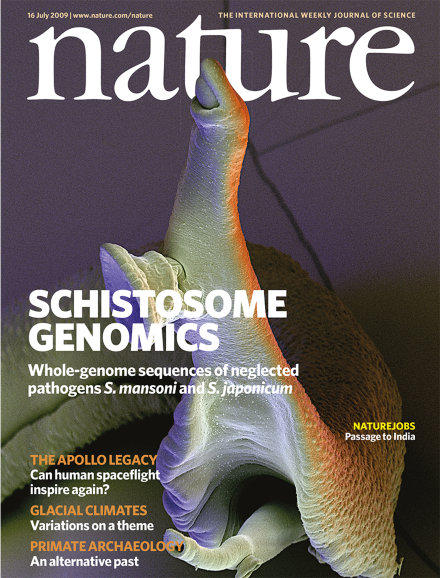
The Schistosoma japonicum genome reveals features of host–parasite interplay p345
Schistosoma mansoni and Schistosoma japonicum are the pathogenic agents that cause the tropical disease schistosomiasis. Here, and in an accompanying paper, the genomes of these two flatworms are sequenced and analysed. The results provide insights into the molecular architecture and host interactions of the flatworms, as well as avenues for future development of targeted interventions for schistosomiasis.
The Schistosoma japonicum Genome Sequencing and Functional Analysis Consortium
doi:10.1038/nature08140
Abstract | Full Text | PDF (633K) | Supplementary information
See also: Editor's summary
The genome of the blood fluke Schistosoma mansoni p352
Schistosoma mansoni and Schistosoma japonicum are the pathogenic agents that cause the tropical disease schistosomiasis. Here, and in an accompanying paper, the genomes of these two flatworms are sequenced and analysed. The results provide insights into the molecular architecture and host interactions of the flatworms, as well as avenues for future development of targeted interventions for schistosomiasis.
Matthew Berriman, Brian J. Haas, Philip T. LoVerde, R. Alan Wilson, Gary P. Dillon, Gustavo C. Cerqueira, Susan T. Mashiyama, Bissan Al-Lazikani, Luiza F. Andrade, Peter D. Ashton, Martin A. Aslett, Daniella C. Bartholomeu, Gaelle Blandin, Conor R. Caffrey, Avril Coghlan, Richard Coulson, Tim A. Day, Art Delcher, Ricardo DeMarco, Appolinaire Djikeng, Tina Eyre, John A. Gamble, Elodie Ghedin, Yong Gu, Christiane Hertz-Fowler, Hirohisha Hirai, Yuriko Hirai, Robin Houston, Alasdair Ivens, David A. Johnston, Daniela Lacerda, Camila D. Macedo, Paul McVeigh, Zemin Ning, Guilherme Oliveira, John P. Overington, Julian Parkhill, Mihaela Pertea, Raymond J. Pierce, Anna V. Protasio, Michael A. Quail, Marie-Adèle Rajandream, Jane Rogers, Mohammed Sajid, Steven L. Salzberg, Mario Stanke, Adrian R. Tivey, Owen White, David L. Williams, Jennifer Wortman, Wenjie Wu, Mostafa Zamanian, Adhemar Zerlotini, Claire M. Fraser-Liggett, Barclay G. Barrell & Najib M. El-Sayed
doi:10.1038/nature08160
Abstract | Full Text | PDF (504K) | Supplementary information
See also: Editor's summary
The active form of DNA polymerase V is UmuD'2C–RecA–ATP p359
Escherichia coli DNA polymerase (pol) V is involved in the mutagenic process of limited DNA synthesis across a DNA lesion, but the molecular composition of mutagenically active pol V and the importance of the RecA nucleoprotein filament RecA* have remained unclear. The biochemical role of RecA* is now defined.
Qingfei Jiang, Kiyonobu Karata, Roger Woodgate, Michael M. Cox & Myron F. Goodman
doi:10.1038/nature08178
Abstract | Full Text | PDF (618K) | Supplementary information
See also: Editor's summary
Letters
Contamination of the asteroid belt by primordial trans-Neptunian objects p364
The main asteroid belt contains a surprising diversity of objects, ranging from primitive ice-rock mixtures to igneous rocks. The standard model used to explain this assumes the violent dynamical evolution of the giant-planet orbits. Here, this evolution is shown to lead to the insertion of primitive trans-Neptunian objects into the outer belt, implying that the observed diversity of the asteroid belt is not a direct reflection of the intrinsic compositional variation of the proto-planetary disk, but rather of dynamical evolution.
Harold F. Levison, William F. Bottke, Matthieu Gounelle, Alessandro Morbidelli, David Nesvorný & Kleomenis Tsiganis
doi:10.1038/nature08094
First paragraph | Full Text | PDF (308K) | Supplementary information
See also: Editor's summary
Manipulation of photons at the surface of three-dimensional photonic crystals p367
Photonic bandgap materials are envisioned to provide the necessary tools for guiding and manipulating photons in optical circuits. So far, basic approaches for photonic control have been based on embedding artificial defects and light emitters inside three-dimensional materials. Here it is demonstrated that three-dimensional photonic crystals possess two-dimensional surface states that can easily be manipulated to control photons, providing an alternative approach.
Kenji Ishizaki & Susumu Noda
doi:10.1038/nature08190
First paragraph | Full Text | PDF (703K) | Supplementary information
See also: Editor's summary | News and Views by John
Photoconductance and inverse photoconductance in films of functionalized metal nanoparticles p371
A photoconductor is a material in which electrical conductivity changes when it is illuminated — invariably increasing in response to impinging light. However, here it is shown that nanoparticle-based materials can be engineered, through the careful choice of the molecules used to stabilize the nanoparticles, to exhibit negative photoconductance: conductivity in these materials decreases in the presence of light.
Hideyuki Nakanishi, Kyle J. M. Bishop, Bartlomiej Kowalczyk, Abraham Nitzan, Emily A. Weiss, Konstantin V. Tretiakov, Mario M. Apodaca, Rafal Klajn, J. Fraser Stoddart & Bartosz A. Grzybowski
doi:10.1038/nature08131
First paragraph | Full Text | PDF (827K) | Supplementary information
See also: Editor's summary
Evidence for middle Eocene Arctic sea ice from diatoms and ice-rafted debris p376
The presence of ice-rafted debris (IRD) in middle Eocene ocean sediments has previously been demonstrated, but it has been unclear whether the source of IRD was land-based glacial ice or sea ice, a distinction with important climate implications. The analysis of a sediment core from the ACEX project now reveals evidence that sea ice was the dominant source for IRD from 47.5 to 45.5 million years ago.
Catherine E. Stickley, Kristen St John, Nalân Koç, Richard W. Jordan, Sandra Passchier, Richard B. Pearce & Lance E. Kearns
doi:10.1038/nature08163
First paragraph | Full Text | PDF (1,026K) | Supplementary information
See also: Editor's summary
Migration of the subtropical front as a modulator of glacial climate p380
Ice cores extracted from the Antarctic ice sheet suggest that glacial conditions and the relationship between temperatures and atmospheric carbon dioxide concentrations have been constant over the last 800,000 years, but there is some evidence for a fluctuating severity of glacial periods mediated by previously unidentified mechanisms. Variable migration of the subtropical front is now shown to modulate the severity of glacial periods, partially decoupling global climate from atmospheric carbon dioxide concentrations.
Edouard Bard & Rosalind E. M. Rickaby
doi:10.1038/nature08189
First paragraph | Full Text | PDF (526K) | Supplementary information
See also: Editor's summary | News and Views by Zahn
Global patterns of speciation and diversity p384
The question of why biological diversity is spread in characteristic patterns is perhaps the biggest problem in ecology. In recent years, the 'neutral theory' of biodiversity has modelled the distribution of species in a very simple way, without reference to species interactions or history. Sexual reproduction, mutation and dispersal are now introduced to the simulation of populations; the resulting predictions correlate well with real data sets.
M. A. M. de Aguiar, M. Baranger, E. M. Baptestini, L. Kaufman & Y. Bar-Yam
doi:10.1038/nature08168
First paragraph | Full Text | PDF (1,087K) | Supplementary information
See also: Editor's summary | News and Views by Banavar & Maritan
Evolution of a malaria resistance gene in wild primates p388
The study of a population of yellow baboons in Amboseli National Park in Kenya reveals the first reported association and functional characterization linking genetic variation and a complex trait — susceptibility to malaria — in a natural population of nonhuman primates.
Jenny Tung, Alexander Primus, Andrew J. Bouley, Tonya F. Severson, Susan C. Alberts & Gregory A. Wray
doi:10.1038/nature08149
First paragraph | Full Text | PDF (320K) | Supplementary information
See also: Editor's summary
Rapamycin fed late in life extends lifespan in genetically heterogeneous mice p392
Although inhibition of the TOR signalling pathway extends lifespan in invertebrates, it was unknown whether mTOR signalling inhibition has similar effects in mammalian species. Here, feeding mice the drug rapamycin — an inhibitor of the mTOR pathway — late in life is shown to extend lifespan by 9–14%; currently, the only way to extend lifespan in rodents is by severe dietary restriction.
David E. Harrison, Randy Strong, Zelton Dave Sharp, James F. Nelson, Clinton M. Astle, Kevin Flurkey, Nancy L. Nadon, J. Erby Wilkinson, Krystyna Frenkel, Christy S. Carter, Marco Pahor, Martin A. Javors, Elizabeth Fernandez & Richard A. Miller
doi:10.1038/nature08221
First paragraph | Full Text | PDF (447K) | Supplementary information
See also: Editor's summary | News and Views by Kaeberlein & Kennedy
A conserved ubiquitination pathway determines longevity in response to diet restriction p396
The fact that dietary restriction increases longevity in diverse species suggests that there is a conserved mechanism for nutrient regulation and prosurvival responses. The E3 ubiquitin ligase WWP-1 and the E2 ubiquitin conjugating enzyme UBC-18 are now shown to be essential for such lifespan extension in the worm Caenorhabditis elegans.
Andrea C. Carrano, Zheng Liu, Andrew Dillin & Tony Hunter
doi:10.1038/nature08130
First paragraph | Full Text | PDF (407K) | Supplementary information
See also: Editor's summary
A reevaluation of X-irradiation-induced phocomelia and proximodistal limb patterning p400
The condition of phocomelia, a human birth defect in which the long bones are shorter than normal, is mimicked in developing chick limb buds exposed to X-rays. Studies of X-irradiation-induced phocomelia have served as evidence supporting the 'progress zone' model of limb patterning. Here, X-irradiation-induced phocomelia is shown not to be a patterning defect at all; rather, it results from a time-dependent loss of skeletal progenitors.
Jenna L. Galloway, Irene Delgado, Maria A. Ros & Clifford J. Tabin
doi:10.1038/nature08117
First paragraph | Full Text | PDF (705K) | Supplementary information
See also: Editor's summary
The AP-1 transcription factor Batf controls TH17 differentiation p405
TH17 cells comprise a subset of CD4+ T cells that coordinate the inflammatory response in host defence but are pathogenic in autoimmunity. Here, the AP-1 transcription factor BATF is shown to have a critical role in TH17 cell differentiation, with Batf-/- mice displaying a defect in TH17 differentiation and resistance to experimental autoimmune encephalomyelitis.
Barbara U. Schraml, Kai Hildner, Wataru Ise, Wan-Ling Lee, Whitney A.-E. Smith, Ben Solomon, Gurmukh Sahota, Julia Sim, Ryuta Mukasa, Saso Cemerski, Robin D. Hatton, Gary D. Stormo, Casey T. Weaver, John H. Russell, Theresa L. Murphy & Kenneth M. Murphy
doi:10.1038/nature08114
First paragraph | Full Text | PDF (672K) | Supplementary information
See also: Editor's summary
Cohesins form chromosomal cis-interactions at the developmentally regulated IFNG locus p410
As well as its role in sister chromatid cohesion, cohesin is thought to have a role in the control of gene expression. Here, cohesin is shown to form the topological and mechanistic basis for cell-type-specific long-range chromosomal interactions at the developmentally regulated cytokine locus IFNG.
Suzana Hadjur, Luke M. Williams, Natalie K. Ryan, Bradley S. Cobb, Tom Sexton, Peter Fraser, Amanda G. Fisher & Matthias Merkenschlager
doi:10.1038/nature08079
First paragraph | Full Text | PDF (657K) | Supplementary information
See also: Editor's summary
Technology Features
Systems biology: Untangling the protein web p415
Researchers have identified thousands of macromolecular interactions within cells. But, as Nathan Blow finds out, joining them up in networks and figuring out how they work still poses a big challenge.
Nathan Blow
doi:10.1038/460415a
Systems biology: Playing by the rules p417
doi:10.1038/460417a
Systems biology: Table of suppliers p419
doi:10.1038/460419a
Naturejobs
Careers Q&ADouglas Yanega p423
Entomologist is appointed to international taxonomy board.
Douglas Yanega
doi:10.1038/nj7253-423a
Postdoc journal
Wealth of knowledge? p423
Life as a scientist nomad.
Sam Walcott
doi:10.1038/nj7253-423b
In Brief
Energy bill to create jobs? p423
US Senate weighs in on jobs implications of energy bill.
doi:10.1038/nj7253-423c
Californian budget woes p423
Eminent faculy members from the University of California warn of budget-cut consequences.
doi:10.1038/nj7253-423d
Physicists wanted p423
New posts at SLAC National Acceleratory Laboratory.
doi:10.1038/nj7253-423e
Careers and Recruitment
Down but not out p424
Indian outsourcing has been hit badly by the global downturn, but signs of growth remain. K. S. Jayaraman investigates.
K. S. Jayaraman
doi:10.1038/nj7253-424a