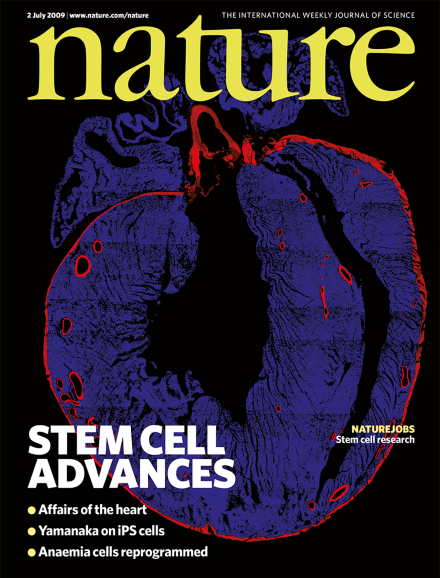
Table of contents
Volume 460 Number 7251 pp11-140
(this content only available online) indicates content that is available online only
Editorials
We are all Iranians p11
Iran's endogenous civil-rights movement needs international solidarity, not political meddling. Academics, universities and non-governmental organizations can help.
doi:10.1038/460011a
Time for early action p12
Carbon dioxide is not the only warming agent worth tackling now in the bid to cool the planet.
doi:10.1038/460012a
Research Highlights
Geosciences: Losing Louisiana p14
doi:10.1038/460014a
Cancer biology: Double agent p14
doi:10.1038/460014b
Neuroscience: Early bird learns the tune p14
doi:10.1038/460014c
Physiology: Ground control p14
doi:10.1038/460014d
Ecology: Putting height on the map p14
doi:10.1038/460014e
Evolutionary development: The birth of a thymus p14
doi:10.1038/460014f
Biology: Shell shocker p15
doi:10.1038/460015a
Chemistry: Fire boxed p15
doi:10.1038/460015b
Astronomy: Little neighbours p15
doi:10.1038/460015c
Genomics: Murky associations p15
doi:10.1038/460015d
News
African science drops down G8 agenda p16
Researchers lament poor progress on commitments to developing nations.
Natasha Gilbert
doi:10.1038/460016a
Chief scientist quits California stem-cell agency p17
Departure raises questions over leadership at flagship centre.
Erika Check Hayden
doi:10.1038/460017a
Snapshot: Vanishing meadows p17
The dire state of seagrass.
Daniel Cressey
doi:10.1038/460017b
How to fix a broken heart? p18
Clues about how human hearts form hint at routes to cell-based therapies.
Monya Baker
doi:10.1038/460018a
Italians sue over stem cells p19
Government's exclusion of human embryonic cells from funding call sparks anger.
Alison Abbott
doi:10.1038/460019a
Budget request tackles habitat changes p20
US wildlife agency bids to revitalize research with focus on effects of global warming.
Roberta Kwok
doi:10.1038/460020a
Lawsuit puts flu-vaccine contract in doubt p21
Biotech company sued by creditors.
Heidi Ledford
doi:10.1038/460021a
UK Met Office hit by cuts to climate project p21
Defence ministry slashes programme budget by a quarter.
Olive Heffernan
doi:10.1038/460021b
Indian university system overhauled p22
National commission set to regulate higher education.
K. S. Jayaraman
doi:10.1038/460022a
Impasse at talks leaves whales high and dry p23
doi:10.1038/460023a
Key polar research centres sign up to cooperative deal p23
doi:10.1038/460023b
Recession deals a glancing blow to nanomaterials p23
doi:10.1038/460023c
African institutions gain support networks p23
doi:10.1038/460023d
Soundbites: Talking climate targets p23
doi:10.1038/460023e
Heritage alert for Central American reef p23
doi:10.1038/460023f
Column
Don't cry politicization p24
To call biomedical research proposals political distorts the issue, says David Goldston.
David Goldston
doi:10.1038/460024a
News Features
Nuclear energy: The hybrid returns p25
Slotting a fusion reactor into the heart of a nuclear fission plant could accelerate the development of waste-free nuclear energy. So why are all the designs still on paper, asks Ed Gerstner.
doi:10.1038/460025a
Atmospheric science: Climate's smoky spectre p29
With their focus on greenhouse gases, atmospheric scientists have largely overlooked lowly soot particles. But black carbon is now a hot topic among researchers and politicians. Jeff Tollefson investigates.
doi:10.1038/460029a
Correspondence
Invitation to help compile an index of biodiversity in cities p33
Lena Chan & Ahmed Djoghlaf
doi:10.1038/460033a
We must reverse the Bush legacy of stem-cell problems p33
Christopher Thomas Scott, Jason Owen-Smith & Jennifer McCormick
doi:10.1038/460033b
The pleasure and importance of printed journals p33
François Diederich
doi:10.1038/460033c
Books and Arts
When DNA goes on trial p34
The science of DNA profiling is firm, but the way that the adversarial justice system interprets probability can cause controversy, argues Peter Gill.
Peter Gill reviews Truth Machine: The Contentious History of DNA Fingerprinting by Michael Lynch, Simon A. Cole, Ruth McNally & Kathleen Jordan
doi:10.1038/460034a
Evolutionary embryos p35
Eric Werner reviews The Origin of Individuals by Jean-Jacques Kupiec
doi:10.1038/460035a
Stuffed spectacular p36
Josie Glausiusz reviews Extreme Mammals: The Biggest, Smallest, and Most Amazing Mammals of All Time
doi:10.1038/460036a
Evolution's influence on art nouveau p37
Colin Martin reviews Emile Gallé, Nature and Symbolism: Influences from Japan
doi:10.1038/460037a
News and Views
Developmental biology: A cellular view of regeneration p39
How the salamander regrows an entire limb after injury has flummoxed the wisest of scientists. A closer look at the cells involved in limb regeneration shows that remembering past origins may be crucial for this feat.
Alejandro Sánchez Alvarado
doi:10.1038/460039a
See also: Editor's summary
Biogeochemistry: Climatic plant power p40
Levels of atmospheric carbon dioxide constrain vegetation types and thus also non-biological uptake during rock weathering. That's the reasoning used to explain why CO2 levels did not fall below a certain point in the Miocene.
Yves Goddéris & Yannick Donnadieu
doi:10.1038/460040a
See also: Editor's summary
Immunology: A metabolic switch to memory p41
Two therapeutic drugs have been found to enhance memory in immune cells called T cells, apparently by altering cellular metabolism. Are changes in T-cell metabolism the key to generating long-lived immune memory?
Martin Prlic & Michael J. Bevan
doi:10.1038/460041a
See also: Editor's summary
Nanooptics: Photons pushed together p42
Photons don't interact well with each other, which is a real headache for researchers developing all-optical transistors for computing applications. But a single molecule can mediate photon–photon affairs.
Michel Orrit
doi:10.1038/460042a
See also: Editor's summary
Cell biology: The not-so-odd couple p44
Actively dividing cells do so at a risk — with each division, chromosome ends tend to shorten. Pairing proteins that promote cell division with a chromosome-end repair factor is a smart way to solve this problem.
Sarah E. Millar
doi:10.1038/460044a
See also: Editor's summary
Applied physics: A leak of information p45
As capacitors, the ubiquitous components of electronic circuitry, get smaller, keeping them insulating is a challenge. But that's not necessarily bad news — some conductivity might be just the thing for data storage.
Pavlo Zubko & Jean-Marc Triscone
doi:10.1038/460045a
See also: Editor's summary
Obituary: Robert Furchgott (1916–2009) p47
Nobel laureate who pioneered research into nitric oxide.
Solomon H. Snyder
doi:10.1038/460047a
Progress
Elite and stochastic models for induced pluripotent stem cell generation p49
Shinya Yamanaka
doi:10.1038/nature08180
First paragraph | Full Text | PDF (299K)
See also: Editor's summary
Articles
Disease-corrected haematopoietic progenitors from Fanconi anaemia induced pluripotent stem cells p53
The generation of patient-specific induced pluripotent stem cells (iPS cells) is thought to hold great therapeutic potential. Here, somatic cells from Fanconi anaemia patients are reprogrammed to pluripotency after correction of the genetic defect, generating patient-specific iPS cells.
Ángel Raya, Ignasi Rodríguez-Pizà, Guillermo Guenechea, Rita Vassena, Susana Navarro, María José Barrero, Antonella Consiglio, Maria Castellà, Paula Río, Eduard Sleep, Federico González, Gustavo Tiscornia, Elena Garreta, Trond Aasen, Anna Veiga, Inder M. Verma, Jordi Surrallés, Juan Bueren & Juan Carlos Izpisúa Belmonte
doi:10.1038/nature08129
Abstract | Full Text | PDF (1,354K) | Supplementary information
See also: Editor's summary
Cells keep a memory of their tissue origin during axolotl limb regeneration p60
By using an integrated GFP transgene to track the major limb tissues during limb regeneration in the salamander Ambystoma mexicanum (the axolotl), it has been possible to demonstrate that each limb tissue produces a different set of progenitors with restricted potential. Thus, the blastema—the collection of cells that regenerates the diverse tissues of the limb—is composed of a heterogeneous collection of restricted progenitor cells instead of dedifferentiated pluripotent cells, as previously thought.
Martin Kragl, Dunja Knapp, Eugen Nacu, Shahryar Khattak, Malcolm Maden, Hans Henning Epperlein & Elly M. Tanaka
doi:10.1038/nature08152
Abstract | Full Text | PDF (1,254K) | Supplementary information
See also: Editor's summary | News and Views by Sánchez Alvarado
Telomerase modulates Wnt signalling by association with target gene chromatin p66
The genetic pathways controlling stem cells are frequently dysregulated during tumorigenesis, with either stimulation of Wnt/
-catenin signalling or overexpression of telomerase sufficient to activate epidermal stem cells in vivo. Here, the telomerase protein component TERT (telomerase reverse transcriptase) is shown to have a role as a transcriptional modulator of the Wnt/
-catenin pathway, revealing a significant level of integration between the two pathways.
Jae-Il Park, Andrew S. Venteicher, Ji Yeon Hong, Jinkuk Choi, Sohee Jun, Marina Shkreli, Woody Chang, Zhaojing Meng, Peggie Cheung, Hong Ji, Margaret McLaughlin, Timothy D. Veenstra, Roel Nusse, Pierre D. McCrea & Steven E. Artandi
doi:10.1038/nature08137
Abstract | Full Text | PDF (1,069K) | Supplementary information
See also: Editor's summary | News and Views by Millar
Letters
An intermediate-mass black hole of over 500 solar masses in the galaxy ESO 243-49 p73
Ultraluminous X-ray sources are extragalactic objects located outside the nucleus of the host galaxy with bolometric luminosities exceeding 1039 erg s-1. These extreme luminosities imply the presence of an accreting black hole with a mass of
102–105 solar masses, but the existence of such intermediate mass black holes is in dispute. A variable X-ray source with an implied mass of
500 solar masses is now reported in the galaxy ESO 243–49.
Sean A. Farrell, Natalie A. Webb, Didier Barret, Olivier Godet & Joana M. Rodrigues
doi:10.1038/nature08083
First paragraph | Full Text | PDF (251K)
See also: Editor's summary
A single-molecule optical transistor p76
The transistor is the most fundamental building block in present-day technologies. For the purpose of quantum information processing schemes and for the development of a 'quantum computer', photons are attractive information carriers because of their speed and robustness against decoherence. However, their robustness also prevents them from being easily controlled; despite this, experiments now show the realization of a quantum optical transistor.
J. Hwang, M. Pototschnig, R. Lettow, G. Zumofen, A. Renn, S. Götzinger & V. Sandoghdar
doi:10.1038/nature08134
First paragraph | Full Text | PDF (409K)
See also: Editor's summary | News and Views by Orrit
Giant tunnel electroresistance for non-destructive readout of ferroelectric states p81
As alternative technologies for non-volatile memory elements are looked at, the utilization of ferroelectric layers to read-write upon is seen as promising. However, it is plagued by several problems, including a destructive readout process. Now, by using a thin layer of BaTiO3 put under intense strain, it has been shown possible to read out the polarization state of the material without destroying it.
V. Garcia, S. Fusil, K. Bouzehouane, S. Enouz-Vedrenne, N. D. Mathur, A. Barthélémy & M. Bibes
doi:10.1038/nature08128
First paragraph | Full Text | PDF (615K) | Supplementary information
See also: Editor's summary | News and Views by Zubko & Triscone
The role of terrestrial plants in limiting atmospheric CO2 decline over the past 24 million years p85
It is thought that the Earth's atmospheric carbon dioxide concentrations did not fall below about 200–250 parts per million during the past 24 million years despite the drawdown of atmospheric carbon dioxide by high rates of global silicate rock weathering. Simulations of terrestrial and geochemical carbon cycles now suggest that limited vegetation activity in regions of active mountain ranges effectively diminished biotic-driven silicate rock weathering and thereby provided a negative feedback mechanism to stabilize carbon dioxide concentrations.
Mark Pagani, Ken Caldeira, Robert Berner & David J. Beerling
doi:10.1038/nature08133
First paragraph | Full Text | PDF (874K) | Supplementary information
See also: Editor's summary | News and Views by Goddéris & Donnadieu
Seismic reflection images of a near-axis melt sill within the lower crust at the Juan de Fuca ridge p89
The style of accretion of the lower oceanic crust at mid-ocean ridges is disputed, with some models proposing that the lower oceanic crust is accreted from melt sills intruded at multiple levels within the lower crust. However, seismic images of such sills have been elusive; here, deep crustal seismic reflections off the southern Juan de Fuca ridge are interpreted as originating from a molten sill presently forming within the lower oceanic crust.
J. Pablo Canales,
Mladen R. Nedimovi
,
Graham M. Kent,
Suzanne M. Carbotte
&
Robert S. Detrick
doi:10.1038/nature08095
First paragraph | Full Text | PDF (2,740K) | Supplementary information
See also: Editor's summary
Neural mechanisms of rapid natural scene categorization in human visual cortex p94
Human beings are able to rapidly detect the presence of object categories such as animals or vehicles, even when a scene is presented very briefly. The use of functional magnetic resonance imaging during an object categorization task now indicates that the rapid detection of categorical information in natural scenes is mediated by a category-specific biasing mechanism in object-selective cortex that operates across the visual field.
Marius V. Peelen, Li Fei-Fei & Sabine Kastner
doi:10.1038/nature08103
First paragraph | Full Text | PDF (451K) | Supplementary information
See also: Editor's summary
Cyclic AMP intoxication of macrophages by a Mycobacterium tuberculosis adenylate cyclase p98
Mycobacterium tuberculosis induces a cyclic AMP (cAMP) burst within infected macrophages that influences cell signalling, but the underlying mechanism for this increase in cAMP remains unclear. It is now shown that it is produced by a bacterial adenylate cyclase that facilitates delivery of bacterial-derived cAMP into the macrophage cytoplasm, presumably enhancing virulence through the activation of downstream signalling pathways.
Nisheeth Agarwal, Gyanu Lamichhane, Radhika Gupta, Scott Nolan & William R. Bishai
doi:10.1038/nature08123
First paragraph | Full Text | PDF (512K) | Supplementary information
See also: Editor's summary
Enhancing CD8 T-cell memory by modulating fatty acid metabolism p103
On antigen stimulation, CD8 T cells undergo a developmental program characterized by expansion and then contraction of antigen-specific effector (TE) populations, followed by the persistence of long-lived memory (TM) cells. During this transition, CD8 T cells are now shown to switch from glucose metabolism to fatty acid metabolism by a TRAF6-dependent mechanism.
Erika L. Pearce, Matthew C. Walsh, Pedro J. Cejas, Gretchen M. Harms, Hao Shen, Li-San Wang, Russell G. Jones & Yongwon Choi
doi:10.1038/nature08097
First paragraph | Full Text | PDF (568K) | Supplementary information
See also: Editor's summary | News and Views by Prlic & Bevan
mTOR regulates memory CD8 T-cell differentiation p108
Inducing effective memory T-cell responses is a major goal of vaccines against chronic infections and tumours. Here, mTOR, the mammalian target for the immunosuppressive drug rapamycin, is shown to enhance the quantity and quality of virus-specific CD8 T cells in mouse and non-human primate models.
Koichi Araki, Alexandra P. Turner, Virginia Oliva Shaffer, Shivaprakash Gangappa, Susanne A. Keller, Martin F. Bachmann, Christian P. Larsen & Rafi Ahmed
doi:10.1038/nature08155
First paragraph | Full Text | PDF (595K) | Supplementary information
See also: Editor's summary | News and Views by Prlic & Bevan
Human ISL1 heart progenitors generate diverse multipotent cardiovascular cell lineages p113
Studying the mechanisms underlying the diversification of human heart cell lineages has been hampered by the lack of genetic tools to purify early cardiac progenitors and define their developmental potential. By using independent transgenic and gene-targeting approaches in human embryonic stem cell lines, it has now been possible to show that populations of these primordial progenitors are capable of self-renewal and expansion prior to differentiation into the three major cell types in the heart.
Lei Bu, Xin Jiang, Silvia Martin-Puig, Leslie Caron, Shenjun Zhu, Ying Shao, Drucilla J. Roberts, Paul L. Huang, Ibrahim J. Domian & Kenneth R. Chien
doi:10.1038/nature08191
First paragraph | Full Text | PDF (1,026K) | Supplementary information
See also: Editor's summary
A parallel circuit of LIF signalling pathways maintains pluripotency of mouse ES cells p118
The Jak–Stat3 pathway is known to mediate leukaemia inhibitory factor (LIF) signals, maintaining pluripotency in mouse embryonic stem cells; however, it is unclear how LIF signals are linked to the core circuitry of pluripotency-associated transcription factors. Here it is shown that two LIF signalling pathways are each connected to the core circuitry by different transcription factors, indicating that there are parallel pathways controlling pluripotency.
Hitoshi Niwa, Kazuya Ogawa, Daisuke Shimosato & Kenjiro Adachi
doi:10.1038/nature08113
First paragraph | Full Text | PDF (719K) | Supplementary information
See also: Editor's summary
Genome-wide silencing in Drosophila captures conserved apoptotic effectors p123
Caspases, and the proximal regulators of caspases, are central to the core machinery of apoptosis. The results of a genome-wide silencing screen in Drosophila—using a strategy combining a library of double-stranded RNAs together with a chemical antagonist of Inhibitor of apoptosis proteins (IAPs)—now reveals a set of validated targets necessary for cell death provoked by several stimuli, as well as a new effector for apoptosis, Tango7.
Su Kit Chew, Po Chen, Nichole Link, Kathleen A. Galindo, Kristi Pogue & John M. Abrams
doi:10.1038/nature08087
First paragraph | Full Text | PDF (748K) | Supplementary information
See also: Editor's summary
The pluripotency factor Oct4 interacts with Ctcf and also controls X-chromosome pairing and counting p128
During both stem cell differentiation and X-chromosome inactivation (XCI) of mouse embryonic stem cells, chromatin undergoes epigenetic reprogramming. XCI and cell differentiation are tightly coupled, with the blocking of one process compromising the other. The pluripotency factor, Oct4, is now shown to regulate XCI, and is the first identified factor that links both processes.
Mary E. Donohoe, Susana S. Silva, Stefan F. Pinter, Na Xu & Jeannie T. Lee
doi:10.1038/nature08098
First paragraph | Full Text | PDF (801K) | Supplementary information
See also: Editor's summary
Naturejobs
Careers Q&APierluigi Nicotera p135
Founding director of the new German Centre for Neurodegenerative Diseases in Bonn, Germany.
doi:10.1038/nj7251-135a
Postdoc journal
The simple life p135
Motherhood has its benefits
Joanne Isaac
doi:10.1038/nj7251-135b
In Brief
Competitive edge p135
Federal legislators worry that US research universities are losing their edge.
doi:10.1038/nj7251-135c
Brain research p135
Federal grant sets up neuroplasticity centre at Stanford.
doi:10.1038/nj7251-135d
Green economy p135
A green economy will create jobs and battle climate change.
doi:10.1038/nj7251-135e
Careers and Recruitment
Multiple fates p136
Despite the economic downturn, US universities are seeking faculty members with stem-cell expertise. That doesn't mean times are easy. Monya Baker investigates.
Monya Baker
doi:10.1038/nj7251-136a
Futures
A Breederax for Dalia p140
All play and no work is a recipe for disaster.
Janett L. Grady
doi:10.1038/460140a