Table of contents

indicates content that is available online only

Top

Editorials

Wanted: cyber-czars p945

The world needs stronger leadership in safeguarding the security of computation and communication networks. That includes research institutions.

doi:10.1038/458945a


More than hot air p945

The United States has finally acknowledged that global warming is a threat. It must now act on that.

doi:10.1038/458945b


No more catch-up p946

Regulatory agencies need to be more proactive in preparing for avant-garde products.

doi:10.1038/458946a


Top

Research Highlights

Cell biology: Night vision p948

doi:10.1038/458948a


Biochemistry: Hushing the flush p948

doi:10.1038/458948b


Climate change: Network effects p948

doi:10.1038/458948c


Population studies: China needs women p948

doi:10.1038/458948d


Neuroscience: Connecting dementias p948

doi:10.1038/458948e


Circadian rhythms: Magnetic clocks p948

doi:10.1038/458948f


Cognitive psychology: Bilingual baby talk p949

doi:10.1038/458949a


Climate modelling: Soot and warming p949

doi:10.1038/458949b


Evolution: Bitter apple p949

doi:10.1038/458949c


Microbiology: Colony collapse cured? p949

doi:10.1038/458949d


Top

Journal Club

Journal club p949

Dave Featherstone

doi:10.1038/458949e


Top

News

Still strict on stem cells p950

Even some Bush-approved cell lines could be denied federal funding.

Meredith Wadman

doi:10.1038/458950a


Pharmaceutical companies join forces on HIV p950

GlaxoSmithKline and Pfizer create spin-off to develop new combination drugs.

Declan Butler

doi:10.1038/458950b


Fees delay pharmed drug p951

European trial of 'pharmed' anti-HIV monoclonal delayed by costly regulatory process

Natasha Gilbert

doi:10.1038/458951a


High hopes for US patent reform p952

Lawmakers may be nearing agreement on how to fix the nation's crumbling patent system, reports Heidi Ledford.

Heidi Ledford

doi:10.1038/458952a


FANTOM sees networks in cells p955

Systems biology boosted by RNA-sequencing consortium.

Heidi Ledford

doi:10.1038/458954a


India's electioneers make bold pledges on science p956

Major parties back climate plan, but differ on nuclear policy.

K. S. Jayaraman

doi:10.1038/458956a


Snapshot: Motion detector p956

Radar images home in on source of Italian earthquake.

Lucas Laursen

doi:10.1038/458956b


French life-science alliance unveiled p957

Coordinated approach aims to derive national strategies.

Declan Butler

doi:10.1038/458957a


Australia launches global carbon-capture institute p958

doi:10.1038/458958a


Company offering ethical reviews suspends activity p958

doi:10.1038/458958b


US and Japan to collaborate on stem-cell technology p958

doi:10.1038/458958c


Jailed Iranian AIDS doctors lose court appeal p958

doi:10.1038/458958d


US medical institute invests in undergraduates p958

doi:10.1038/458958e


Germany joins in with maize moratorium p958

doi:10.1038/458958f


Top

News Features

Personal technology: Phoning in data p959

Far from being just an accessory, mobile phones are starting to be used to collect data in an increasing number of disciplines. Roberta Kwok looks into their potential.

doi:10.1038/458959a


Stem cells: Fast and furious p962

The field of induced pluripotent stem cells has gone from standing start to headlong rush in less than three years. Monya Baker charts the course so far, and the obstacles ahead.

doi:10.1038/458962a


Top

Correspondence

Open-access publishing can survive recession p967

Raf Aerts

doi:10.1038/458967a


Crystal growers are being forced to scatter p967

Christian Kloc

doi:10.1038/458967b


Struggle to translate Darwin's view of concurrency p967

U. Kutschera

doi:10.1038/458967c


Top

Commentary

Big Brother has evolved p968

Tracking someone's movements can now be done cheaply and easily, and there are few restrictions on who can monitor whom, says Jerome E. Dobson.

doi:10.1038/458968a


Top

Essay

This title is false p969

Comparing gene networks to Greek philosophy could help biologists to see the truth, argue Mark Isalan and Matthew Morrison.

Mark Isalan & Matthew Morrison

doi:10.1038/458969a


Top

Books and Arts

Final warning from a sceptical prophet p970

In his new book, James Lovelock fears that humanity faces widespread death and mass migration as Earth's systems become further unbalanced by climate change, explains Andrew Watson.

Andrew Watson

doi:10.1038/458970a


Pursuing the infinite p971

Jascha Hoffman reviews Naming Infinity: A True Story of Religious Mysticism and Mathematical Creativity by Loren Graham & Jean-Michel Kantor

doi:10.1038/458971a


The hidden language of cells p972

John Galloway reviews How We Live and Why We Die: The Secret Lives of Cells by Lewis Wolpert

doi:10.1038/458972a


Industrial strength, corroded p973

Jane Qiu reviews Qiu Zhijie: Breaking Through the Ice

doi:10.1038/458973a


Culture dish p973

doi:10.1038/458973b


Top

News and Views

Quantum chemistry: The little molecule that could p975

The creation of diatomic molecules bound by roaming electrons that allow a huge internuclear distance is some achievement. It opens the door to further experimental exploitation of the principles involved.

Chris H. Greene

doi:10.1038/458975a

See also: Editor's summary


Schizophrenia: A point of disruption p976

Much is still to be learned about the molecular basis of mental disorders. The identification of a signalling pathway that is affected in schizophrenia, and which thus provides potential therapeutic targets, is a welcome advance.

Christopher A. Ross & Russell L. Margolis

doi:10.1038/458976a


Global change: China at the carbon crossroads p977

In China, as in other nations that produce carbon dioxide from fossil fuels on a large scale, the terrestrial biosphere mops up a proportion of the emissions. Estimates of the amounts involved are now available.

Kevin Robert Gurney

doi:10.1038/458977a

See also: Editor's summary


Complex systems: Cooperative network dynamics p979

Nested, or hierarchically arranged, mutualisms allow ecosystems to support more species than they otherwise would. But in this and other contexts, the growth of such networks could carry a heavy price.

George Sugihara & Hao Ye

doi:10.1038/458979a

See also: Editor's summary


Neuroscience: Optical control of reward p980

Is it wishful thinking that the behaviour of an organism as complex as a mouse might be controlled by modulating its intracellular signalling with light? No: this is just what researchers have achieved with an elegant technique.

David E. Moorman & Gary Aston-Jones

doi:10.1038/458980a

See also: Editor's summary


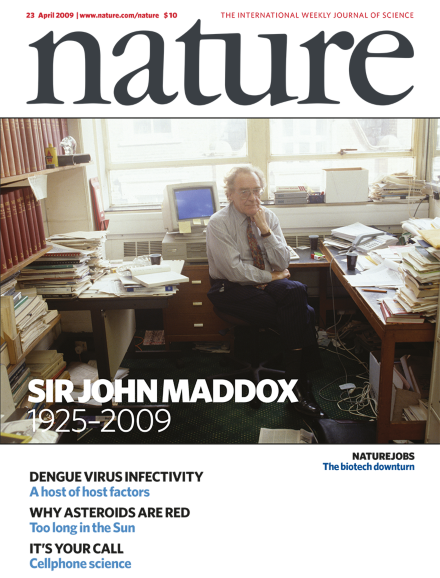
Obituary: John Maddox (1925–2009) p983

John Maddox, who died on 12 April, was editor of Nature during 1966–73 and 1980–95. He transformed the journal from a collegially amateurish publication into one that was challenging and professional in its assessment of science and in its journalistic reportage.

Walter Gratzer

doi:10.1038/458983a


A Publisher's perspective p984

Nicholas Byam Shaw

doi:10.1038/458984a


Maddox by his successor p985

Philip Campbell

doi:10.1038/458985a


Top

Brief Communications Arising

Mantle skewness and ridge segmentation pE11

Satish C. Singh & Ken C. Macdonald

doi:10.1038/nature07887


Toomey et al. reply pE12

Douglas R. Toomey, David Jousselin, Robert A. Dunn, William S. D. Wilcock & R. S. Detrick

doi:10.1038/nature07888


Top

Article

Genome-wide analysis of Notch signalling in Drosophila by transgenic RNAi p987

Knoblich and colleagues use a library of Drosophila strains expressing inducible hairpin RNA interference constructs to study the Notch signalling pathway during external sensory organ development. They assign putative loss-of-function phenotypes to 21.2% of the protein-coding Drosophila genes, identify 6 new genes involved in asymmetric cell division and 23 novel genes regulating the Notch signalling pathway.

Jennifer L. Mummery-Widmer, Masakazu Yamazaki, Thomas Stoeger, Maria Novatchkova, Sheetal Bhalerao, Doris Chen, Georg Dietzl, Barry J. Dickson & Juergen A. Knoblich

doi:10.1038/nature07936

See also: Editor's summary


Top

Letters

Solar wind as the origin of rapid reddening of asteroid surfaces p993

Asteroids are much 'redder' than meteorites (which come from asteroids); the accepted explanation is 'space weathering', though the actual processes and timescales involved have remained controversial. Vernazza et al. report observations of two young asteroid families, revealing that 'space weathering' must be a very rapid process, which favours solar wind implantation as the main mechanism; they further demonstrate an apparent weathering dependence on olivine abundance.

P. Vernazza, R. P. Binzel, A. Rossi, M. Fulchignoni & M. Birlan

doi:10.1038/nature07956

See also: Editor's summary


Optimized dynamical decoupling in a model quantum memory p996

Quantum systems are subject to random phase errors that can dramatically affect the fidelity of a desired quantum operation or measurement, but existing quantum error correction techniques have large resource requirements, motivating a search for alternative strategies. The authors experimentally validate the use of the dynamical decoupling technique to suppress qubit error rates, using novel optimized pulse sequences that suppress errors by orders of magnitude compared to other existing sequences.

Michael J. Biercuk, Hermann Uys, Aaron P. VanDevender, Nobuyasu Shiga, Wayne M. Itano & John J. Bollinger

doi:10.1038/nature07951

See also: Editor's summary


Universal transduction scheme for nanomechanical systems based on dielectric forces p1001

When a non-uniform electric field is applied to a nonconducting material, that material experiences a force, as in the deflection of a stream of water by a statically charged comb. Unterreithmeier and colleagues have adapted this phenomenon to provide a simple, speedy means of controlling the vibrational properties of tiny mechanical elements on a chip — or, applying the principle in reverse, of detecting the motion of these elements. Such nanoelectromechanical systems are potentially useful for applications from sensing to signal processing.

Quirin P. Unterreithmeier, Eva M. Weig & Jörg P. Kotthaus

doi:10.1038/nature07932

See also: Editor's summary


Observation of ultralong-range Rydberg molecules p1005

A Rydberg atom has one electron excited into an orbital with a very high principal quantum number. The scattering of such an electron from a second atom in the ground state gives rise to long-range bonding, yielding giant molecules with internuclear separations reaching several thousand Bohr radii. Using s-state rubidium Rydberg atoms with quantum numbers between 34 and 40, Bendkowsky and colleagues have now spectroscopically characterized such 'Rydberg molecules', and measured their lifetimes and polarizabilities.

Vera Bendkowsky, Björn Butscher, Johannes Nipper, James P. Shaffer, Robert Löw & Tilman Pfau

doi:10.1038/nature07945

See also: Editor's summary | News and Views by Greene


The carbon balance of terrestrial ecosystems in China p1009

This paper analyses the terrestrial carbon balance of China during the 1980s and 1990s using biomass and soil carbon inventories extrapolated by satellite greenness measurements, ecosystem models and atmospheric inversions. These three methods produce similar estimates of a net sink of 0.19–0.26 billion tonnes of carbon per year, indicating that China absorbed 28–37 per cent of its fossil carbon emissions over these two decades, mainly attributable to regional climate change, large-scale plantation programmes and shrub recovery.

Shilong Piao, Jingyun Fang, Philippe Ciais, Philippe Peylin, Yao Huang, Stephen Sitch & Tao Wang

doi:10.1038/nature07944

See also: Editor's summary | News and Views by Gurney


Impact of changes in diffuse radiation on the global land carbon sink p1014

More radiation generally increases vegetation photosynthesis, but field studies show that a given amount of diffuse radiation leads to more fixed carbon than direct radiation. Mercado and colleagues simulate the effect of late twentieth century increases in the diffuse radiation fraction, and find that the terrestrial carbon sink is enhanced by about 25% —paradoxically, reducing future anthropogenic pollution will reduce this diffuse radiation effect, creating a positive feedback to global warming.

Lina M. Mercado, Nicolas Bellouin, Stephen Sitch, Olivier Boucher, Chris Huntingford, Martin Wild & Peter M. Cox

doi:10.1038/nature07949

See also: Editor's summary


The architecture of mutualistic networks minimizes competition and increases biodiversity p1018

In this paper the authors show that the 'nestedness' of mutualistic interactions between animals and plants acts to reduce competition and enhance the number of species. Nested networks seem to occur in many biological and social contexts, indicating that the results are relevant in a wide range of fields, from biology to banking.

Ugo Bastolla, Miguel A. Fortuna, Alberto Pascual-García, Antonio Ferrera, Bartolo Luque & Jordi Bascompte

doi:10.1038/nature07950

See also: Editor's summary | News and Views by Sugihara & Ye


A semi-aquatic Arctic mammalian carnivore from the Miocene epoch and origin of Pinnipedia p1021

Seals, sea lions and the walrus (collectively the pinnipeds) evolved from land-living carnivores, but the earliest known pinniped, Enaliarctos, already had flippers. This paper describes a fossil from the Canadian Arctic that represents an earlier stage in pinniped evolution, documenting the otter-like transition between land and water.

Natalia Rybczynski, Mary R. Dawson & Richard H. Tedford

doi:10.1038/nature07985

See also: Editor's summary


Temporally precise in vivo control of intracellular signalling p1025

Ion channels driven by light have provided electrophysiologists with unprecedented control over the activity state of neurons; here Deisseroth and colleagues introduce new molecules that offer a similar level of control over signalling pathways to biochemists. Opsin/GPCR chimaeras were engineered, enabling the authors to modulate G-protein activity via light, which in turn could influence neuronal firing; activating these molecules expressed in vivo could drive conditioned place preference in behaving mice

Raag D. Airan, Kimberly R. Thompson, Lief E. Fenno, Hannah Bernstein & Karl Deisseroth

doi:10.1038/nature07926

See also: Editor's summary | News and Views by Moorman & Aston-Jones


Natural variation in a neural globin tunes oxygen sensing in wild Caenorhabditis elegans p1030

This study shows that the soluble guanylate cyclase GCY-35 responds to increased oxygen and that a neural globin, GLB-5, is involved in sensing reduced oxygen. The behavioural response to GLB-5 activation involves the neuropeptide receptor NPR-1, and both glb-5 and npr-1 show natural variation amongst different Caenorhabditis elegans strains.

Annelie Persson, Einav Gross, Patrick Laurent, Karl Emanuel Busch, Hugo Bretes & Mario de Bono

doi:10.1038/nature07820

See also: Editor's summary


Glycerol monolaurate prevents mucosal SIV transmission p1034

Glycerol monolaurate in a microbicide is shown to protect monkeys from infection after intra-vaginal exposure to high doses of SIV. The suppressive activity may be due to the inhibition of target cell recruitment due to glycerol-monolaurate-mediated inhibition of epithelial cell signalling and inflammatory cytokine expression.

Qingsheng Li, Jacob D. Estes, Patrick M. Schlievert, Lijie Duan, Amanda J. Brosnahan, Peter J. Southern, Cavan S. Reilly, Marnie L. Peterson, Nancy Schultz-Darken, Kevin G. Brunner, Karla R. Nephew, Stefan Pambuccian, Jeffrey D. Lifson, John V. Carlis & Ashley T. Haase

doi:10.1038/nature07831

See also: Editor's summary


Identification of IFRD1 as a modifier gene for cystic fibrosis lung disease p1039

Cystic fibrosis is more severe in some individuals than in others. This study identifies the neutrophil transcriptional co-regulator IFRD1 as a new genetic modifier.

YuanYuan Gu, Isaac T. W. Harley, Lindsay B. Henderson, Bruce J. Aronow, Ilja Vietor, Lukas A. Huber, John B. Harley, Jeffrey R. Kilpatrick, Carl D. Langefeld, Adrienne H. Williams, Anil G. Jegga, Jing Chen, Marsha Wills-Karp, S. Hasan Arshad, Susan L. Ewart, Chloe L. Thio, Leah M. Flick, Marie-Dominique Filippi, H. Leighton Grimes, Mitchell L. Drumm, Garry R. Cutting, Michael R. Knowles & Christopher L. Karp

doi:10.1038/nature07811

See also: Editor's summary


Germline-encoded amino acids in the alphabeta T-cell receptor control thymic selection p1043

In this paper the authors present evidence that T-cell receptor genes encode inherent specificity for major histocompatibility complex molecules.

James P. Scott-Browne, Janice White, John W. Kappler, Laurent Gapin & Philippa Marrack

doi:10.1038/nature07812

See also: Editor's summary


Discovery of insect and human dengue virus host factors p1047

This report identifies host factors required for Dengue virus propagation by using a high throughput genome-wide RNA interference screening approach in Drosophila cells.

October M. Sessions, Nicholas J. Barrows, Jayme A. Souza-Neto, Timothy J. Robinson, Christine L. Hershey, Mary A. Rodgers, Jose L. Ramirez, George Dimopoulos, Priscilla L. Yang, James L. Pearson & Mariano A. Garcia-Blanco

doi:10.1038/nature07967

See also: Editor's summary


Directional Delta and Notch trafficking in Sara endosomes during asymmetric cell division p1051

This study provides a mechanistic basis for differential signalling of Notch, by showing that in fly sensory organ precursors, Notch and Delta traffic to special endosomes marked by the protein Sara. The asymmetric trafficking of endosomes containing Notch and Delta increases Notch signalling in pIIa daughter cells and decreases it in pIIb cells.

F. Coumailleau, M. Fürthauer, J. A. Knoblich & M. González-Gaitán

doi:10.1038/nature07854

See also: Editor's summary


AMPK regulates energy expenditure by modulating NAD+ metabolism and SIRT1 activity p1056

AMP-activated protein kinase (AMPK) is shown to transcriptionally regulate genes involved in controlling energy metabolism in skeletal muscle by acting together with the NAD+-dependent deacetylase SIRT1. AMPK enhances SIRT1 activity by increasing cellular NAD+ levels, resulting in the deacetylation and activation of the SIRT1 downstream target PGC-1alpha.

Carles Cantó, Zachary Gerhart-Hines, Jerome N. Feige, Marie Lagouge, Lilia Noriega, Jill C. Milne, Peter J. Elliott, Pere Puigserver & Johan Auwerx

doi:10.1038/nature07813

See also: Editor's summary


Top

Naturejobs

Prospects

Japan's postdocs open to alternative work p1062

The government and universities must highlight non-academic careers and nurture a diverse skill set, say Toshiyuki Misu and Akira Horoiwa.

Toshiyuki Misu & Akira Horoiwa

doi:10.1038/nj7241-1062a


News

Biotech job projections bleak p1062

Biotech companies are struggling, and jobs in the sector are becoming scarce, according to one analyst.

Paul Smaglik

doi:10.1038/nj7241-1062b


Careers Q&A

Systems approach p1063

New BBSRC chief will move science forward with help from the Internet.

Douglas Kell

doi:10.1038/nj7241-1063a


Postdoc journal

Take a scientist to work? p1063

Will academia kick me out before I nab my dream job?

Julia Boughner

doi:10.1038/nj7241-1063b


In Brief

US faculty pay rises 3.4% p1063

But numbers compiled before recession took hold.

doi:10.1038/nj7241-1063c


Battery unit for Kentucky p1063

Research to focus on advanced battery technology.

doi:10.1038/nj7241-1063d


Photonics centre launches p1063

New institute will research all aspects of optics and photonics.

doi:10.1038/nj7241-1063e


Top

Futures

Outsourced p1066

Equal opportunities?

Shelly Li

doi:10.1038/4581066a


Extra navigation

.

Open Innovation Challenges

naturejobs

ADVERTISEMENT