
Volume 453 Issue 7195, 29 May 2008
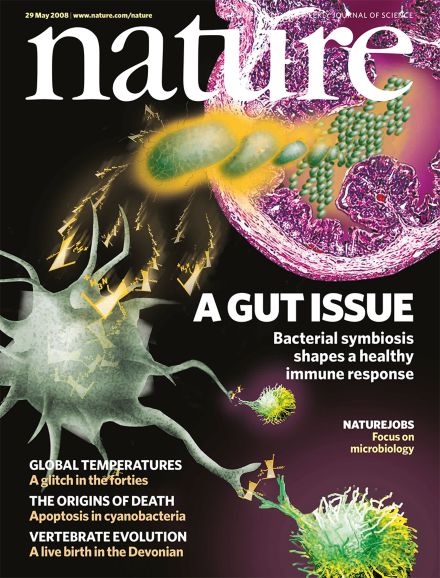
Microbiologists are beginning to understand how and why mammals are colonized by multitudes of symbiotic bacteria. But what differentiates 'good' from benign or harmful bacteria remains largely unknown. The intestinal microbe Bacteroides fragilis was shown in 2005 to have profound effect on the mammalian immune system, an effect ascribed to a single molecule, capsular polysaccharide A (PSA). Now B. fragilis PSA is shown to protect animals against both bacterial and chemical colitis in a process involving interleukin-10 producing T cells. This suggests that B. fragilis helps maintain human health by suppressing the intestinal inflammatory response, and that symbiosis factors may provide a route to new therapies. The cover graphic (by Tom DiCesere, Sarkis Mazmanian & Dennis Kasper) represents the actin niof microbe and its symbiosis factor in the human intestine. Work in this field is being promoted by several major efforts to characterize the human microbiota and determine its role in health and disease, including the Human Microbiome Project. In News Features, Asher Mullard examines the various approaches, and Apoorva Mandavilli reports on a rare opportunity to watch the gut being colonized from scratch after intestinal transplants.
Editorial
-
Advertisement
Research Highlights
Journal Club
News
News in Brief
Correction
News Feature
Correspondence
Commentary
Books & Arts
Essay
News & Views
-
Sex ratios writ small
Focus:

