
Volume 453 Issue 7194, 22 May 2008
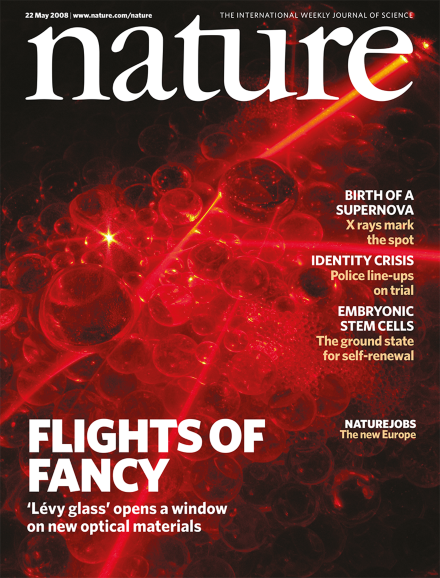
Translucent materials such as milk, clouds and biological tissues owe their appearance to the way they interact with light, randomly scattering an incident ray many times before it re-emerges. This process ãâ analogous to the brownian motion of particles in a fluid ãâ is called a random walk, a concept central to statistical physics. It is used, for example, to describe the diffusion of heat, light and sound. An extension of this idea is the Lãâ©vy flight, where a moving entity can occasionally take unusually large steps, thereby transforming a systemãâs behaviour. Lãâ©vy flights have been recognized in systems as diverse as earthquakes and animal food searches. Barthelemy et al. have now engineered such behaviour into an optical material (titanium dioxide particles in a glass matrix). In the resulting ãâLãâ©vy glassãâ, rather than regular diffusion, light waves perform a Lãâ©vy flight, in which photons spread around extremely efficiently. This will be an ideal model for studying Lãâ©vy flights, and may also lead to novel optical materials. The cover the photonsãâ path, with the light source top right. Photo by Diederik and Leonardo Wiersma
Editorial
-
Advertisement

