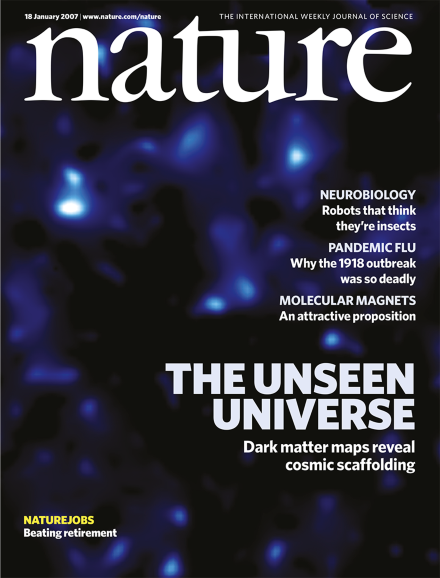
Table of contents
Volume 445 Number 7125 pp229-338
Editorials
Leading by example p229
The primary safeguard against scientific misconduct is the example set every day by thousands of senior researchers in the laboratory.
doi:10.1038/445229a
The database revolution p229
Funding agencies face conflicting challenges in supporting the databases essential to modern biology.
doi:10.1038/445229b
Capitol calling p230
A fresh perspective on science and politics.
doi:10.1038/445230a
News
Europe moves to secure its future energy supply p234
Commission proposes common policy to tackle climate change.
Quirin Schiermeier
doi:10.1038/445234a
Palaeontology journal will 'fuel black market' p234
Academics say published fossil finds should be available for study.
Michael Hopkin
doi:10.1038/445234b
Concern as revived 1918 flu virus kills monkeys p237
Questions raised over safety of revived microbe.
Kerri Smith
doi:10.1038/445237a
Sidelines p237
doi:10.1038/445237b
Behind the hunt for the Higgs boson p239
Race to find elusive particle steps up a gear.
Jenny Hogan
doi:10.1038/445239a
Misconduct? It's all academic... p240
The legal quagmire, strain and bad press of misconduct investigations leave many universities tempted to ignore misconduct allegations. But getting an investigation right can reduce the pain and boost an institution's reputation, says Geoff Brumfiel.
doi:10.1038/445240a
Breeding cheats p242
Understanding the social and psychological factors behind scientific misconduct will enable bad practice to be minimized, but never eliminated, says Jim Giles.
doi:10.1038/445242a
Where are they now? p244
Nature catches up with some past fraud investigations — and finds that, whether researchers are found to be guilty or innocent, the wounds are slow to heal.
Lucy Odling-Smee, Jim Giles, Ichiko Fuyuno, David Cyranoski and Emma Marris
doi:10.1038/445244a
Column
Party of One: Climate of opportunity p248
With the shift of power in the US Congress comes an chance to re-engage in the debate over climate change. But the process will not be simple, says our new columnist David Goldston.
David Goldston
doi:10.1038/445248a
Business
Turning back the clock p249
Technology companies across the United States are under investigation for manipulating the timing of their bosses' stock options. Heidi Ledford reports.
doi:10.1038/445249a
News Features
Biological robotics: Working out the bugs p250
Programming a robot to think like an insect is tough, finds Alison Abbott, but it could help breed machines as manoeuvrable as flies.
doi:10.1038/445250a
Full Text | PDF (881K) | Supplementary information
See also: Editor's summary
Statistics: Conviction by numbers p254
Statistics have the power to trip everyone up — including judges and juries. Even when extra care is taken to get the numbers right in court, confusion often reigns. Mark Buchanan reports.
doi:10.1038/445254a
Correspondence
How a database of nuclear databases could help the effort to combat trafficking p256
Klaus Luetzenkirchen and Klaus Mayer
doi:10.1038/445256a
Time to give due weight to the 'carbon footprint' issue p256
Geoffrey Hammond
doi:10.1038/445256b
Moon and Venus as worthy of exploration as Mars p256
Curt Covey
doi:10.1038/445256c
Need to speak English puts burden on Asian scientists p256
Ian Smith
doi:10.1038/445256d
Commentaries
Merging and emerging cohorts: Not worth the wait p257
How best to study the effects of genes and environment on US health? In the first of two commentaries, Walter C. Willett and his co-authors argue that investing in existing studies is the most efficient approach.
doi:10.1038/445257a
See also: Editor's summary
Merging and emerging cohorts: Necessary but not sufficient p259
doi:10.1038/445259a
See also: Editor's summary
Books and Arts
Social outcasts p261
The most commonly studied social insects are the Hymenoptera, but what about all the rest?
Jenai M. Milliser and George W. Uetz review The Other Insect Societies by James T. Costa
doi:10.1038/445261a
Beyond fractals p262
J. R. Mureika reviews Superfractals: Patterns of Nature by Michael F. Barnsley
doi:10.1038/445262a
Heady days in Princeton p263
John Stachel reviews Pursuit of Genius: Flexner, Einstein, and the Early Faculty at the Institute for Advanced Study by Steve Batterson
doi:10.1038/445263a
Display elements p263
Bernadette Bensaude-Vincent reviews The Periodic Table: Its Story And Its SignificanceEric M. Scerri
doi:10.1038/445263b
Science in culture p264
Vija Celmins' graphite and charcoal drawings are inspired by the natural world.
Colin Martin
doi:10.1038/445264a
Essay
ConceptGalaxy Morphology: Out of order p265
Recent observations of vast numbers of galaxies may pose problems for the galaxy classification scheme proposed by Edwin Hubble.
Sidney van den Bergh
doi:10.1038/445265a
See also: Editor's summary
News and Views
Influenza: Fatal immunity and the 1918 virus p267
Innate immune defences are our first line of protection against infection by viruses and are essential in limiting viral disease. But their reaction to the 1918 influenza virus could have been deadly.
Yueh-Ming Loo and Michael Gale, Jr
doi:10.1038/445267a
See also: Editor's summary
Semiconductor electronics: Trapped fast at the gate p268
The speed record for programming organic transistor memory has been shattered. Work is needed on the stability of the memory storage, but it's a promising step towards some novel technological applications.
Gerwin Gelinck
doi:10.1038/445268a
50 & 100 Years Ago p269
doi:10.1038/445269a
Climate change: Lessons from a distant monsoon p270
The burden of global warming falls most heavily on the developing world. A connection forged between the Indian Ocean climate, Asian monsoons and drought in Indonesia makes for an especially bleak outlook for that nation.
Jonathan T. Overpeck and Julia E. Cole
doi:10.1038/445270a
See also: Editor's summary
Polymer chemistry: Sacrificial synthesis p271
The size and uniformity of polymer molecules makes it difficult to modify them at just one selected site. But a single chemical group can be attached at the end of a polymer if part of the starting material is forfeited.
Sébastien Perrier and Xiaosong Wang
doi:10.1038/445271a
Cell biology: A switch for S phase p272
DNA replication is a necessary prelude to the division of a eukaryotic cell. Initiation of this process requires a complex script, involving many proteins: details of one of the main acts now emerge.
Michael Botchan
doi:10.1038/445272a
See also: Editor's summary
Cosmology: The Universe's skeleton sketched p273
The deepest and clearest maps yet of the Universe's skeleton of dark-matter structure present a picture broadly in concord with favoured models — although puzzling discrepancies remain.
Eric V. Linder
doi:10.1038/nature05522
See also: Editor's summary
Brief Communications Arising
Astrophysics: Quark matter in compact stars? pE7
M. Alford, D. Blaschke, A. Drago, T. Klähn, G. Pagliara and J. Schaffner-Bielich
doi:10.1038/nature05582
First paragraph | Full Text | PDF (153K)
Astrophysics: Quark matter in compact stars? (Reply) pE8
F. Özel
doi:10.1038/nature05583
First paragraph | Full Text | PDF (98K)
Articles
Specialized hepatocyte-like cells regulate Drosophila lipid metabolism p275
Eugenio Gutierrez, David Wiggins, Barbara Fielding and Alex P. Gould
doi:10.1038/nature05382
Abstract | Full Text | PDF (1,269K) | Supplementary information
See also: Editor's summary
Phosphorylation of Sld2 and Sld3 by cyclin-dependent kinases promotes DNA replication in budding yeast p281
Philip Zegerman and John F. X. Diffley
doi:10.1038/nature05432
Abstract | Full Text | PDF (515K) | Supplementary information
See also: Editor's summary | News and Views by Botchan
Letters
Dark matter maps reveal cosmic scaffolding p286
Richard Massey, Jason Rhodes, Richard Ellis, Nick Scoville, Alexie Leauthaud, Alexis Finoguenov, Peter Capak, David Bacon, Hervé Aussel, Jean-Paul Kneib, Anton Koekemoer, Henry McCracken, Bahram Mobasher, Sandrine Pires, Alexandre Refregier, Shunji Sasaki, Jean-Luc Starck, Yoshi Taniguchi, Andy Taylor and James Taylor
doi:10.1038/nature05497
First paragraph | Full Text | PDF (1,163K) | Supplementary information
See also: Editor's summary | News and Views by Linder
High-temperature metal–organic magnets p291
Rajsapan Jain, Khayrul Kabir, Joe B. Gilroy, Keith A. R. Mitchell, Kin-chung Wong and Robin G. Hicks
doi:10.1038/nature05439
First paragraph | Full Text | PDF (452K) | Supplementary information
See also: Editor's summary
Reversible stress softening of actin networks p295
Ovijit Chaudhuri, Sapun H. Parekh and Daniel A. Fletcher
doi:10.1038/nature05459
First paragraph | Full Text | PDF (324K) | Supplementary information
See also: Editor's summary
Seasonal characteristics of the Indian Ocean Dipole during the Holocene epoch p299
Nerilie J. Abram, Michael K. Gagan, Zhengyu Liu, Wahyoe S. Hantoro, Malcolm T. McCulloch and Bambang W. Suwargadi
doi:10.1038/nature05477
First paragraph | Full Text | PDF (359K) | Supplementary information
See also: Editor's summary | News and Views by Overpeck & Cole
Complex gas hydrate from the Cascadia margin p303
Hailong Lu, Yu-taek Seo, Jong-won Lee, Igor Moudrakovski, John A. Ripmeester, N. Ross Chapman, Richard B. Coffin, Graeme Gardner and John Pohlman
doi:10.1038/nature05463
First paragraph | Full Text | PDF (253K) | Supplementary information
See also: Editor's summary
A critical ligamentous mechanism in the evolution of avian flight p307
David B. Baier, Stephen M. Gatesy and Farish A. Jenkins
doi:10.1038/nature05435
First paragraph | Full Text | PDF (450K)
See also: Editor's summary
Sonic hedgehog function in chondrichthyan fins and the evolution of appendage patterning p311
Randall D. Dahn, Marcus C. Davis, William N. Pappano and Neil H. Shubin
doi:10.1038/nature05436
First paragraph | Full Text | PDF (3,021K) | Supplementary information
See also: Editor's summary
Categorization of behavioural sequences in the prefrontal cortex p315
Keisetsu Shima, Masaki Isoda, Hajime Mushiake and Jun Tanji
doi:10.1038/nature05470
First paragraph | Full Text | PDF (1,086K) | Supplementary information
See also: Editor's summary
Aberrant innate immune response in lethal infection of macaques with the 1918 influenza virus p319
Darwyn Kobasa, Steven M. Jones, Kyoko Shinya, John C. Kash, John Copps, Hideki Ebihara, Yasuko Hatta, Jin Hyun Kim, Peter Halfmann, Masato Hatta, Friederike Feldmann, Judie B. Alimonti, Lisa Fernando, Yan Li, Michael G. Katze, Heinz Feldmann and Yoshihiro Kawaoka
doi:10.1038/nature05495
First paragraph | Full Text | PDF (473K) | Supplementary information
See also: Editor's summary | News and Views by Loo & Gale
Toxoplasma co-opts host gene expression by injection of a polymorphic kinase homologue p324
J. P. J. Saeij, S. Coller, J. P. Boyle, M. E. Jerome, M. W. White and J. C. Boothroyd
doi:10.1038/nature05395
First paragraph | Full Text | PDF (462K) | Supplementary information
See also: Editor's summary
CDK-dependent phosphorylation of Sld2 and Sld3 initiates DNA replication in budding yeast p328
Seiji Tanaka, Toshiko Umemori, Kazuyuki Hirai, Sachiko Muramatsu, Yoichiro Kamimura and Hiroyuki Araki
doi:10.1038/nature05465
First paragraph | Full Text | PDF (491K) | Supplementary information
See also: News and Views by Botchan
Naturejobs
ProspectProspects p333
Perks beyond pay attract researchers to top employers.
Paul Smaglik
doi:10.1038/nj7125-333a
Special Report
Don't stop me now p334
Unlike their US counterparts, European scientists can be forced to retire while they're still productive. But some in Germany are finding ways to go on. Britta Danger reports.

Britta Danger
doi:10.1038/nj7125-334a
Recruitment
Great expectations p338
You know what you want from a job. But how do you convince an employer that your skills are relevant?
Jens-Peter Mayer
doi:10.1038/nj7125-338a
Highlights
Opportunities: The National Institutes of Health
doi:10.1038/nj0143