Table of contents

indicates content that is available online only


Editorials

No more protection p485

Cutting NASA's science budgets is one thing; rejecting the agency's historic role in the study of Earth is something else entirely.

doi:10.1038/442485a


A foundation for Africa p486

A research plan that has to be seen to be believed.

doi:10.1038/442486a


What's in a name? p486

Chemistry is here to stay.

doi:10.1038/442486b


Top

Research Highlights

Research highlights p488

doi:10.1038/442488a


Top

News

Maths 'Nobel' rumoured for Russian recluse p490

Proof of Poincaré conjecture is tipped for Fields medal

Jenny Hogan

doi:10.1038/422490a


Bird flu not set for pandemic, says US team p490

H5N1 virus fails to cause epidemic in ferret experiment.

Erika Check

doi:10.1038/422490b


Sidelines p492

doi:10.1038/442492a


NASA threatens to axe science on space station p492

Funds may be diverted to Moon programme.

Heidi Ledford

doi:10.1038/442492b


The proof is in the product p492

Chemists clash over structure of mushroom molecule.

Emma Marris

doi:10.1038/442492c


Singapore pulls plug on US collaboration p493

Research ties with Johns Hopkins University cut.

Ichiko Fuyuno

doi:10.1038/442493a


Mouse data hint at human pheromones p495

Receptors in the nose pick up subliminal scents.

Helen Pearson

doi:10.1038/442495a


Meteorologists pour into west Africa p496

Big push under way to collect monsoon data

Jim Giles

doi:10.1038/442496a


Home health tests are 'genetic horoscopes' p497

'Nutrigenetics' comes under fire after Senate hearing.

Gene Russo

doi:10.1038/442497a


News in brief p498

doi:10.1038/442498a


Correction p498

doi:10.1038/442498b


Top

Business

Gas for the greenhouse p499

For big oil companies, carbon dioxide is waste; for people who grow fruit, it's a valuable commodity. Ned Stafford reports on a marriage of convenience in the Netherlands.

doi:10.1038/442499a


Top

News Features

Chemistry: What chemists want to know p500

Chemistry is a key component in all the scientific disciplines. But does that mean it is nothing more than a handy tool — or are there still major chemical questions to crack? Philip Ball finds out.

doi:10.1038/442500a

See also: Editor's summary


Conservation at a distance:  Atomic detectives p504

There's more to ecology than ringing birds, and in this special section Nature explores how the molecular sciences are transforming the field. In this, the first of two features, Sharon Levy explores how atoms in feathers can reveal the secrets of rare warblers. In the second, Carina Dennis unveils a technique that aims to make killing whales for science a thing of the past.

doi:10.1038/442504a

See also: Editor's summary


Conservation at a distance:  A gentle way to age p507

There's more to ecology than ringing birds, and in this special section Nature explores how the molecular sciences are transforming the field. In the first of two features, Sharon Levy explored how atoms in feathers can reveal the secrets of rare warblers. In this, the second, Carina Dennis unveils a technique that aims to make killing whales for science a thing of the past.

doi:10.1038/442507a

See also: Editor's summary


Top

Correspondence

The gender debate: science promises an honest investigation of the world p510

Steven Pinker

doi:10.1038/442510a

See also: Editor's summary


Let's encourage gentler, more reflective scientists p510

Peter A. Lawrence

doi:10.1038/442510b

See also: Editor's summary


Bias was built into research from the beginning p510

Margaret M. McCarthy

doi:10.1038/442510c

See also: Editor's summary


Holding the centre among the scatter-brained p510

Donna L. Dierker

doi:10.1038/442510d

See also: Editor's summary


Top

Books and Arts

Future perfect? p511

Dizzying advances predicted for the next century could improve the world — or lead to disaster.

Norman Myers reviews The Meaning of the 21st Century: A Vital Blueprint for Ensuring Our Future by James Martin

doi:10.1038/442511a


The road less travelled p512

Richard Akerman reviews The Long Tail: Why the Future of Business is Selling Less of More by Chris Anderson

doi:10.1038/442512a


Sensitive to modern life p513

Peter J. Barnes reviews Allergy: The History of a Modern Malady by Mark Jackson

doi:10.1038/442513a


Science in Culture: Hearing colours, seeing sounds p514

Wassily Kandinsky's synaesthetic paintings go on show in London.

Martin Kemp and Colin Blakemore

doi:10.1038/442514a


Top

News and Views

Evolutionary biology: How to build a longer beak p515

Evolutionary changes in the beaks of Darwin's finches have been instrumental in the adaptive radiation of these birds. The molecular basis for variation in beak size and shape is opening up to investigation.

Nipam H. Patel

doi:10.1038/442515a

See also: Editor's summary


50 & 100 years ago p516

doi:10.1038/442516a


Particle physics: A finer constant p516

For the first time in a decade, the precision of the fine-structure constant — central to understanding the electromagnetic force — has improved. But even greater accuracy is required to test new physics.

Andrzej Czarnecki

doi:10.1038/442516b


Chemical biology: Cutting out the middle man p517

Wouldn't it be nice if you could control the function of any protein with one small molecule? Unlikely as it sounds, this could become possible through a crafty process known as protein splicing.

Tom W. Muir

doi:10.1038/442517a


Cell biology: Polarity bites p519

Cells often need to have polarity to function — cells lining the gut, for instance, secrete digestive enzymes only from their intestinal side. A protein called Bitesize is pivotal in determining which way is up.

Richard Fehon

doi:10.1038/nature05036


Astronomy: A dwarf-eats-dwarf world p520

A white dwarf burnt-out star and a brown dwarf wannabe star have been found in mutual orbit. This fascinating system has had a turbulent past, and its future evolution could be just as spectacular.

James Liebert

doi:10.1038/442520a

See also: Editor's summary


Energy technology: Hydrogen quick and clean p521

Systems for producing pure hydrogen for fuel cells from methanol run into problems with energy efficiency and short lifetimes. Unless, that is, you combine the right catalyst and the right purification membrane.

Rich Masel

doi:10.1038/442521a


Superconductivity: Hot vibes p522

Lattice vibrations — phonons — have long been implicated in conventional low-temperature superconductivity. That they could also have a supporting role when the heat is turned up had been dismissed.

Alex de Lozanne

doi:10.1038/442522a


Top

Brief Communications

Behavioural ecology: Bees associate warmth with floral colour p525

Pollinators may be seeking more than just food as a reward when they choose one flower over another.

Adrian G. Dyer, Heather M. Whitney, Sarah E. J. Arnold, Beverley J. Glover and Lars Chittka

doi:10.1038/442525a

See also: Editor's summary


Superhydrophobicity: Drying transition of confined water p526

Long-range hydrophobic interactions operating underwater are important in the mediation of many natural and synthetic phenomena.

Seema Singh, Jack Houston, Frank van Swol and C. Jeffrey Brinker

doi:10.1038/442526a


Top

Brief Communications Arising

Glass behaviour: Poisson's ratio and liquid's fragility pE7

Spyros N. Yannopoulos and G. P. Johari

doi:10.1038/nature04967


Top

Review

P2X receptors as cell-surface ATP sensors in health and disease p527

Baljit S. Khakh and R. Alan North

doi:10.1038/nature04886

See also: Editor's summary


Top

Article

Dissecting self-renewal in stem cells with RNA interference p533

Natalia Ivanova, Radu Dobrin, Rong Lu, Iulia Kotenko, John Levorse, Christina DeCoste, Xenia Schafer, Yi Lun and Ihor R. Lemischka

doi:10.1038/nature04915

See also: Editor's summary


Top

Letters

The removal of cusps from galaxy centres by stellar feedback in the early Universe p539

Sergey Mashchenko, H. M. P. Couchman and James Wadsley

doi:10.1038/nature04944

See also: Editor's summary


Survival of a brown dwarf after engulfment by a red giant star p543

P. F. L. Maxted, R. Napiwotzki, P. D. Dobbie and M. R. Burleigh

doi:10.1038/nature04987

See also: Editor's summary | News and Views by Liebert


Interplay of electron–lattice interactions and superconductivity in Bi2Sr2CaCu2O8+delta p546

Jinho Lee, K. Fujita, K. McElroy, J. A. Slezak, M. Wang, Y. Aiura, H. Bando, M. Ishikado, T. Masui, J.-X. Zhu, A. V. Balatsky, H. Eisaki, S. Uchida and J. C. Davis

doi:10.1038/nature04973

See also: News and Views by de Lozanne


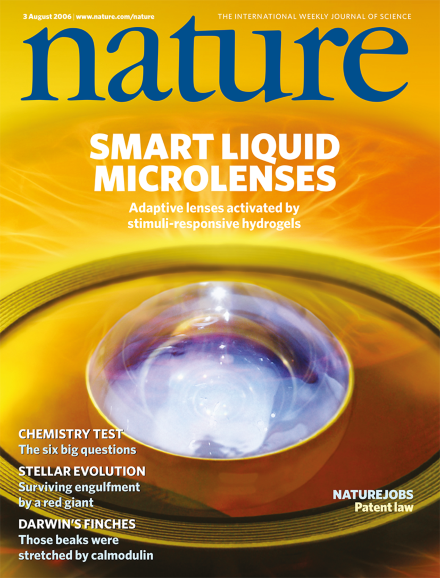
Adaptive liquid microlenses activated by stimuli-responsive hydrogels p551

Liang Dong, Abhishek K. Agarwal, David J. Beebe and Hongrui Jiang

doi:10.1038/nature05024

See also: Editor's summary


Plant litter decomposition in a semi-arid ecosystem controlled by photodegradation p555

Amy T. Austin and Lucía Vivanco

doi:10.1038/nature05038

See also: Editor's summary


Record of mid-Archaean subduction from metamorphism in the Barberton terrain, South Africa p559

Jean-François Moyen, Gary Stevens and Alexander Kisters

doi:10.1038/nature04972

See also: Editor's summary


The calmodulin pathway and evolution of elongated beak morphology in Darwin's finches p563

Arhat Abzhanov, Winston P. Kuo, Christine Hartmann, B. Rosemary Grant, Peter R. Grant and Clifford J. Tabin

doi:10.1038/nature04843

See also: Editor's summary | News and Views by Patel


Collinear activation of Hoxb genes during gastrulation is linked to mesoderm cell ingression p568

Tadahiro Iimura and Olivier Pourquié

doi:10.1038/nature04838


Norm-based face encoding by single neurons in the monkey inferotemporal cortex p572

David A. Leopold, Igor V. Bondar and Martin A. Giese

doi:10.1038/nature04951

See also: Editor's summary


Tumorigenic transformation by CPI-17 through inhibition of a merlin phosphatase p576

Hongchuan Jin, Tobias Sperka, Peter Herrlich and Helen Morrison

doi:10.1038/nature04856

See also: Editor's summary


Spatial control of actin organization at adherens junctions by a synaptotagmin-like protein p580

Fanny Pilot, Jean-Marc Philippe, Céline Lemmers and Thomas Lecuit

doi:10.1038/nature04935

See also: News and Views by Fehon


The physical basis of how prion conformations determine strain phenotypes p585

Motomasa Tanaka, Sean R. Collins, Brandon H. Toyama and Jonathan S. Weissman

doi:10.1038/nature04922

See also: Editor's summary


Rad54 protein promotes branch migration of Holliday junctions p590

Dmitry V. Bugreev, Olga M. Mazina and Alexander V. Mazin

doi:10.1038/nature04889


Corrigendum: Titan Radar Mapper observations from Cassini's T3 fly-by p594

C. Elachi, S. Wall, M. Janssen, E. Stofan, R. Lopes, R. Kirk, R. Lorenz, J. Lunine, F. Paganelli, L. Soderblom, C. Wood, L. Wye, H. Zebker, Y. Anderson, S. Ostro, M. Allison, R. Boehmer, P. Callahan, P. Encrenaz, E. Flamini, G. Francescetti, Y. Gim, G. Hamilton, S. Hensley, W. Johnson, K. Kelleher, D. Muhleman, G. Picardi, F. Posa, L. Roth, R. Seu, S. Shaffer, B. Stiles, S. Vetrella and R. West

doi:10.1038/nature05004


Top

Naturejobs

Prospect

Prospects p595

New EU nations are shedding talent to the West.

Paul Smaglik

doi:10.1038/nj7102-595a


Special Report

From bench to briefs p596

Patent law offers opportunities for those who wish to leave the lab but not science, says Monya Baker.

Monya Baker

doi:10.1038/nj7102-596a


Top

Futures

Gordy gave me your name p600

Somebody out there likes me.

Jim Giles

doi:10.1038/442600a


Extra navigation

.
  • Japanese table of contents

Open Innovation Challenges

naturejobs

ADVERTISEMENT