Table of contents
Volume 430 Number 7002 pp815-949
Editorials
Passing the torch p815
With the death of Francis Crick, biology is mourning one of its deepest thinkers. A work of futurology, published in 1970, reveals the extent of his prescience — and suggests challenges for today's theorists.
doi:10.1038/430815a
Let's blame Canada p815
Americans should worry less about their neighbour and more about the prestige of regulators who protect public health.
doi:10.1038/430815b
News
Biologists fear cloning hype will undermine stem-cell research p817
Talk of disease cures obscures challenges facing cloning teams
Jonathan Knight
doi:10.1038/430817a
Crisis foments as unstable lake builds in the Himalayas p818
Indian scientists say China is denying access to dammed river
K. S. Jayaraman
doi:10.1038/430818a
Climate modellers go local to target California's politicians p818
Regional study ushers in new generation of forecasts
Emma Marris
doi:10.1038/430818b
Newton's religious screeds get online airing p819
Biblical musings reveal another side of the father of modern science
Geoff Brumfiel
doi:10.1038/430819a
Firm sets sights on gene silencing to protect vision p819
RNA technology on track for first clinical trials
Erika Check
doi:10.1038/430819b
Kerry pledges to axe Yucca Mountain nuclear-waste dump p820
Troubled repository embroiled in US election race
Geoff Brumfiel
doi:10.1038/430820a
Researchers seek to turn the tide on problem of acid seas p820
Rising carbon dioxide levels could devastate marine ecosystems
Quirin Schiermeier
doi:10.1038/430820b
Sick veterans pin hopes on Gulf War inquiry p821
Confusion surrounds cause of veterans' ill-health
David Osumi-Sutherland
doi:10.1038/430821a
Plan for light relay sparks heated opposition p821
Physics celebrations will cause light pollution, say astronomers
Mark Peplow
doi:10.1038/430821b
News Features
CERN: The show goes on p824
CERN, the centre for particle physics in Europe, has been smashing its way through the subatomic world for the past 50 years. Alison Abbott finds out what's in store for the future.
doi:10.1038/430824a
Archaeology: Pyramid power p828
Archaeologists have failed to learn the secrets of Mexico's largest ancient monument. Particle physicists might save the day, says Michael Hopkin.
doi:10.1038/430828a
Correspondence
Communication is key to aid development efforts p829
Government could hone its use of science but scientists need to understand the issues.
Edward H. Allison
doi:10.1038/430829a
Proud past but no future for pioneering institute p829
Tadashi Hirata
doi:10.1038/430829b
Plant biologists need to get back to their roots p829
Emanuel Epstein
doi:10.1038/430829c
Commentary
Raising Europe's game p831
How to create a research council that is a Champions League for science.
doi:10.1038/430831a
Books and Arts
Seeing stars in a big way p833
The Gemini project typifies the growth of astronomy into 'big science'.
Sidney C. Wolff reviews Giant Telescopes: Astronomical Ambition and the Promise of Technology by W. Patrick McCray
doi:10.1038/430833a
The course of true science p834
Robert Olby reviews Investigative Pathways: Patterns and Stages in the Careers of Experimental Scientists by Frederic Lawrence Holmes
doi:10.1038/430834a
A struggle for order p834
Bernadette Bensaude-Vincent reviews A Well-Ordered Thing: Dmitrii Mendeleev and the Shadow of the Periodic Table by Michael D. Gordin
doi:10.1038/430834b
An architectural aside p835
Giovanni F. Bignami
doi:10.1038/430835a
Essay
Turning pointsThe blind leading the sighted p836
An eye-opening experience of the wonders of perception.
Richard Gregory
doi:10.1038/430836a
News and Views
Chemical biology: Hitting the sweet spot p837
By taking advantage of the cell's carbohydrate metabolism, reactive sugar analogues can be used to tag specific cells, potentially singling them out for imaging studies or drug delivery.
David A. Tirrell
doi:10.1038/430837a
Medicinal chemistry: A worthy adversary for malaria p838
A remarkable set of antimalarial drug candidates has been developed by an international collaboration of scientists, using the age-old Chinese herbal medicine artemisinin as a template.
Paul M. O'Neill
doi:10.1038/430838a
Condensed-matter physics: Vortices weave a tangled web p839
In high-temperature superconductors, quantized vortex filaments can be twisted up into a DNA-like double helix. An experiment is proposed to test how easily these vortex lines cut through each other.
David R. Nelson
doi:10.1038/430839a
Cell division: Timing the machine p840
During cell division everything must happen at the right time, or errors occur. A common cellular control device, protein phosphorylation, is now shown to time the assembly of a key part of the division machinery.
Bruce Bowerman
doi:10.1038/430840a
100 and 50 years ago p841
doi:10.1038/430841a
Palaeoclimatology: Fresh angle on the polar seesaw p842
During the last glacial period, climatic variation in the Northern and Southern Hemispheres was evidently linked. Modelling work points to freshwater discharge into the North Atlantic as a driving factor.
Trond M. Dokken and Kerim H. Nisancioglu
doi:10.1038/430842a
Structural biology: Anthrax hijacks host receptor p843
An atomic picture of how anthrax toxin binds to its host's cells reveals that the toxin commandeers a host receptor protein and tricks it into helping the toxin enter the cell.
James G. Bann and Scott J. Hultgren
doi:10.1038/430843a
Oceanography: Islands in the stream p843
Heike Langenberg
doi:10.1038/430843b
Obituary: Francis Crick (1916–2004) p845
Alexander Rich and Charles F. Stevens, respectively an early collaborator of Crick's and a long-standing colleague at the Salk Institute, describe the life and work of one of the great thinkers of twentieth-century biology.
Alexander Rich and Charles F. Stevens
doi:10.1038/430845a
Brief Communications
Communications: Quantum teleportation across the Danube p849
A real-world experiment marks a step towards worldwide quantum communication.
Rupert Ursin, Thomas Jennewein, Markus Aspelmeyer, Rainer Kaltenbaek, Michael Lindenthal, Philip Walther and Anton Zeilinger
doi:10.1038/430849a
First paragraph | Full Text | PDF (159K)
Biomechanics: Hydrodynamic function of the shark's tail p850
C. D. Wilga and G. V. Lauder
doi:10.1038/430850a
First paragraph | Full Text | PDF (426K)
Articles
Strong hemispheric coupling of glacial climate through freshwater discharge and ocean circulation p851
R. Knutti, J. Flückiger, T. F. Stocker and A. Timmermann
doi:10.1038/nature02786
Abstract | Full Text | PDF (771K) | Supplementary information
See also: News and Views by Dokken & Nisancioglu
The structure and evolution of centromeric transition regions within the human genome p857
Xinwei She, Julie E. Horvath, Zhaoshi Jiang, Ge Liu, Terrence S. Furey, Laurie Christ, Royden Clark, Tina Graves, Cassy L. Gulden, Can Alkan, Jeff A. Bailey, Cenk Sahinalp, Mariano Rocchi, David Haussler, Richard K. Wilson, Webb Miller, Stuart Schwartz and Evan E. Eichler
doi:10.1038/nature02806
Abstract | Full Text | PDF (563K) | Supplementary information
Letters to Nature
Discovery of five irregular moons of Neptune p865
Matthew J. Holman, J. J. Kavelaars, Tommy Grav, Brett J. Gladman, Wesley C. Fraser, Dan Milisavljevic, Philip D. Nicholson, Joseph A. Burns, Valerio Carruba, Jean-Marc Petit, Philippe Rousselot, Oliver Mousis, Brian G. Marsden and Robert A. Jacobson
doi:10.1038/nature02832
First paragraph | Full Text | PDF (288K)
Addition of nanoparticle dispersions to enhance flux pinning of the YBa2Cu3O7-x superconductor p867
T. Haugan, P. N. Barnes, R. Wheeler, F. Meisenkothen and M. Sumption
doi:10.1038/nature02792
First paragraph | Full Text | PDF (264K)
Direct evidence for atomic defects in graphene layers p870
Ayako Hashimoto, Kazu Suenaga, Alexandre Gloter, Koki Urita and Sumio Iijima
doi:10.1038/nature02817
First paragraph | Full Text | PDF (350K) | Supplementary information
Chemical remodelling of cell surfaces in living animals p873
Jennifer A. Prescher, Danielle H. Dube and Carolyn R. Bertozzi
doi:10.1038/nature02791
First paragraph | Full Text | PDF (561K) | Supplementary information
See also: News and Views by Tirrell
Variable ageing and storage of dissolved organic components in the open ocean p877
Ai Ning Loh, James E. Bauer and Ellen R. M. Druffel
doi:10.1038/nature02780
First paragraph | Full Text | PDF (297K) | Supplementary information
Impact of climate change on marine pelagic phenology and trophic mismatch p881
Martin Edwards and Anthony J. Richardson
doi:10.1038/nature02808
First paragraph | Full Text | PDF (343K) | Supplementary information
Context-dependent autonomous self-fertilization yields reproductive assurance and mixed mating p884
Susan Kalisz, Donna W. Vogler and Kristen M. Hanley
doi:10.1038/nature02776
First paragraph | Full Text | PDF (148K)
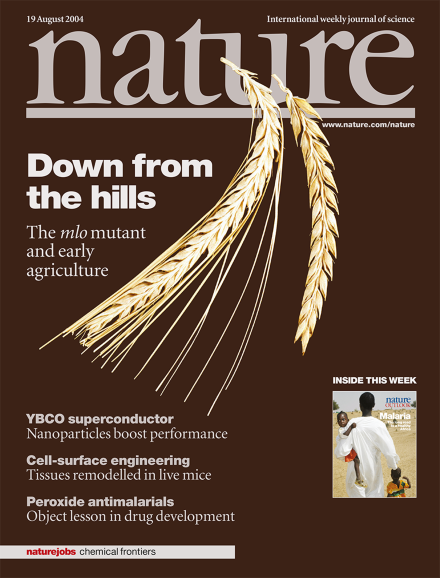
A barley cultivation-associated polymorphism conveys resistance to powdery mildew p887
Pietro Piffanelli, Luke Ramsay, Robbie Waugh, Abdellah Benabdelmouna, Angélique D'Hont, Karin Hollricher, Jørgen Helms Jørgensen, Paul Schulze-Lefert and Ralph Panstruga
doi:10.1038/nature02781
First paragraph | Full Text | PDF (476K) | Supplementary information
SNF-6 is an acetylcholine transporter interacting with the dystrophin complex in Caenorhabditis elegans p891
Hongkyun Kim, Matthew J. Rogers, Janet E. Richmond and Steven L. McIntire
doi:10.1038/nature02798
First paragraph | Full Text | PDF (793K) | Supplementary information
Coupling of agonist binding to channel gating in an ACh-binding protein linked to an ion channel p896
Cecilia Bouzat, Fernanda Gumilar, Guillermo Spitzmaul, Hai-Long Wang, Diego Rayes, Scott B. Hansen, Palmer Taylor and Steven M. Sine
doi:10.1038/nature02753
First paragraph | Full Text | PDF (758K) | Supplementary information
Identification of an antimalarial synthetic trioxolane drug development candidate p900
Jonathan L. Vennerstrom, Sarah Arbe-Barnes, Reto Brun, Susan A. Charman, Francis C. K. Chiu, Jacques Chollet, Yuxiang Dong, Arnulf Dorn, Daniel Hunziker, Hugues Matile, Kylie McIntosh, Maniyan Padmanilayam, Josefina Santo Tomas, Christian Scheurer, Bernard Scorneaux, Yuanqing Tang, Heinrich Urwyler, Sergio Wittlin and William N. Charman
doi:10.1038/nature02779
First paragraph | Full Text | PDF (246K) | Supplementary information
See also: News and Views by O'Neill
Crystal structure of a complex between anthrax toxin and its host cell receptor p905
Eugenio Santelli, Laurie A. Bankston, Stephen H. Leppla and Robert C. Liddington
doi:10.1038/nature02763
First paragraph | Full Text | PDF (391K)
See also: News and Views by Bann & Hultgren
Cell cycle regulation of central spindle assembly p908
Masanori Mishima, Visnja Pavicic, Ulrike Grüneberg, Erich A. Nigg and Michael Glotzer
doi:10.1038/nature02767
First paragraph | Full Text | PDF (412K) | Supplementary information
See also: News and Views by Bowerman
Structural basis for inhibition of the replication licensing factor Cdt1 by geminin p913
Changwook Lee, BumSoo Hong, Jung Min Choi, Yugene Kim, Saori Watanabe, Yukio Ishimi, Takemi Enomoto, Shusuke Tada, Youngchang Kim and Yunje Cho
doi:10.1038/nature02813
First paragraph | Full Text | PDF (438K) | Supplementary information
Structural basis for redox regulation of Yap1 transcription factor localization p917
Matthew J. Wood, Gisela Storz and Nico Tjandra
doi:10.1038/nature02790
First paragraph | Full Text | PDF (342K) | Supplementary information
erratum: No stellar p-mode oscillations in space-based photometry of Procyon p921
Jaymie M. Matthews, Rainer Kuschnig, David B. Guenther, Gordon A. H. Walker, Anthony F.J. Moffat, Slavek M. Rucinski, Dimitar Sasselov and Werner W. Weiss
doi:10.1038/nature02812
corrigendum: Sirt1 promotes fat mobilization in white adipocytes by repressing PPAR-
p921
Frédéric Picard, Martin Kurtev, Namjin Chung, Acharawan Topark-Ngarm, Thanaset Senawong, Rita Machado de Oliveira, Mark Leid, Michael W. McBurney and Leonard Guarente
doi:10.1038/nature02892
Outlook
Plague of my people p925
"It is high time we addressed the widening inequities that characterize our planet today. We need to focus our energies towards achieving basic healthcare for all."
Pascoal Mocumbi, former prime minister of Mozambique
Pascoal Mocumbi
doi:10.1038/430925a
Between hope and a hard place p926
Campaigns against malaria are multiplying, but so are malaria deaths. Brian Greenwood asks what can be done to turn the tide.
Brian Greenwood
doi:10.1038/430926a
Power to the people p928
In Africa, where malaria hits hardest, scientists are crying out for countries to take matters into their own hands, says Declan Butler.
Declan Butler
doi:10.1038/430928a
An attack on all fronts p930
To win the fight against malaria we will need to scale up existing programmes and develop new weapons, say Richard Klausner and Pedro Alonso.
Richard Klausner and Pedro Alonso
doi:10.1038/430930a
Where did it all go wrong? p932
International agencies have failed to meet their own malaria performance targets and should be held to account, says Amir Attaran.
Amir Attaran
doi:10.1038/430932a
The invisible victims p934
We need to know how bad the malaria situation is before we can make it better, says Robert Snow.
Robert W. Snow
doi:10.1038/430934a
Struggling to make an impact p935
Apoorva Mandavilli
doi:10.1038/430935a
Taking aim at mosquitoes p936
The malaria vector is back in scientists' sights, says Janet Hemingway, with insecticides and transgenic insects offering fresh hope.
Janet Hemingway
doi:10.1038/430936a
The long and winding road p937
Documentary makers can get as close to the war zones of disease as doctors and researchers — perhaps even closer. Julie Clayton and Declan Butler talk to Kevin Hull about his experiences.
Julie Clayton and Declan Butler
doi:10.1038/430937a
Strength in unity p938
The world must increase collaboration to meet the pressing need for a malaria vaccine, argue Carter Diggs, Sarah Ewart and Melinda Moree.
Melinda Moree, Sarah Ewart and Carter Diggs
doi:10.1038/430938a
Save the children p940
Creating a malaria vaccine will be tough. But Africa needs one now more than ever, says Stephen Hoffman.
Stephen Hoffman
doi:10.1038/430940a
Winning the drugs war p942
We have the science to make new antimalarials, say Robert Ridley and Yeya Toure, but we need better mechanisms and resources to develop drugs and deliver them.
Robert Ridley and Yeya Toure
doi:10.1038/430942a
Know thine enemy p944
The malaria and mosquito genomes will allow us to find new drug and vaccine targets, says Daniel Carucci.
Daniel Carucci
doi:10.1038/430944a
Naturejobs
ProspectsGranting longevity p947
Paul Smaglik
doi:10.1038/nj7002-947a
Careers and Recruitment
Breathing life into chemistry p948
Chemical biology, using chemical tools to solve biological problems, is awakening interest among students and creating a new breed of researcher, says Tim Chapman.
Tim Chapman
doi:10.1038/nj7002-948a