Table of contents


Top

Editorial

Who'd want to work in a team? p1

Biologists and their institutions are increasingly confronted by the challenges of working in major collaborations that other disciplines have already addressed. A gathering last week showed how much further there is to go.

doi:10.1038/424001a


Top

News

Below-par performance hampers Fermilab quest for Higgs boson p3

Geoff Brumfiel

doi:10.1038/424003a


String theorists bypass NSF en route to Iran seminar p3

Geoff Brumfiel

doi:10.1038/424003b


Fusion cash shortfall leaves JET grounded p4

Jim Giles

doi:10.1038/424004a


Anger mounts over cutbacks at US army pathology lab p4

Erika Check

doi:10.1038/424004b


Studies assess risks of drugs in water cycle p5

Quirin Schiermeier

doi:10.1038/424005a


Tribunal clears obesity researcher of fraud p6

Declan Butler

doi:10.1038/424006a


Astronomers try to save Mars probe p6

David Cyranoski

doi:10.1038/424006b


Collision debris yields five-quark particle p7

David Cyranoski

doi:10.1038/424007a


Oxford professor accused of discrimination over e-mail p7

Haim Watzman

doi:10.1038/424007b


news in brief p8

doi:10.1038/424008a


Top

news feature

Tropical diseases: Raiding the medicine cabinet p10

Many candidate drugs to fight diseases in the developing world have been shelved before approval — until now. Enter a medical charity that made its name by bringing hope to the world's disaster zones. Declan Butler reports.

Declan Butler

doi:10.1038/424010a


Mathematics: Does the proof stack up? p12

Think peer review takes too long? One mathematician has waited four years to have his paper refereed, only to hear that the exhausted reviewers can't be certain whether his proof is correct. George Szpiro investigates.

George Szpiro

doi:10.1038/424012a


Top

Correspondence

Impact factors: a tool of the sterile audit culture p14

Stalked by accountants, unaware of pre-Internet work, how can young scientists thrive?

Adrian Tuck

doi:10.1038/424014a


Reproductive cloning: don't rush to judgement p14

John A. Robertson

doi:10.1038/424014b


Reproductive cloning: an attack on human dignity p14

David P. Leader

doi:10.1038/424014c


Top

Books and Arts

The mind behind me p15

How and why does the brain generate a sense of self?

Marc Hauser reviews The Face in the Mirror: The Search for the Origins of Consciousness by Julian Keenan, Gordon G. Gallup, Jr and Dean Falk

doi:10.1038/424015a


New in paperback p16

doi:10.1038/424016a


A flexible theory of evolution p16

Gerdien de Jong and Ross H. Crozier review Developmental Plasticity and Evolution by Mary Jane West-Eberhard

doi:10.1038/424016b


The finger of Galileo p17

Ryan J. Huxtable reviews The Oxford Companion to the History of Modern Science

doi:10.1038/424017a


Science in culture p18

Martin Kemp reviews

doi:10.1038/424018a


Top

Lifeline

Luis Chiappe: Classified information p19

doi:10.1038/424019a


Top

News and Views

Good to CU p21

A powerful arm of the cellular defence against microbial invaders has been characterized. APOBEC3G, a protein that can fight off HIV, works by introducing 'typographical errors' during viral replication.

Yapeng Gu and Wesley I. Sundquist

doi:10.1038/424021a


Planetary science: The history of air p22

Giant impacts on Earth destroyed the envelope of gases surrounding the fledgling planet — so how has the modern-day planet regained its atmosphere? The answer, it seems, is that all was not lost.

H. J. Melosh

doi:10.1038/424022a


Evolutionary biology: Polygamy and parenting p23

In most animal groups, females put more effort into rearing children, and males compete for female attention. But what about seahorses and pipefish, in which males invest the most in offspring?

Mark Pagel

doi:10.1038/424023a


Condensed-matter physics: Really cool molecules p24

Ultracold molecules have been made by applying a changing magnetic field to a quantum gas of 'fermionic' atoms. This raises the prospect of creating novel superfluids and molecular Bose–Einstein condensates.

Paul S. Julienne

doi:10.1038/424024a


Reproductive biology: Mammary messages p25

Identification of a pheromone that induces suckling in newborn rabbits sets a standard for studies on other mammals, and should prime investigations of the neurobiological basis of this behaviour.

Elliott M. Blass

doi:10.1038/424025a


Ecology: Roots of diversity p26

Competition between plants is in part responsible for the diversity of vegetation in different ecosystems. Diversity studies have to take into account what is happening beneath the soil as well as above it.

Peter D. Moore

doi:10.1038/424026a


Astronomy: Heartbeats of a neutron star p27

Different oscillations in the flux of X-rays emitted from a neutron star now seem to be linked to the frequency at which the star is spinning. That spin rate in turn hints at what the interior of such a star is made of.

Robert V. Wagoner

doi:10.1038/424027a


100 and 50 years ago p27

doi:10.1038/424027b


Ion channels: Hearing aid p28

Mechanically controlled ion channels — transduction channels — are a key feature of the cells that detect sound, touch and movement. In fruitfly ears, the channels belong to a very familiar group of proteins.

Rachel A. Dumont and Peter G. Gillespie

doi:10.1038/424028a


Obituary: Ilya Prigogine (1917–2003) p30

Radu Balescu

doi:10.1038/424030a


news and views in brief p31

doi:10.1038/424031a


Top

Brief Communications

Animal behaviour: Insect orientation to polarized moonlight p33

An African dung beetle uses the moonlit sky to make a swift exit after finding food.

Marie Dacke, Dan-Eric Nilsson, Clarke H. Scholtz, Marcus Byrne and Eric J. Warrant

doi:10.1038/424033a


Photosynthesis (communication arising): A new function for an old cytochrome? p33

Fernando P. Molina-Heredia, Jrgen Wastl, José A. Navarro, Derek S. Bendall, Manuel Hervás, Christopher J. Howe and Miguel A. De la Rosa

doi:10.1038/424033b


Top

Article

Structure of the core domain of human cardiac troponin in the Ca2+-saturated form p35

Soichi Takeda, Atsuko Yamashita, Kayo Maeda and Yuichiro Maéda

doi:10.1038/nature01780


Top

Letters to Nature

Nuclear-powered millisecond pulsars and the maximum spin frequency of neutron stars p42

Deepto Chakrabarty, Edward H. Morgan, Michael P. Muno, Duncan K. Galloway, Rudy Wijnands, Michiel van der Klis and Craig B. Markwardt

doi:10.1038/nature01732

See also:


Quasi-periodic X-ray brightness fluctuations in an accreting millisecond pulsar p44

R. Wijnands, M. van der Klis, J. Homan, D. Chakrabarty, C.B. Markwardt and E.H. Morgan

doi:10.1038/nature01754

See also:


Creation of ultracold molecules from a Fermi gas of atoms p47

Cindy A. Regal, Christopher Ticknor, John L. Bohn and Deborah S. Jin

doi:10.1038/nature01738

See also: News and Views by Julienne


Achromatic Fresnel optics for wideband extreme-ultraviolet and X-ray imaging p50

Yuxin Wang, Wenbing Yun and Chris Jacobsen

doi:10.1038/nature01756


Asymmetric pores in a silicon membrane acting as massively parallel brownian ratchets p53

Sven Matthias and Frank Müller

doi:10.1038/nature01736


High 3He/4He ratios in picritic basalts from Baffin Island and the role of a mixed reservoir in mantle plumes p57

Finlay M. Stuart, Solveigh Lass-Evans, J. Godfrey Fitton and Robert M. Ellam

doi:10.1038/nature01711


Carbon loss by deciduous trees in a CO2-rich ancient polar environment p60

Dana L. Royer, Colin P. Osborne and David J. Beerling

doi:10.1038/nature01737


Detoxification of vinyl chloride to ethene coupled to growth of an anaerobic bacterium p62

Jianzhong He, Kirsti M. Ritalahti, Kun-Lin Yang, Stephen S. Koenigsberg and Frank E. Löffler

doi:10.1038/nature01717


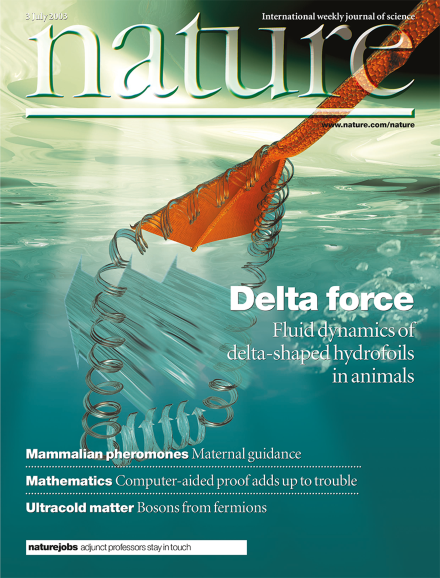
Delta-wing function of webbed feet gives hydrodynamic lift for swimming propulsion in birds p65

L. Christoffer Johansson and R. Åke Norberg

doi:10.1038/nature01695


Chemical and behavioural characterization of the rabbit mammary pheromone p68

Benoist Schaal, Gérard Coureaud, Dominique Langlois, Christian Giniès, Etienne Sémon and Guy Perrier

doi:10.1038/nature01739

See also: News and Views by Blass


Spontaneous muscle twitches during sleep guide spinal self-organization p72

Per Petersson, Alexandra Waldenström, Christer Fåhraeus and Jens Schouenborg

doi:10.1038/nature01719


Melanopsin and rod–cone photoreceptive systems account for all major accessory visual functions in mice p75

S. Hattar, R. J. Lucas, N. Mrosovsky, S. Thompson, R. H. Douglas, M. W. Hankins, J. Lem, M. Biel, F. Hofmann, R. G. Foster and K.-W. Yau

doi:10.1038/nature01761


A TRPV family ion channel required for hearing in Drosophila p81

Janghwan Kim, Yun Doo Chung, Dae-young Park, SooKyung Choi, Dong Wook Shin, Heun Soh, Hye Won Lee, Wonseok Son, Jeongbin Yim, Chul-Seung Park, Maurice J. Kernan and Changsoo Kim

doi:10.1038/nature01733

See also: News and Views by Dumont & Gillespie


Assessing the redundancy of MADS-box genes during carpel and ovule development p85

Anusak Pinyopich, Gary S. Ditta, Beth Savidge, Sarah J. Liljegren, Elvira Baumann, Ellen Wisman and Martin F. Yanofsky

doi:10.1038/nature01741


Selective imprinting of gut-homing T cells by Peyer's patch dendritic cells p88

J. Rodrigo Mora, Maria Rosa Bono, N. Manjunath, Wolfgang Weninger, Lois L. Cavanagh, Mario Rosemblatt and Ulrich H. von Andrian

doi:10.1038/nature01726


The cytidine deaminase CEM15 induces hypermutation in newly synthesized HIV-1 DNA p94

Hui Zhang, Bin Yang, Roger J. Pomerantz, Chune Zhang, Shyamala C. Arunachalam and Ling Gao

doi:10.1038/nature01707

See also: News and Views by Gu & Sundquist


Broad antiretroviral defence by human APOBEC3G through lethal editing of nascent reverse transcripts p99

Bastien Mangeat, Priscilla Turelli, Gersende Caron, Marc Friedli, Luc Perrin and Didier Trono

doi:10.1038/nature01709

See also: News and Views by Gu & Sundquist


Processive AID-catalysed cytosine deamination on single-stranded DNA simulates somatic hypermutation p103

Phuong Pham, Ronda Bransteitter, John Petruska and Myron F. Goodman

doi:10.1038/nature01760


Top

New on the Market

Of mice and Tecnomice p108

A model for oestrogen receptor defects, and in vitro antibody production.

doi:10.1038/424108a


Top

Naturejobs

Prospects

A demanding world p109

Paul Smaglik

doi:10.1038/nj6944-109a


SPECIAL REPORT

Part-time teaching: Benefitting as a part-time teacher p110

For researchers in industry, a part-time teaching job can prove to be hugely beneficial. Myrna Watanabe reports from the classroom.

Myrna Watanabe

doi:10.1038/nj6944-110a


Extra navigation

.
  • Japanese table of contents

Open Innovation Challenges

ADVERTISEMENT